
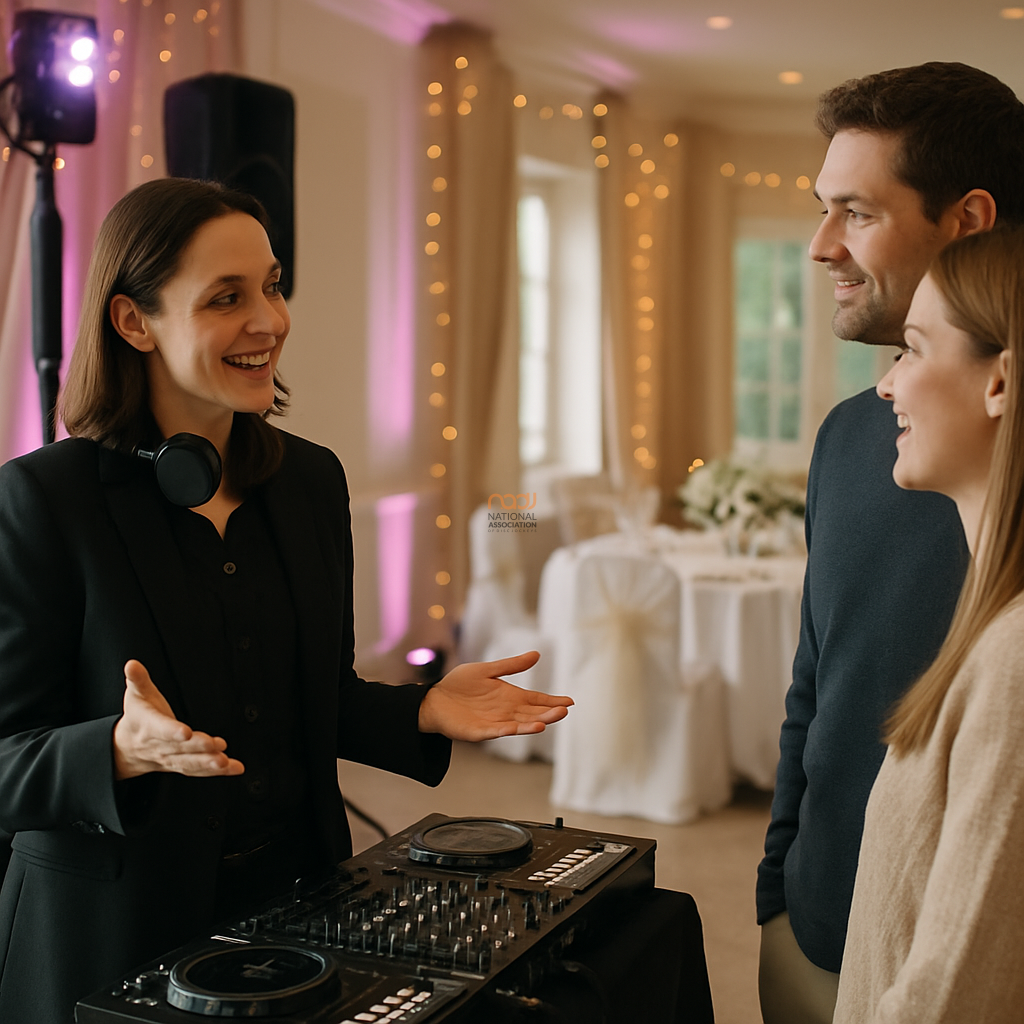
If you are trying to choose a wedding DJ in the UK, the best results usually come from asking better questions, not just comparing quotes. A polished website or a low fee can be useful indicators, but they do not tell you whether a DJ can read a room, work with your venue, or handle the realities of a wedding day from first dance to last song.
For a broader overview of planning and venue coordination, see the NADJ cornerstone guide here: Wedding DJ Planning Guide for UK Couples and Venues. This article focuses on one practical part of the process: the questions couples should actually ask before they book.
Start with the basics: who exactly are you booking?
Not every wedding DJ works in the same way. Some are solo mobile DJs, some are part of a small agency, and some specialise in a particular style such as contemporary chart music, club-style mixing, or classic wedding floor-filling. Couples should ask who will attend on the day, who will take responsibility for communication, and whether the person they speak to at enquiry stage is the person who will actually perform.
Useful questions include:
- Will you personally DJ our wedding?
- If not, who will?
- How many weddings do you typically handle each year?
- Have you worked at venues similar to ours?
This is especially relevant across the UK, where venues range from city hotels in London and Manchester to village halls in the Midlands, barns in Wales, and listed buildings in Scotland and Northern Ireland. A DJ who understands different room layouts, power access and finish times is often easier to work with than someone who only knows one type of event.
Ask how they tailor the music
One of the most common mistakes couples make is assuming a wedding DJ will automatically know their taste. A professional should be able to explain how they build a playlist around your preferences without ignoring the wider crowd. That means asking how they balance your must-plays, do-not-plays and guest requests with the need to keep the dance floor moving.
Ask questions such as:
- How do you collect our music preferences?
- Can we give you a shortlist of songs we want included?
- How do you handle requests from guests?
- What happens if our tastes are very different from our guests’?
The right answer is not “we play everything” or “we never take requests”. Instead, look for a DJ who can explain a clear, flexible process. That usually tells you they can adapt to a mixed-age wedding audience, whether you are celebrating in Birmingham, Leeds, Bristol, Cardiff, Glasgow, Liverpool, Nottingham, Leicester or Coventry.
Check how they work with the venue and schedule
Weddings run to timings, and the DJ needs to fit into that structure. Couples should ask how the DJ coordinates with the venue team, photographer, master of ceremonies or toastmaster, and whether they are used to working around speeches, meal service, late room access or noise restrictions.
Ask:
- How do you coordinate the evening timetable with the venue?
- What time do you usually arrive to set up?
- Do you liaise directly with the venue in advance?
- What do you need from us before the wedding day?
This matters because a good reception set is more than a playlist. It includes setup discipline, sound checks, smooth transitions between formalities and dancing, and awareness of room acoustics. If the venue has restrictions, the DJ should know how to work within them. Couples should always confirm live venue rules and timing requirements directly with the venue and the DJ.
Don’t skip the equipment questions
Equipment is often overlooked until something goes wrong. A sensible conversation should cover the DJ’s sound system, lighting, microphones and backup approach. You do not need to understand every technical detail, but you should ask enough to know whether the setup is suitable for your venue and guest numbers.
Ask:
- What equipment do you bring as standard?
- Can your setup suit our room size and guest count?
- Do you provide microphones for speeches or announcements?
- What backup equipment do you carry?
It is also reasonable to ask whether the DJ can adapt to unusual spaces, such as marquees, village halls, or hotels with limited loading access. In larger cities such as London or Manchester, this can make a real difference to setup time and practicality. The goal is not to test the DJ, but to understand whether they are genuinely prepared.
Ask about insurance, paperwork and professional standards
Couples are not expected to audit a DJ’s business, but they should ask about the basics of professionalism. Depending on the venue, a DJ may be asked to provide public liability insurance evidence, PAT testing information, or other compliance documents. Requirements vary, so check what your venue asks for and confirm details with the DJ before booking.
For more background on one common venue requirement, see NADJ’s guide to DJ public liability insurance in the UK. It is also sensible to ask whether the DJ belongs to a professional body, and if so, which membership level they hold. NADJ’s membership tiers explained page can help couples understand the differences between membership categories.
Professional presentation matters too. A DJ who communicates clearly, responds promptly and provides written confirmation of agreed details is usually easier to trust than someone who relies on vague promises.
Ask what happens if plans change
Weddings are planned carefully, but real life intervenes. Couples should ask what happens if the DJ becomes ill, the venue changes timings, or the wedding runs late. You are not asking because you expect a problem; you are asking because you want to know the DJ has considered one.
Questions to include:
- Do you have a contingency plan if you cannot attend?
- How do you handle delays on the day?
- Can the package be adjusted if timings change?
- What is your cancellation or postponement process?
A clear answer here is often a sign of a well-run business. In contrast, vague reassurance can be a warning sign. The same applies if the DJ cannot explain how they would manage a technical issue mid-event.
Use location and listings to compare like-for-like
If you are researching options across the UK, it can help to compare DJs in a structured way rather than relying on social media alone. NADJ’s directory is a useful starting point for finding working DJs, and the gig listings page can also help you understand the kind of events DJs are currently handling.
You can also use NADJ Hub for wider professional information and resources, and explore NADJ Media Ltd if you are looking at services that support professional DJ businesses. While these tools are aimed at industry users, they can help couples recognise the difference between a working DJ and a casual hobbyist.
What couples should listen for in the answers
The best wedding DJs tend to give practical, specific answers. They will explain how they work, what they need from the couple, and where they can flex to suit the event. They will not promise impossible outcomes or present themselves as the right fit for every wedding.
As a rule, look for:
- clear communication
- evidence of wedding experience
- venue awareness
- music flexibility
- backup planning
- professional documentation where required
If a DJ answers confidently but without detail, ask again. A strong provider will welcome sensible questions, because they understand that couples are making an important choice. That is particularly true for weddings, where the reception atmosphere can shape the whole memory of the day.
In short, the best way to choose a wedding DJ in the UK is to ask questions that reveal how they actually work, not just how they market themselves. Do that well, and you are far more likely to end up with a DJ who fits your venue, your guests and your plans.
AI transparency note
NADJ uses artificial intelligence as an editorial assistant. Articles produced through this publisher begin with a human-selected idea, source, brief or editorial direction, and AI may be used to research, structure, draft or improve the wording. AI does not set NADJ editorial policy or operate free-range: people acting for NADJ set the instructions and publishing framework, monitor the output and retain editorial responsibility.
Images used by NADJ may include stock photography or AI-generated visuals where appropriate. NADJ is volunteer-led and editorial time is limited; much of our available time is currently absorbed by governance and management, a substantial data audit and membership-system transfer, and planning 12 Tea & Test days across the UK. You can help strengthen member-led content by sending article ideas or completed submissions to hello@nadj.org.uk.


 Avtar Thethy
 Fabio Capozzi
 Alastair Craig

 Dave Mills