
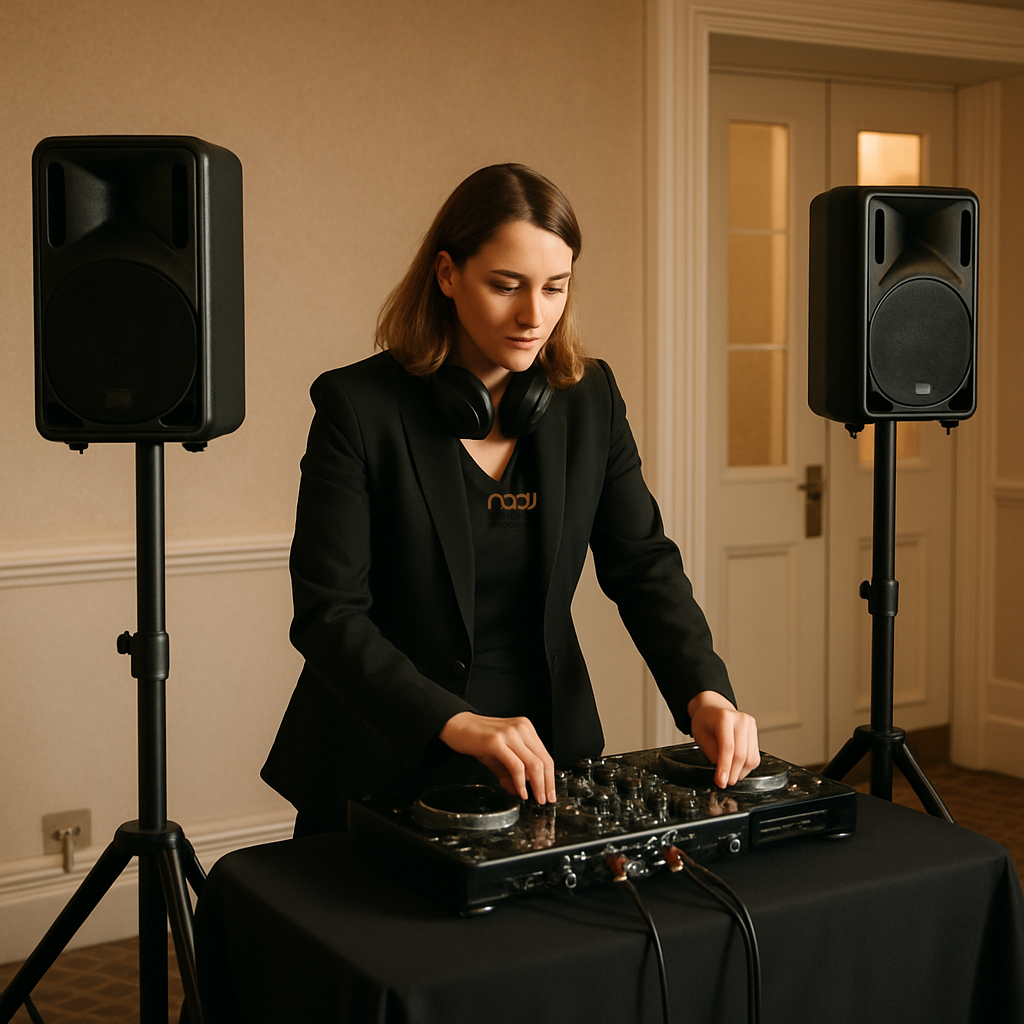
For wedding DJs, preventing sound spill between events is not just a technical issue; it is part of delivering a calm, professional experience in shared venues. Across the UK, from city hotels in London, Manchester and Birmingham to country houses in the Midlands, Scotland, Wales and Northern Ireland, many weddings now take place alongside another function, a ceremony room changeover or a nearby public space. If your sound leaks into the wrong room, it can quickly undermine both events.
The good news is that most sound-spill problems can be reduced with good planning, sensible equipment choices and clear communication. In practice, that means working with the venue, understanding the room layout and keeping your system under control from the start.
Why sound spill matters at weddings
Sound spill is any unwanted audio escaping your event space and reaching another area where it should not be heard. In a wedding setting, that may mean music from the evening reception drifting into a ceremony room, a dining room, a corridor, or a neighbouring event space. It can also work the other way round, with speeches or background music from another function intruding into your dance floor.
Even when the spill seems minor, it can create problems. Guests may struggle to hear announcements, venue staff may need to intervene, and the couple may feel the atmosphere has been diluted. For DJs, the aim is not simply to play louder; it is to shape the sound so it stays where it belongs.
Start with the venue layout
Before you unload equipment, ask the venue for a clear briefing on the room plan. Where are the adjoining spaces? Which walls, doors or screens are shared? Are there restrictions on facing speakers towards certain areas? Is there a second event at the same time, or a ceremony still finishing nearby?
This is especially important in hotels, conference centres and converted buildings, which often have lightweight partitions or acoustically tricky layouts. A ballroom in Leeds may look spacious, but a thin partition can still carry bass into a neighbouring lounge. Likewise, a marquee in Bristol or Cardiff may have elegant styling but very little natural sound isolation.
If possible, walk the route from your DJ position to the nearest sensitive boundary. That will help you decide where to place the speakers and whether you need to adjust the setup.
Speaker placement is your first line of defence
Speaker position can make a bigger difference than many DJs expect. As a rule, aim the main system towards the dance floor and away from doors, corridors, bars and adjoining rooms. Keep speakers as close as practical to the audience area so you do not need excessive volume to achieve good coverage.
Whenever possible, use a matched left-right setup that gives even coverage without over-projecting into one side of the room. If the room is long and narrow, or if guests are split across multiple zones, consider whether additional low-level fill is preferable to simply turning up the main system.
Subwoofers deserve special attention. Low frequencies travel easily through floors and thin walls, so keep bass under control. If the venue is particularly sensitive, reducing sub output slightly can be more effective than cutting overall volume too sharply.
Use the equipment you actually need
There is no prize for bringing the biggest rig into the room. The best system is the one that suits the event, the building and the number of guests. Oversized speakers are more likely to produce spill, especially in compact venues or rooms with hard surfaces.
That is one reason many professional mobile DJs rely on practical, reliable monitoring rather than guesswork. Good headphones can help when cueing tracks, setting levels and checking edits before playback. If you are reviewing your kit, NADJ has a useful guide to professional mobile DJ headphones, which may help you think about cueing and monitoring in a working environment.
Also remember that clarity is better than sheer level. A well-EQ’d system at a sensible volume usually travels less than an uncontrolled setup with too much top end or bass.
Work with the venue team, not around them
Venue staff often know where the acoustic weak points are. They may tell you which room shares a wall with the ceremony space, where guests tend to gather outside, or which doors are best kept closed during music-heavy moments. Treat that information as valuable operational guidance.
Where there is a shared venue timeline, agree key moments in advance: first dance, evening entrance, background music during food service, and any speech or announcement windows. In some cases, a simple adjustment of start times or speaker direction can prevent awkward overlap.
If the venue uses a sound limiter, or if there are site-specific rules, check the live requirements before the event. These can vary between venues in Glasgow, Liverpool, Nottingham, Leicester and beyond, and they can change without much notice.
Manage volume dynamically through the night
Prevention is not only about the setup; it is also about control during the event. A room that is full at 9 pm may need less level than the same room at midnight. Keep an eye on crowd density, the energy of the dance floor and the proximity of neighbouring events.
When the music does need to drop, do it intentionally. Sudden changes can disrupt the atmosphere, but modest reductions during quieter sections, meal service or close contact with nearby rooms can make a real difference. If the venue asks for a lower level during a ceremony, be ready to comply promptly.
Where speech clarity matters, such as for speeches in a shared dining room, avoid compensating with unnecessary gain. A clean microphone setup and careful positioning will usually outperform a louder system.
Documentation and professionalism help
Although every venue is different, good records can help you avoid repeat issues. Make notes after each shared-venue job: speaker positions, room characteristics, any spill complaints and what worked well. Over time, this builds a useful reference for future weddings.
Professional standards also matter. If you are reviewing your membership level or looking to strengthen your business profile, NADJ’s membership tiers explained page is a useful place to start. For broader support and resources, members can also use the NADJ hub.
If you are seeking established industry contacts or want to be more visible to clients and venues, the NADJ directory is worth exploring. For opportunity-led work, the gig listings section may also be useful.
Insurance and venue responsibility: check the details
It is sensible to hold appropriate cover and to understand what your policy includes, but DJs should always check the live wording of any insurance arrangement and venue contract rather than assuming protection applies in every case. NADJ’s page on DJ public liability insurance explains the subject in a UK context, but it should not be treated as legal advice.
Similarly, venue rules around noise control, licensing and operating hours can differ across England, Scotland, Wales and Northern Ireland. If anything is unclear, ask the venue to confirm it in writing.
Final thought
Preventing sound spill between events is about respect, control and preparation. The best wedding DJs do not simply fill a room; they manage sound intelligently so every guest gets the experience they were promised. In shared venues, that professionalism is noticed by couples, venue teams and fellow suppliers alike.
If you want to stay connected with the wider UK DJ community, keep an eye on NADJ and the resources available through the organisation. Careful planning, good communication and sensible system choices will always be the foundation of a successful shared-venue wedding set.
AI transparency note
NADJ uses artificial intelligence as an editorial assistant. Articles produced through this publisher begin with a human-selected idea, source, brief or editorial direction, and AI may be used to research, structure, draft or improve the wording. AI does not set NADJ editorial policy or operate free-range: people acting for NADJ set the instructions and publishing framework, monitor the output and retain editorial responsibility.
Images used by NADJ may include stock photography or AI-generated visuals where appropriate. NADJ is volunteer-led and editorial time is limited; much of our available time is currently absorbed by governance and management, a substantial data audit and membership-system transfer, and planning 12 Tea & Test days across the UK. You can help strengthen member-led content by sending article ideas or completed submissions to hello@nadj.org.uk.


 Avtar Thethy
 Fabio Capozzi
 Alastair Craig

 Dave Mills