
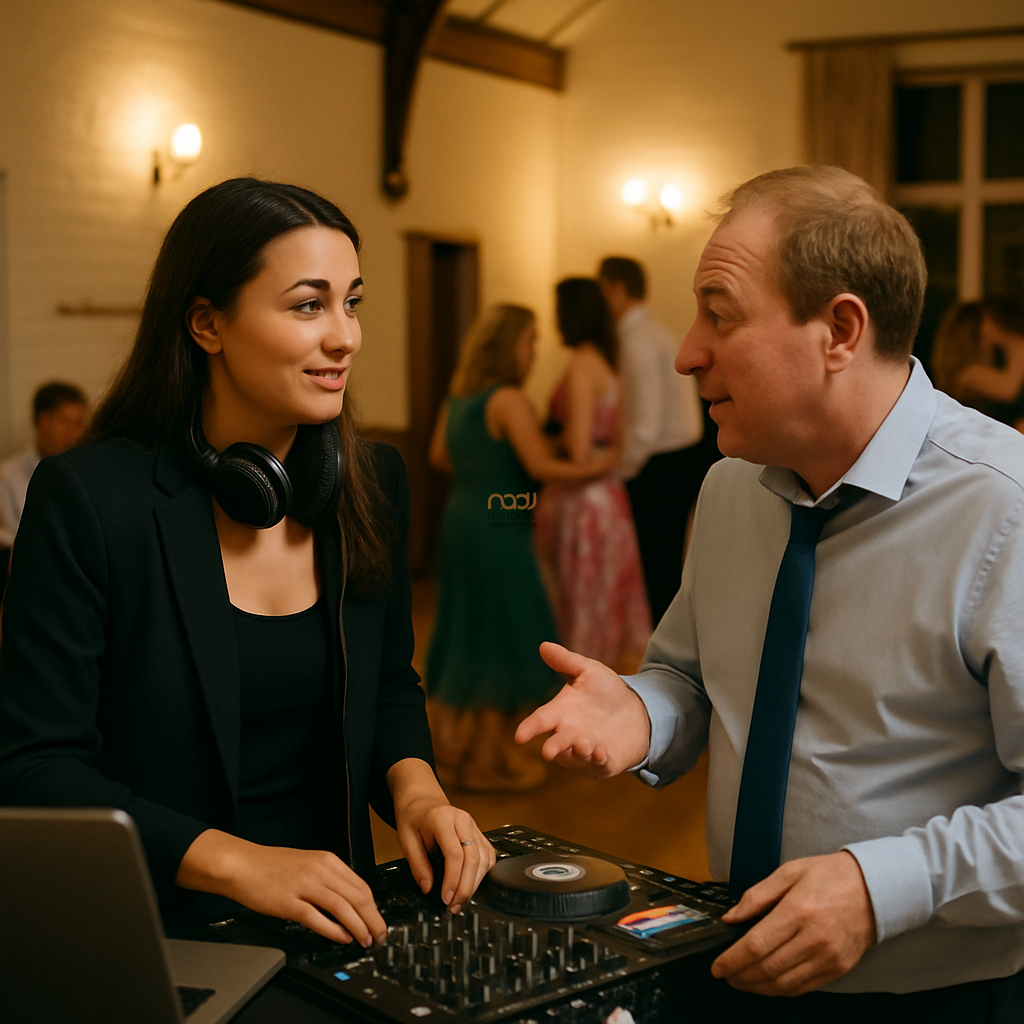
How wedding DJs handle drunk guests and awkward requests is one of the clearest tests of professionalism on a wedding floor. In the UK, receptions can move quickly from formal speeches to high-energy dancing, and that shift often brings overexcited guests, repeated song requests and the occasional person who has had one drink too many. The best DJs do not react emotionally. They stay calm, consistent and in control of the room.
This article is a satellite guide supporting the Wedding DJ Planning Guide for UK Couples and Venues, and it focuses on one specific challenge: dealing with difficult guest behaviour without damaging the atmosphere for everyone else. If you work weddings across England, Scotland, Wales or Northern Ireland, the principles are broadly the same, whether you are playing in London, Manchester, Birmingham, Leeds, Bristol, Cardiff, Glasgow, Liverpool, Nottingham, Leicester or Coventry.
Start with prevention, not reaction
The easiest situation to manage is the one that never escalates. Good wedding DJs reduce friction before the first awkward request arrives. That starts with a short pre-event conversation with the couple or planner. Ask who the decision-makers are, whether there are any “must play” or “do not play” tracks, and whether there are any family sensitivities you should be aware of. For some weddings, especially mixed-age or multi-cultural celebrations, the tone of the room may need a little extra thought.
It also helps to agree how requests will be handled. A simple line such as “All requests go through the DJ, and final choices are made on the night” gives you authority without sounding defensive. If you are listed on the NADJ directory, this kind of planning and professionalism is exactly the sort of standard couples and venues expect.
Keep your response calm and neutral
When a guest is drunk, the main risk is not usually the request itself; it is the way the guest may deliver it. The right response is brief, friendly and non-confrontational. Avoid sarcasm, raised voices or public correction unless there is a genuine safety issue. A calm smile and a short phrase often work best:
- “I’ll see what I can do.”
- “Thanks, I’ve noted it.”
- “I’m keeping the couple’s plan in mind, but I’ll take a look at where it might fit.”
This approach avoids escalation and keeps the guest from feeling embarrassed. It also protects your authority with everyone nearby. Once the crowd sees that you are polite but not easily pushed around, most issues resolve themselves.
Know when to say no
Some requests are simply not suitable for the moment, or for the event at all. A drunk guest may ask for a song that clashes with the couple’s agreed style, tries to turn the evening into a personal tribute, or would clear the dancefloor at the wrong time. In those cases, it is perfectly professional to decline, but do it tactfully.
Try framing the refusal around timing rather than personal preference. For example: “That one might work later, but I’ve got a better track for this part of the night.” This keeps the conversation positive and gives the guest an alternative. If a request is inappropriate, offensive, or could unsettle the room, you can be firmer: “I’m not able to play that one tonight.” You do not need to over-explain.
Use the couple’s brief as your shield
When a guest insists, it can help to refer back to the couple’s wishes. This is one of the simplest ways to remain professional, because you are not making the conversation about yourself. You are protecting the event. A line such as “I’ve got to stay with the couple’s plan for the evening” is usually enough.
This is also where advance planning matters. If the couple has given you clear guidance, you can confidently protect the music policy without appearing stubborn. The more clearly you have agreed the flow of the night before the event, the easier it is to navigate awkward guests during the reception.
Manage repeated requests without losing momentum
Sometimes the problem is not drunkenness but persistence. A guest may ask the same song several times, approach the booth repeatedly, or bring friends to reinforce the request. In these cases, consistency matters more than debate. A polite acknowledgment followed by a clear boundary is usually enough. If necessary, write the request down and move on. You are signalling that you have heard them, while not allowing the interaction to dominate your attention.
Do not stop the flow of the dancefloor every time someone leans in. If the room is busy and the energy is right, your first responsibility is to the wider crowd and the couple, not the loudest person near the booth.
Protect your setup and your personal space
Professionalism also means knowing where your boundary is physically. A drunk guest who leans across your mixer, grabs a microphone or reaches towards your laptop is no longer making a harmless request. Keep your gear arranged so that guests cannot easily interfere, and position yourself so you can step back if needed. This is another reason strong booth layout and cable management matter.
If a guest becomes disruptive, do not try to handle everything alone if the venue has staff or a duty manager. A calm handover is often the safest option. Venue teams deal with this kind of behaviour regularly and may be better placed to redirect the person away from your setup. If you are unsure about your wider duty of care, it is worth reading NADJ guidance on DJ public liability insurance and cover requirements so you understand what is and is not covered by your policy. Always check live wording and policy details yourself, as terms can change.
What to do when the request is awkward rather than rude
Not every awkward request comes from a drunk guest. Sometimes it is a relative who means well, a friend trying to be helpful, or someone who does not understand the mood of the night. In these cases, the answer is often about pacing. You can thank the person, note the request, and decide later whether it suits the room. A skilled wedding DJ reads the crowd as well as the guest.
That judgement comes with experience, and it is one of the reasons many DJs choose to stay connected to the wider profession through resources such as the NADJ hub, membership information at membership tiers explained, and the gig opportunities listed on gig listings. Being part of a professional network helps DJs compare notes, share practical approaches and stay current with good practice across the UK.
Professionalism is visible in the small moments
Guests remember how you made the room feel. They also remember whether the DJ remained composed when the requests got strange or the drinks flowed a bit too freely. The best response is rarely dramatic. It is usually a combination of preparation, steady communication and a willingness to protect the event without creating a scene.
That is the standard the NADJ encourages across the industry: practical competence, polite boundaries and respect for the couple’s celebration. If you can manage difficult moments with tact, you will not just survive wedding receptions. You will earn the trust that leads to repeat bookings, venue recommendations and a stronger reputation across the UK market.
AI transparency note
NADJ uses artificial intelligence as an editorial assistant. Articles produced through this publisher begin with a human-selected idea, source, brief or editorial direction, and AI may be used to research, structure, draft or improve the wording. AI does not set NADJ editorial policy or operate free-range: people acting for NADJ set the instructions and publishing framework, monitor the output and retain editorial responsibility.
Images used by NADJ may include stock photography or AI-generated visuals where appropriate. NADJ is volunteer-led and editorial time is limited; much of our available time is currently absorbed by governance and management, a substantial data audit and membership-system transfer, and planning 12 Tea & Test days across the UK. You can help strengthen member-led content by sending article ideas or completed submissions to hello@nadj.org.uk.


 Avtar Thethy
 Fabio Capozzi
 Alastair Craig

 Dave Mills