
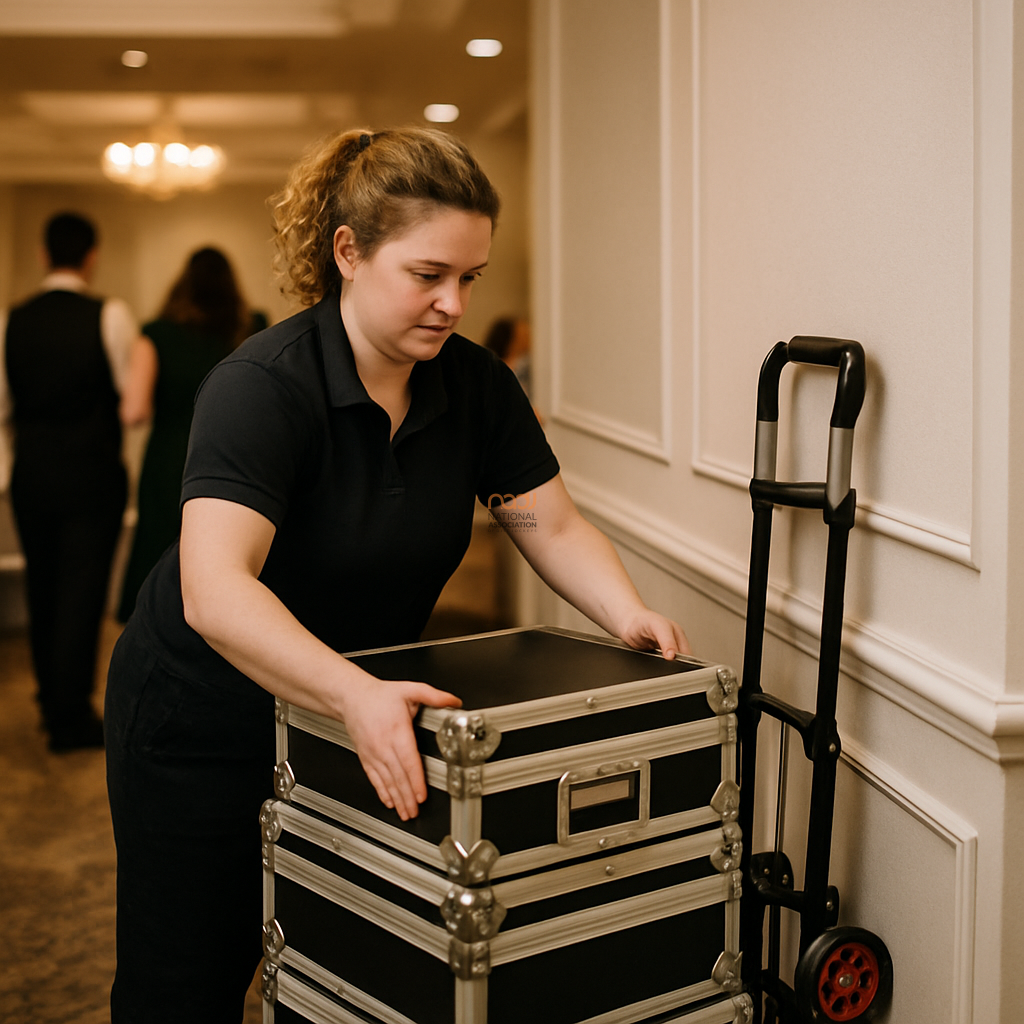
Safe storage of DJ cases and trolleys is one of those small operational details that can make a big difference to the smooth running of an event. Whether you are working a wedding in Bristol, a corporate night in London, a school disco in Leeds, or a club event in Glasgow, the way you manage your cases, flight cases and trolleys during the night affects safety, presentation and workflow.
For mobile DJs, the issue is not just about protecting equipment. It is also about keeping access routes clear, reducing trip hazards and avoiding unnecessary damage to venue flooring, furniture and other suppliers’ kit. The National Association of DJs encourages working practices that are professional, tidy and considerate, because those habits help protect both your business and your reputation.
Why storage matters once the rig is in place
During load-in, cases and trolleys are useful. Once the main setup is complete, though, they can quickly become clutter. A trolley left in a narrow passage or a stack of cases beside the dancefloor can create problems for staff, guests and other suppliers. In busy venues across the Midlands, Manchester, Birmingham, Nottingham and Leicester, space is often limited, so planning where everything will go is just as important as planning where the speakers will sit.
Good storage practice also supports a more professional appearance. A neat behind-the-scenes area tells the venue and the client that you are organised and in control. That can matter in places such as function rooms, hotel suites, village halls and private hire venues where the DJ area may be visible to guests.
Plan the storage point before you arrive
The best time to think about case and trolley storage is before the event starts. If possible, check the venue layout in advance or ask the organiser where you can safely leave empty cases once unloading is complete. When the venue has a dedicated service corridor, backstage area or spare room, use it. If not, identify a corner that is out of guest traffic and away from emergency exits.
When speaking with venues in England, Scotland, Wales or Northern Ireland, be clear and practical. Ask:
- Where can I leave empty cases during the event?
- Is there a secure staff-only area available?
- Are there any floors, fire doors or access points I should avoid blocking?
- Do you prefer trolleys to be kept in the loading bay, vehicle, or another location once unloading is finished?
This simple conversation can prevent awkward last-minute moves later on.
Keep access routes clear at all times
One of the most important principles is straightforward: do not block exits, corridors or walkways. Cases and trolleys may be compact when stacked, but they still take up space and can become a hazard if someone has to move quickly through the venue. This is especially relevant in busy event spaces in Cardiff, Liverpool, Coventry, Birmingham and central London where foot traffic can be constant.
Where possible, store cases flat against a wall, not in the middle of a room. Keep trolley handles folded down if that reduces the footprint. If you must place a trolley in a temporary position, make sure it cannot roll. Engage brakes where fitted, and avoid leaving it on slopes or uneven surfaces.
Choose the right storage method for the event
Not every event demands the same approach. A small wedding in a village hall will need a different plan from a large awards night in a hotel ballroom. In some venues, it may be sensible to return unused cases to your vehicle as soon as load-in is complete. In others, that is not practical, so a secure off-floor storage point may be the better option.
If the cases stay on site
If your cases remain inside the venue, keep them grouped together in a tidy stack. Labelled flight cases are easier to identify later, and a consistent packing order will help you clear the room quickly at the end of the night. If you are using soft cases, ensure they are not placed where drinks, spillages or guest bags could damage them.
It is also sensible to keep high-value items with you or in a staff-only area whenever possible. Remember that event venues vary greatly, and NADJ cannot guarantee security arrangements. Use your judgement and take reasonable precautions for the setting.
If the cases go back to the vehicle
For some DJs, the safest option is to return empty cases and trolleys to the vehicle once the rig is set. This can free up space and reduce the chance of damage. However, it is not always practical to leave kit unattended in a car park or loading area. If you do this, consider the venue’s layout, local conditions and your own risk assessment. Never assume that an outside storage point is secure just because it is convenient.
Don’t forget the trolley itself
Trolleys are often treated as a temporary tool, but they deserve the same attention as the cases they carry. Fold them properly, secure loose straps and check for worn wheels or bent frames. A damaged trolley can tip, jam or mark flooring. In venues with polished surfaces, historic interiors or carpeted rooms, that can become a real issue.
For DJs working in cities such as Glasgow, Manchester, Leeds, London and Bristol, repeated load-ins can mean frequent lifts, kerbs and long walks from parking areas. A trolley that is overloaded or poorly maintained will become harder to control and may create avoidable strain. Regular maintenance is a sensible habit, not a luxury.
Protect staff, guests and the venue
Safe storage is part of wider event safety. If cases or trolleys are left where guests might brush past them, or where staff may not see them in low light, they can create an accident risk. Keep them visible enough to avoid surprises, but positioned so they do not intrude on the event.
Where lighting is low, use common sense and avoid moving heavy items during peak guest movement if it is not necessary. Coordinate with photographers, venue staff and other suppliers so that nobody is forced to navigate around your gear at the wrong moment.
Build it into your working routine
The most efficient DJs turn storage into a habit. Create a standard load-in and load-out sequence, then stick to it. Decide where cases will be placed, how trolleys will be folded, and when the vehicle will be used as part of the storage plan. This consistency helps across different types of work, from mobile parties to corporate functions and wedding receptions.
If you are building your professional profile, it may also help to review NADJ resources and services more broadly, including membership tiers explained, the NADJ directory, and the gig listings. For business development support, members and readers may also want to explore NADJ Media Ltd and the NADJ hub.
A professional habit with practical value
Safe storage of DJ cases and trolleys during an event may seem minor, but it supports safety, presentation and efficiency. It helps you protect your equipment, respect the venue and work more confidently in front of clients and guests. In a competitive industry, those details matter.
For DJs across the UK, from the Midlands to Scotland, from Wales to Northern Ireland, the same principle applies: plan where your gear will live once the setup is complete, keep it out of the way, and move it with purpose. That is good practice, good manners and good business.
For related reading on professional DJ kit choices, see our guide to Top 10 Denon DJ Products for UK Mobile DJs. If you are also reviewing your wider business cover, our article on DJ public liability insurance requirements may be useful. Always check live details with the relevant provider or adviser, as requirements and availability can change.
AI transparency note
NADJ uses artificial intelligence as an editorial assistant. Articles produced through this publisher begin with a human-selected idea, source, brief or editorial direction, and AI may be used to research, structure, draft or improve the wording. AI does not set NADJ editorial policy or operate free-range: people acting for NADJ set the instructions and publishing framework, monitor the output and retain editorial responsibility.
Images used by NADJ may include stock photography or AI-generated visuals where appropriate. NADJ is volunteer-led and editorial time is limited; much of our available time is currently absorbed by governance and management, a substantial data audit and membership-system transfer, and planning 12 Tea & Test days across the UK. You can help strengthen member-led content by sending article ideas or completed submissions to hello@nadj.org.uk.


 Avtar Thethy
 Fabio Capozzi
 Alastair Craig

 Dave Mills