

A DJ venue risk assessment does not need to take all evening. In many cases, a focused 30-minute check is enough to spot the main hazards, decide what you can control, and note any issues that need to be raised with the venue. For DJs working across the UK — from London and Birmingham to Glasgow, Cardiff, Leeds, Manchester and beyond — a repeatable process saves time and supports safer, more professional gigs.
This guide is for working DJs who need a practical approach. It is not legal advice, and it should not be treated as a substitute for venue procedures, local rules or current guidance from the relevant authorities. Always check live requirements where licensing, fire safety, electrical safety or public safety are concerned.
Why a quick venue risk assessment matters
A risk assessment is simply a structured way to identify what could go wrong and what action is needed to reduce the likelihood or impact of an incident. For DJs, the most common concerns are often straightforward: trip hazards, cable management, unstable kit, crowd movement, access routes, power supply, load-in conditions and emergency exits.
The goal is not to overcomplicate the job. Instead, it is to arrive prepared, work safely and reduce avoidable problems. That is good for you, good for the venue and good for the audience. It also supports the kind of professional approach NADJ encourages across the industry, whether you are building a one-person operation or developing a broader DJ business. If you want to strengthen that side of your work, see How DJs can build a sustainable small business.
The 30-minute process: a simple framework
Use the same sequence every time. Once it becomes routine, you will move faster without missing the essentials.
1. Start with the venue briefing: 5 minutes
Ask the venue contact the basic questions before you unpack. You are looking for anything that changes how you set up.
- Where is the load-in point?
- Where will the DJ position be?
- Are there any restrictions on access, noise, or timings?
- Where are the fire exits and assembly point?
- Is there a house contact on site during the event?
- Are there known issues with power, flooring, or low ceilings?
If the venue has a house risk assessment or event briefing sheet, ask to see it. Your own assessment should complement it, not replace it.
2. Walk the route: 5 minutes
Before you place any kit, walk from the entrance to the setup area. Check for steps, narrow corridors, wet floors, low light, trailing obstacles and awkward turns. This matters just as much in a small bar in Leicester or Coventry as it does in a large event space in Manchester or London.
If you are moving equipment through public areas, think about the audience, staff and other suppliers. Keep routes as clear as possible and avoid leaving flight cases, bags or stands where people will need to pass.
3. Assess the setup area: 10 minutes
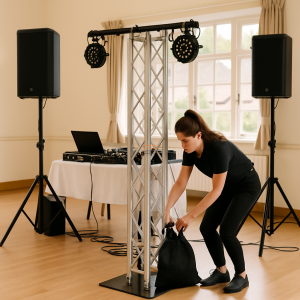
This is usually where the main practical risks sit. Look at the ground, the surrounding space and where your equipment will sit.
- Trip hazards: cables, power strips, lighting leads and bag placement.
- Stability: tables, stands, speaker poles and lighting rigs.
- Power: available sockets, cable length, overload risk and safe routing.
- Space: enough room to work without blocking exits or staff access.
- Environmental factors: spill risk, heat, ventilation, smoke effects or vibration.
Use cable covers where practical, tape down leads where appropriate, and keep the working area tidy. If you are unsure whether a set-up is safe, stop and ask for clarification before continuing. It is better to delay than to improvise around a problem that could have been prevented.
4. Check the crowd and emergency picture: 5 minutes
A DJ set does not happen in isolation. Consider how the crowd will move around your area and what happens if someone needs to leave quickly.
- Are fire exits clearly visible and unobstructed?
- Can guests move safely near the booth?
- Will guests gather tightly around equipment?
- Is the DJ area likely to be used as a storage point by staff or guests?
Remember that conditions can change during the night. A safe room at soundcheck can become a crowded room by 10pm, especially in busy city venues in Birmingham, Bristol, Liverpool or Nottingham.
5. Record the key points: 5 minutes
Keep your notes brief, factual and consistent. You do not need a long document for every event, but you should note the main hazards you found and what action you took. For example:
- “Side entrance has wet tiled floor — use rear route.”
- “One socket cluster available — no additional high-load kit to be added.”
- “Cable run crosses staff walkway — use cover and reposition table.”
If a concern is beyond your control, record who you spoke to and what was agreed. That creates a clearer paper trail and helps everyone remember what was decided.
What DJs should never overlook
Some issues are so common that they deserve extra attention every time. First, power and cable management. Many incidents start with a simple lead across a walkway or an overloaded socket. Second, safe lifting. Even a modest PA can be awkward in cramped conditions, so protect your back and ask for help when needed. Third, venue communication. If a situation feels unclear, raise it early rather than assuming someone else will sort it out.
If you are unsure whether your insurance arrangements match the work you are doing, review your cover carefully and check the latest information. NADJ provides general guidance on this area here: DJ public liability insurance UK: NADJ DJ PLI cover requirements. As always, policy wording and cover terms can change, so check live details with the provider.
Make it part of your standard gig routine
The best risk assessment is the one you can repeat under pressure. Build this 30-minute check into your normal workflow: on arrival, before unloading fully, before power-up, and before guests enter. Over time, you will spot patterns and move faster.
That professionalism also helps DJs present themselves as reliable suppliers, not just performers. If you are refining your business approach, membership structure or professional presence, NADJ resources may help. Explore Membership tiers explained, visit the NADJ Hub, or review the NADJ Directory and gig listings for industry connections and opportunities. You can also learn more at nadj.co.uk.
Final checklist before you press play
- I know the safest route in and out.
- The DJ area is stable, tidy and not blocking exits.
- Cables are controlled and not creating avoidable hazards.
- Power needs have been checked against what is available.
- I have noted any issues and who I raised them with.
- I know what to do if conditions change during the event.
A fast venue risk assessment is not about box-ticking for its own sake. It is about using a disciplined habit to reduce avoidable risk and keep the show moving. For DJs across the UK — whether you work in club environments, weddings, private events or mobile setups — that habit is part of doing the job properly.
Safe, well-prepared DJs help raise standards across the trade. That sits closely with NADJ’s broader aim of supporting professionalism, good practice and long-term sustainability in the UK DJ industry.
DMX Lighting Software for DJs: The Complete Guide
Introducing the NADJ Power Planner — Know Your Load Before You Plug In




 Avtar Thethy
 Fabio Capozzi
 Alastair Craig
 Dave Mills