
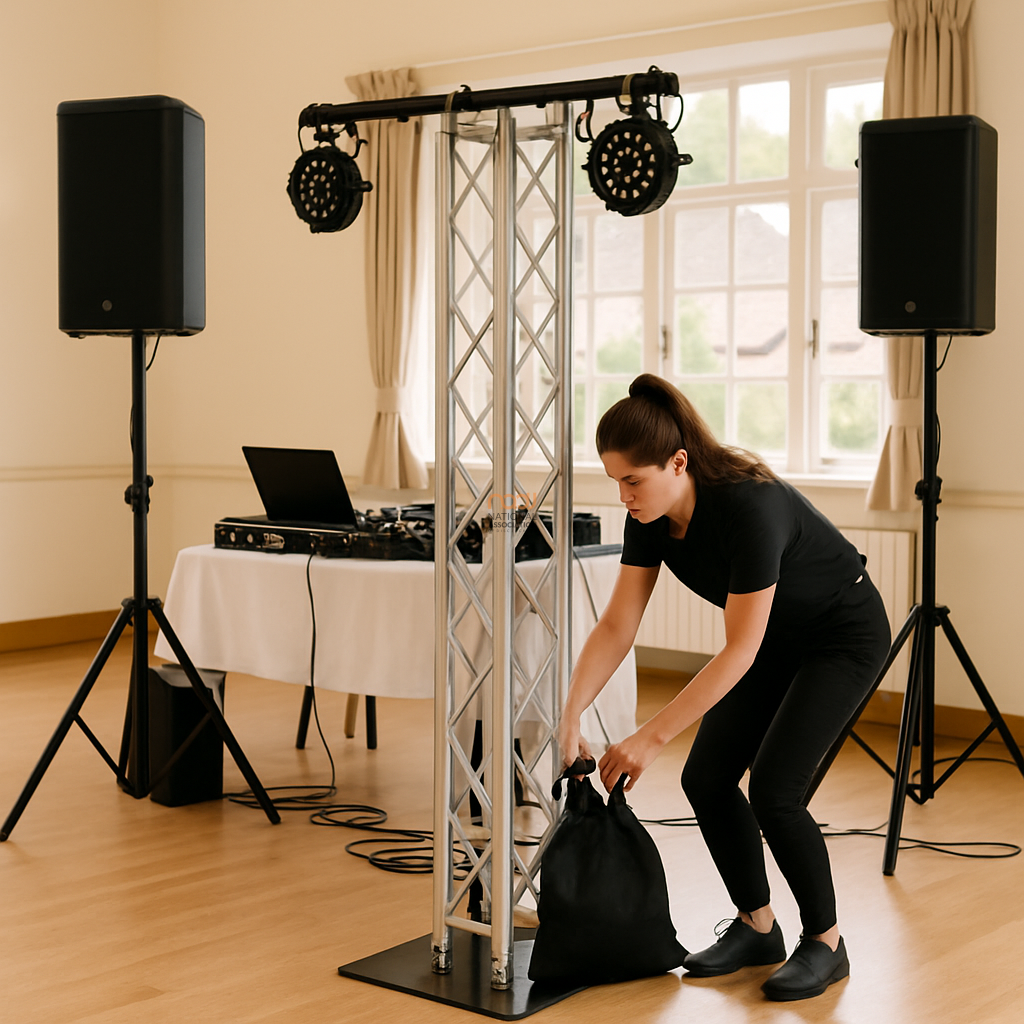
For mobile DJs working across the UK, from village halls in the Midlands to marquee weddings in London, temporary DJ structures must be stable, predictable and suitable for the venue. That is where sandbags and ballast safely becomes more than a practical consideration: it is part of professional setup. Whether you are anchoring a lightweight truss goalpost, a lighting stand, a banner frame or a small outdoor canopy, ballast should be planned, positioned and checked with the same care as your audio and electrical kit.
The National Association of DJs encourages working DJs to think beyond “will it stand up?” and ask “how will it behave if conditions change?”. Wind, uneven ground, crowd movement, cable routes and rushed installations can all affect stability. Good ballast practice reduces risk, helps you work more confidently, and supports a safer event environment for clients and guests alike.
What counts as ballast on a DJ job?
Ballast is any weight used to resist movement or overturning. In DJ work, that can include sandbags, water containers, steel base plates, weight plates, purpose-made stand weights or manufacturer-approved anchor systems. Sandbags are common because they are easy to transport and simple to place, but they are not automatically the best option in every situation.
The key point is that ballast must suit the structure, the surface and the conditions. A lightweight stand in a hotel ballroom may need little more than a manufacturer-recommended weight. A temporary outdoor rig in Leeds on a windy day may need significantly more, plus a different mounting method. In other words, ballast is not just about adding weight; it is about using the right weight in the right way.
Start with the structure, not the sandbag
Before you load anything, identify the actual item you are stabilising. Check the manufacturer’s instructions for the stand, truss, frame or canopy. If there is a specified weight requirement, follow it. If the instructions are unclear, do not guess. Use a competent supplier or technician to confirm an appropriate method.
As a general rule, the larger the sail area, the greater the risk from wind. Banners, scrims, fabric booths and lighting towers can catch air even in conditions that feel mild. That is why temporary DJ structures should be assessed as complete assemblies, not just individual components. For example, a simple booth with a horizontal banner may need a different ballast strategy from a slim mixer table with a pair of speaker poles.
How to use sandbags safely
Sandbags are useful, but only when handled properly. Use bags in good condition with secure closures. Damaged bags can leak, shift or fail when lifted. Keep them dry where possible, because wet sandbags are harder to handle and can transfer dirt or moisture to indoor floors.
Place sandbags low and close to the base of the structure. The aim is to lower the centre of gravity and resist tipping. Avoid stacking them in a way that creates a trip hazard or obstructs emergency routes. If a venue uses polished floors, protect the surface and check whether the venue has any restrictions on load points or floor protection.
Do not rely on one point of ballast when the structure has multiple legs. Spread the weight in line with the manufacturer’s guidance. Equally, do not tie bags to moving parts or use them to compensate for a badly assembled frame. Ballast is not a substitute for correct installation.
Common ballast mistakes to avoid
One of the most common mistakes is underestimating outdoor conditions. A rig that feels stable at 3pm may be vulnerable later in the evening if wind increases or doors open and create airflow. Another frequent issue is using whatever weight happens to be available rather than a planned, measured solution.
Also avoid:
- placing ballast on uneven, slippery or unstable ground without checking the base first
- using loose sand in unsealed bags or containers
- leaving bags where guests, staff or children may trip over them
- mixing incompatible methods, such as improvised ropes and weights, without proper planning
- assuming indoor setups never need ballast; some do, especially tall stands or lightweight modular frames
If your setup involves frequent outdoor work in places such as Bristol, Cardiff, Glasgow or Liverpool, build a ballast check into your standard load-in routine. That consistency is what separates a casual setup from a professional one.
Venue checks matter as much as the equipment
Before you install any temporary DJ structure, look at the venue itself. Are you on hard flooring, carpet, grass or uneven paving? Is there a slope? Is the surface wet? Are there overhead hazards, nearby doors or a walkway that could affect stability? A structure that is fine in a dry function room may need extra consideration at a marquee, pub garden or outdoor festival site.
For events in England, Scotland, Wales and Northern Ireland, venues may also have their own site rules about weights, fixings and access routes. Always follow the venue’s instructions and, where needed, coordinate with the site manager or event organiser. If a venue says no to a particular method, respect that and adapt the setup.
When to seek expert advice
If you are using a complex truss system, tall lighting rig, suspended elements or anything that looks beyond standard mobile DJ equipment, seek advice from a competent hire company or structural professional. This is especially important for outdoor work, because wind loading and dynamic movement can change quickly.
NADJ members often work across weddings, parties and corporate events, and many choose to keep their rigs deliberately simple so they can deploy safely and efficiently. That is sensible. For gear selection and setup planning, you can also review practical buying guidance such as our mixer guide for mobile wedding DJs, and use the NADJ directory to connect with suppliers and services that support your business.
Document your own process
A short checklist helps. Before every job, confirm the structure, surface, weight method, weather exposure and cable routing. After setup, do a final stability check and recheck if the event layout changes. If conditions worsen, be prepared to reduce height, remove banners or take down exposed items.
It is also sensible to keep records of your equipment, training and routine checks. While no article can tell you exactly what is required for your circumstances, good records show that you operate in a planned and professional way. If you are reviewing wider business readiness, see our guide to public liability insurance and cover requirements, and explore membership tiers explained if you are considering NADJ membership options.
A practical mindset keeps everyone safer
Using sandbags and ballast safely is not about overcomplicating the job. It is about working methodically, following manufacturer guidance and avoiding shortcuts. For DJs who travel between venues in the UK, that practical mindset is essential. It protects your equipment, helps your setup look professional and reduces avoidable risk for everyone in the room.
If you need a place to share work opportunities or look for event-related listings, the gig listings area and the NADJ Hub are useful starting points. And if you are exploring NADJ’s wider industry support, you can also visit nadj.co.uk for more information on the association and its services.
As always, check the live guidance relevant to your venue, equipment and event type. A stable rig is not just good practice; it is part of being a professional DJ.
AI transparency note
NADJ uses artificial intelligence as an editorial assistant. Articles produced through this publisher begin with a human-selected idea, source, brief or editorial direction, and AI may be used to research, structure, draft or improve the wording. AI does not set NADJ editorial policy or operate free-range: people acting for NADJ set the instructions and publishing framework, monitor the output and retain editorial responsibility.
Images used by NADJ may include stock photography or AI-generated visuals where appropriate. NADJ is volunteer-led and editorial time is limited; much of our available time is currently absorbed by governance and management, a substantial data audit and membership-system transfer, and planning 12 Tea & Test days across the UK. You can help strengthen member-led content by sending article ideas or completed submissions to hello@nadj.org.uk.







 Avtar Thethy
 Fabio Capozzi
 Alastair Craig
 Dave Mills