

Wedding DJ setup at difficult venues is a familiar challenge for mobile DJs across the UK, from village halls in the Midlands to city-centre hotels in London, Manchester and Birmingham. Restricted space, low ceilings and limited power can all affect safety, presentation and timing, so the best results come from planning early and keeping the rig flexible. For the wider event-planning context, see our Wedding DJ Planning Guide for UK Couples and Venues.
This article focuses on one practical side of that guide: how to build and manage a DJ setup when the venue is less than straightforward. The aim is not to over-engineer the solution. Instead, it is to help you arrive with a setup that fits the room, respects the venue, and still delivers a professional finish for the couple and guests.
Start with a realistic venue assessment
If possible, ask for photos, a floor plan or a quick video walkthrough before the event. A venue’s banqueting suite may look generous in marketing pictures, but the actual performance area can be tighter once a top table, cake table, bandstand or dance floor is in place. Venue teams in places such as Leeds, Bristol, Cardiff, Glasgow, Liverpool, Nottingham, Leicester and Coventry will often know the practical limitations, so it is worth asking direct questions about access, load-in route, ceiling height and power positions.
Key questions to ask include:
- Where exactly is the DJ position?
- How much width, depth and height is available?
- Are there any steps, narrow doors or awkward corners?
- Where are the sockets, and what circuit do they feed?
- Will the room be shared with the wedding breakfast or evening guests?
Getting these details early helps you decide whether you need a compact booth, a modular lighting rig or a reduced speaker footprint.
Restricted space: think compact, stable and tidy
In a tight room, the biggest mistake is bringing a rig that is technically excellent but physically awkward. A smaller, well-managed setup is usually better than squeezing in extra fixtures that cause clutter. Low-profile speaker stands, slim tops and a compact controller-based system can make a significant difference.
Choose kit that fits the room, not just the wish list
A mobile wedding setup should be easy to assemble, easy to cable and easy to move if the venue changes its plan. For restricted venues, consider:
- compact active speakers instead of large cabinets;
- a narrow booth or facade with good cable management;
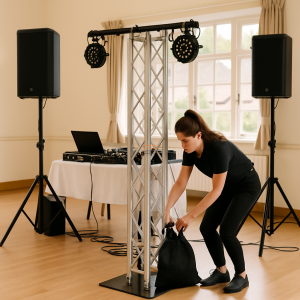
- lighting that mounts neatly on a low truss or goalpost;
- fewer stands and fewer trailing leads;
- equipment cases that double as storage and staging support where appropriate.
Always leave room for the DJ to work safely, and do not block fire exits, service doors or staff routes. In smaller function rooms, a visually neat layout often matters as much as the size of the kit.
Low ceilings: protect the room and your rig
Low ceilings create two issues: physical clearance and light behaviour. Tall truss towers and upward-facing effects can look fine on paper but become impractical when the ceiling is close. In some cases, simply reducing height and angle solves the problem better than changing the whole design.
Use lower mounting points and controlled angles
When ceiling height is restricted, keep any lighting well below the ceiling line and avoid fixtures that throw light directly into the structure. This reduces glare, helps the room feel less cramped and lowers the risk of accidental contact during setup or during an enthusiastic evening reception.
Likewise, be cautious with moving heads or uplighters if the room is particularly intimate. In venues across England, Scotland, Wales and Northern Ireland, many historic or converted spaces have beams, chandeliers or decorative ceilings that cannot be ignored. If the room is low and visually busy, a simpler lighting plan is often the right one.
No power, or not enough power: plan before you plug in
Some venues have no convenient socket near the DJ position. Others have power available but not where you need it, or not with enough headroom for the whole sound and lighting package. In these situations, the sensible approach is to reduce dependence on long extension runs and to confirm the venue’s own requirements in advance.
Check the supply and keep your draw sensible
Ask whether the socket is on a dedicated circuit and whether there are any venue rules about loading. If you are unsure, keep the rig conservative. Efficient amplification, LED lighting and sensible power distribution are far more practical than trying to run a full-size production package from a weak outlet.
Where power is genuinely limited, you may need to consider battery-powered lighting, a smaller sound system or a different layout altogether. However, battery solutions still need testing, and they should never be treated as a substitute for proper planning. If the venue cannot support your proposed system safely and reliably, it is better to adjust the specification than to improvise on the night.
Cables, access and setup order matter more in awkward rooms
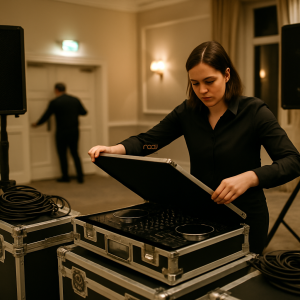
In a difficult venue, setup order saves time and frustration. Bring in the heaviest items first, then build upwards and outwards. Keep signal and mains cables separated where possible, tape or tidy down any visible runs, and avoid leaving unnecessary coils behind the booth.
Also think about how you will get the kit in and out. A room that is fine once set up may still be awkward if you have to move through a narrow service corridor, a stairwell or a crowded function room. If access is difficult, arrive earlier and allow for a slower load-in. That is especially important at weddings, where timings can slip as speeches, meals and photographer needs change the schedule.
Use the venue team as part of the solution
Good venue staff are often your best source of practical information. They know which sockets are reliable, where the room pinches, and which corners are best avoided. If you are working in a hotel in London or a rural hall in Wales, the same principle applies: ask, listen and keep your plan adaptable.
This is also where professional standards matter. Members and readers who want to strengthen their business profile can review membership tiers, use the NADJ directory to connect with other professionals, and check the wider resources available through NADJ and the NADJ Hub. If you are looking for more work, keep an eye on gig listings as well.
Insurance, compliance and professional caution
For any wedding DJ setup at difficult venues, it is sensible to ensure your equipment is maintained, your cabling is sound, and your working practices reflect current venue requirements. Where public liability insurance or other compliance issues are relevant, check live details carefully and do not assume a venue’s rules are the same everywhere. If you need guidance on cover, read our page on DJ public liability insurance in the UK and verify the current terms before you rely on them.
Final thoughts
Difficult venues do not have to mean difficult results. In practice, the best mobile DJs in the UK are the ones who scale their setup to the room, communicate early with the venue, and stay calm when the plan changes. Restricted space, low ceilings and limited power are all manageable when you prioritise fit, safety and reliability over spectacle.
That approach protects the couple’s experience, supports the venue team, and helps you deliver a polished finish whether the wedding is in Birmingham, Cardiff, Glasgow or a small local hall elsewhere in the UK.
AI transparency note
NADJ uses artificial intelligence as an editorial assistant. Articles produced through this publisher begin with a human-selected idea, source, brief or editorial direction, and AI may be used to research, structure, draft or improve the wording. AI does not set NADJ editorial policy or operate free-range: people acting for NADJ set the instructions and publishing framework, monitor the output and retain editorial responsibility.
Images used by NADJ may include stock photography or AI-generated visuals where appropriate. NADJ is volunteer-led and editorial time is limited; much of our available time is currently absorbed by governance and management, a substantial data audit and membership-system transfer, and planning 12 Tea & Test days across the UK. You can help strengthen member-led content by sending article ideas or completed submissions to hello@nadj.org.uk.





 Avtar Thethy
 Fabio Capozzi
 Alastair Craig
 Dave Mills