
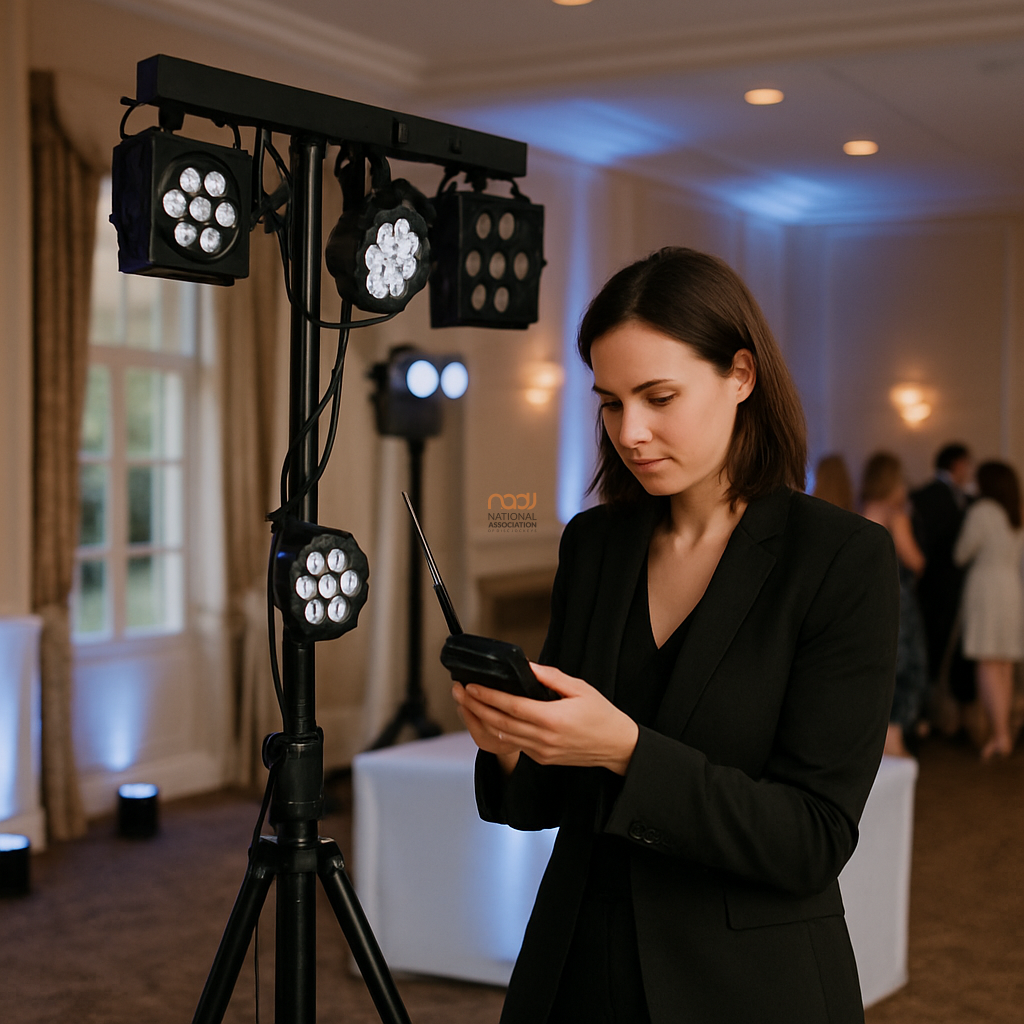
Wireless DMX for mobile DJs has become a genuinely useful tool, especially where fast turnaround, neat rigging and fewer trip hazards matter. In the right venue it can save time and reduce cable runs. However, it is not a magic fix. As with any radio-based system, performance depends on the venue, the kit, and how carefully you set it up.
For working DJs across the UK — whether you are in London, Manchester, Birmingham, Leeds, Bristol, Cardiff, Glasgow, Liverpool, Nottingham, Leicester or Coventry — the key question is not whether wireless DMX works in principle. It is whether it will work consistently in a real room, with real people, real Wi-Fi traffic and real pressure on the night.
What wireless DMX is, and where it helps
Wireless DMX sends lighting control signals without a physical data cable between the controller and the fixtures or receivers. That can be helpful for uplighters, moving heads, LED bars and temporary features where running DMX cable would be awkward or untidy.
For mobile DJs, the main advantages are practical. Fewer cables usually means faster load-in and load-out, a cleaner finish, and less risk of cable damage or accidental disconnection. It can also make sense in venues where cabling across a room would be unsightly or where access is limited.
That said, wireless DMX should be treated as part of a wider setup strategy, not as a replacement for good planning. If a fixture must work continuously during a wedding first dance, awards presentation or packed party, the system needs to be tested and understood before the event.
Reliability depends on the whole chain
When DJs talk about reliability, they are usually thinking about whether the lights respond every time, without dropout or delay. In practice, reliability depends on several points in the chain: the transmitter, the receiver, the antenna position, the channel choice, the venue layout and the surrounding radio environment.
It is also worth remembering that different wireless DMX products do not perform identically. Build quality, antenna design and operating procedure all matter. A good system used badly can be less dependable than a simpler system used well.
Practical reliability checks
Before you rely on wireless DMX for a booked event, test it in the same room if possible. If that is not realistic, test it in conditions that reflect your typical work: similar distance, same kind of lighting load, and a venue with nearby Wi-Fi use. Walk the room, trigger scenes, and leave the system running for long enough to spot any intermittent issues.
Also make sure your fixture addressing, modes and receiver pairing are stored correctly. A simple setup sheet can save time, particularly when you are working multiple rooms or venues across the Midlands, Scotland, Wales or Northern Ireland.
Range: what to expect in real venues
Wireless DMX range is often quoted in ideal conditions, but real venues are rarely ideal. Walls, metal trussing, fire doors, mirrors, thick furniture, filled function rooms and bodies in the line of sight can all affect performance. A system that works at 30 metres in one venue may behave differently in another at a shorter distance.
The safest approach is to assume the published range is not a guarantee. Instead, treat it as a best-case guide. If you are covering a large room, a marquee, or a venue with multiple solid walls, position your transmitter and receivers carefully and do not push the system to its limits.
Where possible, keep the transmitter elevated and away from obstructions. Likewise, avoid burying receivers behind metal cases, powered speakers or dense cabling. A few minutes spent on placement can improve the odds of a stable signal.
Interference: the issue most DJs overlook
In modern venues, interference is often the biggest risk. Function rooms, hotels and leisure venues in cities such as Birmingham, Leeds, Manchester and London may have busy Wi-Fi environments, nearby wireless systems, Bluetooth devices, cordless equipment and general radio congestion. The result can be inconsistent control if your setup is not thought through.
Interference can also come from your own rig. Large power supplies, LED drivers and other electronic equipment may create a noisy environment. That does not mean wireless DMX is unsuitable, but it does mean you should be careful about placement and channel selection.
How to reduce the risk
Start by using the cleanest radio channel available on your system, following the manufacturer’s instructions. Avoid setting up right next to the venue’s Wi-Fi access point if you can help it. If your kit supports it, choose a system with sensible pairing and robust signalling rather than relying on guesswork.
It is also good practice to carry a wired backup route for critical fixtures where practical. That may not be necessary on every job, but having a contingency plan is sensible professional practice. For a wedding or corporate event, a spare DMX lead is a small item that can prevent a bigger problem.
When wired DMX is still the better choice
Wireless does not automatically mean better. If you have a permanent or semi-permanent setup, or if fixtures are close together, a cable may be more reliable and easier to troubleshoot. Wired DMX is often the simpler answer when the route is short and tidy.
For many mobile DJs, the best approach is a hybrid one. Use wireless DMX where it genuinely reduces time, clutter or trip hazards, but do not force it into every situation. The most professional choice is the one that is least likely to fail in the room you are actually working in.
A sensible professional approach
Wireless DMX can absolutely form part of a modern mobile DJ lighting setup, but it rewards preparation. Test your gear, understand your range limits, keep your receivers positioned sensibly and plan for interference. If you work in busy venues across England, Scotland, Wales or Northern Ireland, that discipline matters even more because every room has its own radio and physical quirks.
As with many areas of DJing, professionalism is not just about owning the latest kit. It is about knowing when to trust it, when to back it up and when to choose the simpler option.
If you are refining your wider setup, NADJ members may also find it useful to review related guidance on professional DJ headphones, DJ public liability insurance, and NADJ membership tiers. You can also explore the NADJ directory, the NADJ Hub, our main site at NADJ.co.uk, and current gig listings.
AI transparency note
NADJ uses artificial intelligence as an editorial assistant. Articles produced through this publisher begin with a human-selected idea, source, brief or editorial direction, and AI may be used to research, structure, draft or improve the wording. AI does not set NADJ editorial policy or operate free-range: people acting for NADJ set the instructions and publishing framework, monitor the output and retain editorial responsibility.
Images used by NADJ may include stock photography or AI-generated visuals where appropriate. NADJ is volunteer-led and editorial time is limited; much of our available time is currently absorbed by governance and management, a substantial data audit and membership-system transfer, and planning 12 Tea & Test days across the UK. You can help strengthen member-led content by sending article ideas or completed submissions to hello@nadj.org.uk.









 Avtar Thethy
 Fabio Capozzi
 Alastair Craig
 Dave Mills