
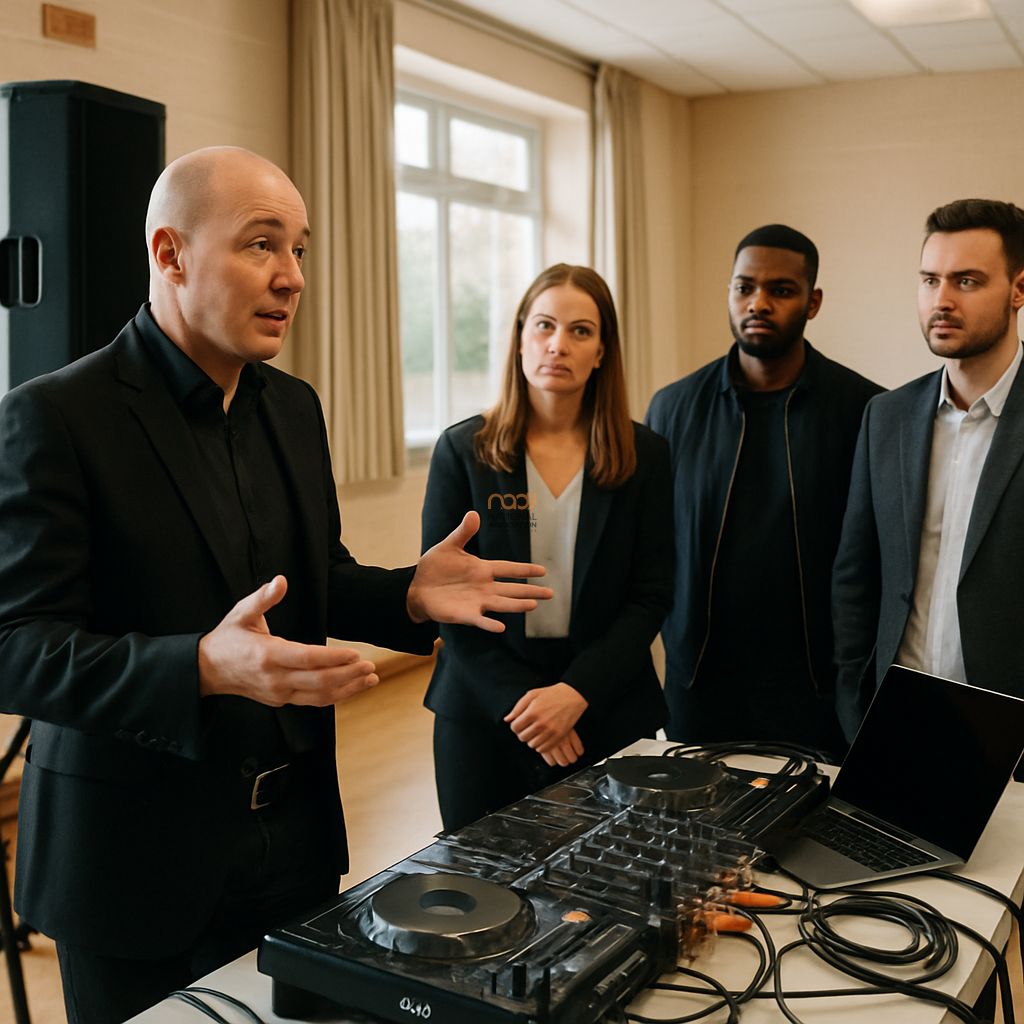
A NADJ technical workshop should do more than show off kit. It should give working DJs practical knowledge they can use at real gigs, whether they are performing in London, Manchester, Birmingham, Leeds, Bristol, Cardiff, Glasgow, Liverpool, Nottingham, Leicester, Coventry or anywhere else in the UK. The best sessions are relevant, current and honest about the realities of mobile, club and event work.
At its best, a workshop supports the wider aims of NADJ: helping DJs improve standards, share knowledge and operate professionally. It should leave attendees clearer about how to set up, test and use their equipment, while also understanding where to find reliable support and information when they need it.
Start with the basics: signal flow and system setup
Every useful workshop should begin with the fundamentals. DJs often pick up equipment piecemeal, so it is important to explain how audio actually moves through a system: source, mixer or controller, processor, amplifier, active speaker, and any additional zone or backup feeds.
That includes input and output types, gain staging, and the difference between mic, line and speaker level. If a DJ understands signal flow, they are less likely to overload an input, create avoidable noise, or lose time on site because of simple connection errors.
It also helps to cover practical cabling. Many problems at events come from damaged leads, incorrect adapters or poor cable management. A workshop should explain what to carry, how to label it, and how to spot the warning signs of worn connectors before a show starts.
Cover sound quality, not just volume
A strong technical workshop should help DJs make their rigs sound better, not merely louder. This means discussing speaker placement, room coverage, EQ discipline and basic acoustic awareness. A wedding in a village hall will behave very differently from a corporate event in a city centre hotel, and the same applies to community venues across the Midlands, Wales, Scotland and Northern Ireland.
Workshops should also address microphone use, feedback prevention and how to balance music with speech. A DJ who can manage a presentation, awards call-outs or announcements professionally will deliver more value to clients and venues alike.
Where possible, trainers should demonstrate with real equipment rather than relying only on slides. A physical setup makes it easier to hear the effect of changes and understand why certain choices work better in practice.
Include safety, inspection and good working practice
Technical training should always include safe working habits. That means sensible cable routing, stable speaker stands, safe loading and unloading, and awareness of trip hazards. It should also cover basic checks for damaged plugs, loose fittings and signs that a piece of equipment needs attention.
Some workshops may touch on PAT testing, ear protection or other compliance topics. If they do, the guidance should be careful and up to date. DJs should be reminded that requirements can vary depending on venue, contractor or local policy, so they should check live information rather than rely on assumptions. Where relevant, NADJ members can also look at services offered through the organisation’s commercial arm and support channels, including NADJ and the wider member resources at hub.nadj.org.uk.
Teach troubleshooting for real-world gig situations
One of the most valuable sections in any NADJ technical workshop is troubleshooting. Working DJs need a calm process for solving problems when time is short and the room is full.
A useful workshop should cover:
- what to check first when there is no sound
- how to trace hums, buzzes and interference
- how to identify a failing cable, input or output
- what to do if a controller, laptop or media player freezes
- how to manage a simple backup plan
This is not about perfection. It is about giving DJs a repeatable method so they can remain composed under pressure. That matters just as much for a one-off party as it does for regular work in busy venues and event spaces.
Address headphones, monitoring and cueing
Good monitoring is often overlooked, yet it is central to clean, confident mixing. A workshop should explain how to choose and use headphones properly, how to monitor in noisy environments and how to protect hearing over long working nights.
If the session includes product discussion, it should be practical rather than promotional. For example, DJs may find it useful to compare features that matter in the real world, such as comfort, isolation, durability and cable style. NADJ has already explored this area in its guide to top DJ headphones for professional mobile DJs in the UK, which can complement workshop learning.
Keep the workshop relevant to different DJ disciplines
Not every DJ needs the same technical advice. A mobile wedding DJ in Bristol may face very different demands from a club DJ in Leeds, a corporate specialist in London, or a wedding and events operator covering Scotland or Wales. A useful workshop should acknowledge those differences.
That means balancing broad principles with examples from different work patterns. It should speak to beginners, but not bore experienced DJs. It should also be honest about the tools people actually use, from compact controller setups to larger multi-speaker systems.
When NADJ members are building confidence or expanding into new areas, access to peer learning can be as valuable as formal training. That is why community resources such as the NADJ directory and gig listings can sit naturally alongside technical development, helping DJs find contacts, work and professional visibility.
Leave room for questions, demonstrations and follow-up
A workshop only becomes truly useful if attendees can ask specific questions. Live Q&A time should not be an afterthought. It should be planned into the session so participants can raise issues from their own setups and venues.
Even better, organisers should provide follow-up notes, checklists or links to further reading. That helps turn a one-day session into long-term improvement. For members exploring where they stand within the organisation, the membership tiers explained page can also help clarify what support is available at different levels.
What success looks like
A successful technical workshop does not try to cover everything. Instead, it prioritises the information that helps DJs work more safely, more efficiently and with greater confidence. If attendees leave knowing how to set up faster, solve common problems and make cleaner sound decisions, the session has done its job.
For NADJ, the goal should always be practical improvement for the UK DJ industry. That means useful training, plain-English guidance and support that reflects how DJs really work, from small local events to major city venues across England, Scotland, Wales and Northern Ireland.
In short, a good NADJ technical workshop should be grounded in reality, shaped by experience and focused on outcomes that matter at the next gig.
AI transparency note
NADJ uses artificial intelligence as an editorial assistant. Articles produced through this publisher begin with a human-selected idea, source, brief or editorial direction, and AI may be used to research, structure, draft or improve the wording. AI does not set NADJ editorial policy or operate free-range: people acting for NADJ set the instructions and publishing framework, monitor the output and retain editorial responsibility.
Images used by NADJ may include stock photography or AI-generated visuals where appropriate. NADJ is volunteer-led and editorial time is limited; much of our available time is currently absorbed by governance and management, a substantial data audit and membership-system transfer, and planning 12 Tea & Test days across the UK. You can help strengthen member-led content by sending article ideas or completed submissions to hello@nadj.org.uk.









 Avtar Thethy
 Fabio Capozzi
 Alastair Craig
 Dave Mills