
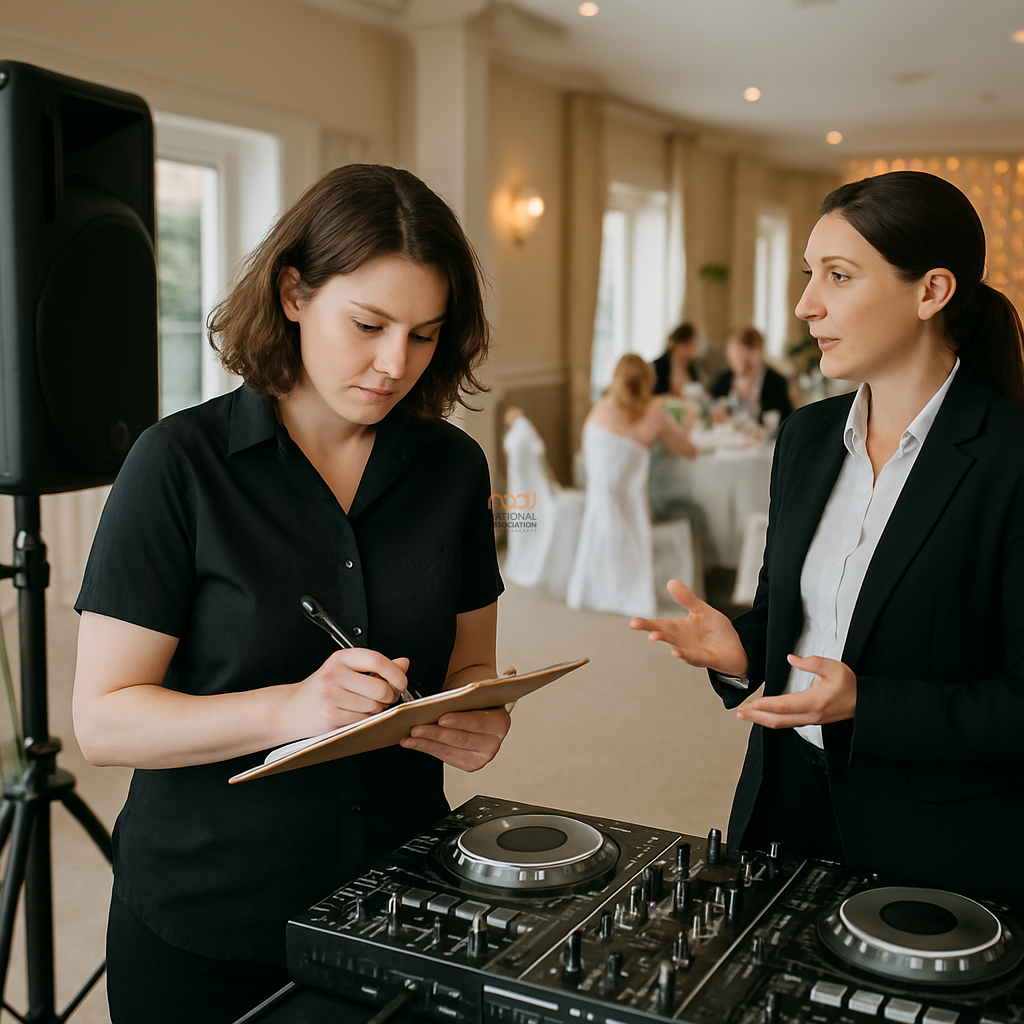
Keeping incident records for DJs is one of those habits that many working DJs only appreciate after a problem has happened. However, the best time to start is before any issue turns into a dispute, complaint or claim. A brief, accurate record can help you remember what happened, when it happened and what action you took.
That matters whether you are playing weddings in the Midlands, club nights in Manchester, private parties in London, school events in Leeds, or corporate functions in Glasgow, Cardiff, Liverpool, Nottingham, Leicester, Coventry, Bristol or Birmingham. Across the UK, the same principle applies: a professional DJ keeps a clear record of events that could later be relevant.
What counts as an incident?
An incident does not have to be dramatic to be worth noting. In practice, it may include anything unusual that affected the event, your equipment, your safety, your client relationship or the running order.
Examples might include:
- tripping a circuit breaker or losing power during setup
- minor damage to your gear or venue property
- a guest injury near your equipment
- noise complaints or venue staff concerns
- late access to the room, loading bay or parking area
- conflict over music requests, timings or access to equipment
- any refusal to follow venue instructions that affected safe working
Not every incident becomes serious. Even so, recording it gives you a reliable note of what took place while the details are fresh.
Why record incidents if nobody is making a claim?
The simple answer is that silence today does not guarantee silence tomorrow. A guest may later raise a complaint. A venue might contact you after reviewing CCTV or speaking to staff. Alternatively, you may need to explain your version of events months later, when memory has faded.
Keeping incident records can also help you in three practical ways.
1. It supports accurate memory
A gig week can be busy. If you are working multiple bookings, it is easy to mix up dates, venues and details. A written note made on the night is far more reliable than trying to reconstruct events later.
2. It helps you identify patterns
Small issues often repeat. For example, you may notice that a particular type of venue repeatedly has weak power access, loading problems or poor communication about setup times. If you see the same issue across several jobs, you can plan better and reduce the chance of repeat disruption.
3. It shows you are working professionally
Professional DJs do not simply turn up, play and leave. They manage risk, communicate clearly and keep sensible records. That includes noting anything unusual, especially if it could affect safety, service delivery or the condition of equipment.
What should a DJ incident record include?
Keep it factual, brief and consistent. You do not need a long report for every event, but you should include enough detail to make the note useful later.
A good incident record might include:
- date, time and venue
- your name and the booking reference, if relevant
- what happened, in plain language
- who was involved or who witnessed it
- what action you took
- any response from the client, venue staff or guests
- whether the event continued normally after the incident
- photos, if relevant and appropriate
Stick to facts rather than assumptions. For example, write that a guest tripped over a cable and was checked by venue staff, rather than speculating about why they fell. Neutral wording is more useful if the note is ever reviewed later.
How long should records be kept?
There is no single rule that suits every DJ business, and record-keeping needs can vary depending on your work, contracts and insurer expectations. For that reason, DJs should check their own circumstances and any live guidance that applies to them. If you are unsure, seek appropriate professional advice.
What matters most is having a sensible, consistent system. Whether you use a notebook, a secure digital form or a business management app, the key is to store records safely and make them easy to retrieve when needed.
Incident records are part of a wider professional toolkit
Good record-keeping sits alongside other basics of professional DJ work: proper setup, careful cable management, appropriate equipment maintenance and clear communication with clients and venues. If you are reviewing your wider toolkit, it is also worth considering practical items such as reliable headphones. Our guide to the top 10 DJ headphones for professional mobile DJs in the UK is a useful place to start.
Likewise, many DJs choose to review their cover and membership options regularly. If you want to understand how support levels differ, see our membership tiers explained page. If you are checking DJ public liability insurance, our guide to DJ public liability insurance in the UK provides helpful context, although details should always be checked against the latest policy wording and live requirements.
Keep records without overcomplicating the job
The aim is not to create paperwork for its own sake. The aim is to make your business more resilient. A short incident note after an event can take only a few minutes, yet it may save hours of uncertainty later. It can also help you improve how you work from one booking to the next.
For many DJs, especially those working across England, Scotland, Wales and Northern Ireland, the biggest benefit is peace of mind. If something unusual happens, you know you have captured the facts while they were still clear. That is a small habit with real professional value.
If you are building your DJ business and want to strengthen your professional profile, it may also be worth joining the wider NADJ community and making use of the resources available through the NADJ Hub. You can also explore the NADJ directory to see how members present themselves professionally, and check gig listings for opportunities and event information.
In short: incident records for DJs are not about expecting the worst. They are about working carefully, staying organised and protecting the professionalism that clients and venues value.
USE THE NADJ INCIDENT REPORTING TOOL
AI transparency note
NADJ uses artificial intelligence as an editorial assistant. Articles produced through this publisher begin with a human-selected idea, source, brief or editorial direction, and AI may be used to research, structure, draft or improve the wording. AI does not set NADJ editorial policy or operate free-range: people acting for NADJ set the instructions and publishing framework, monitor the output and retain editorial responsibility.
Images used by NADJ may include stock photography or AI-generated visuals where appropriate. NADJ is volunteer-led and editorial time is limited; much of our available time is currently absorbed by governance and management, a substantial data audit and membership-system transfer, and planning 12 Tea & Test days across the UK. You can help strengthen member-led content by sending article ideas or completed submissions to hello@nadj.org.uk.









 Avtar Thethy
 Fabio Capozzi
 Alastair Craig
 Dave Mills