

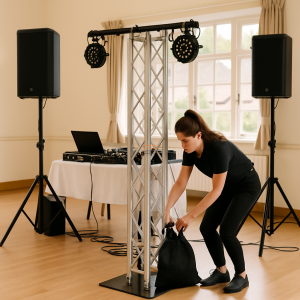
DJ load-in safety should be part of every working DJ’s routine, whether you are playing in London, Manchester, Birmingham, Leeds, Bristol, Cardiff, Glasgow, Liverpool, Nottingham, Leicester, Coventry or anywhere else across the UK. When you are working alone, the risks rise quickly: awkward lifts, poor lighting, narrow stairways, wet entrances and tiredness can all turn a normal arrival into an injury.
The good news is that most solo load-in problems are preventable. With a bit of planning, the right kit choices and a disciplined approach on arrival, you can protect your back, your hands, your equipment and your reputation. At NADJ, we regularly remind DJs that professionalism is not just about performance; it also includes safe working practice.
Why solo load-ins need extra care
When you are on your own, there is no second pair of hands to steady a flight case, hold a door, spot a step or help you recover if something slips. That means every movement matters. You may also be under time pressure, especially at weddings, corporate events and late-night functions where access windows can be tight.
Fatigue is another factor. Many DJs are travelling after another booking or loading in after a long drive. In that state, it is easy to rush. However, rushing is one of the main reasons injuries happen during transport and set-up.
Plan the load-in before you leave home
The safest load-in begins before you get in the vehicle. Check the venue details carefully and, if possible, confirm the following in advance:
- Where to park and how far you will need to carry equipment
- Whether there are stairs, lifts or ramps
- Whether there is a service entrance or a loading bay
- Who will meet you on arrival
- Any restrictions on access times or trolley use
If you regularly work across England, Scotland, Wales or Northern Ireland, do not assume a venue operates the same way as the last one. Even two similar hotels can have very different access routes. If a gig is listed through a directory or marketplace, such as the NADJ gig listings, it still pays to verify the practical details yourself.
Choose kit that helps you work safely
Solo DJs often carry the wrong kind of equipment because it looks efficient on paper but becomes hard work in real life. Wherever possible, use gear that suits one-person handling. That might mean modular systems, lighter cases, smaller subwoofers or wheeled transport solutions.
Think about the full journey, not just the booth. A compact controller might be easy to lift, but if your speaker stands, cables and lighting bags are badly packed, the whole load becomes awkward. Balance matters. So does grip. Cases with decent handles, smooth wheels and secure latches can reduce strain and improve control.
It is also sensible to keep regularly used items together. For example, store cables, adapters, mains leads and essentials in a way that lets you reach for them without over-stretching or rummaging while holding other items.
Use safer lifting habits every time
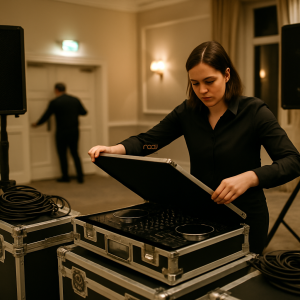
Basic manual handling discipline still matters, even for experienced DJs. Keep loads close to your body. Avoid twisting while carrying. Bend your knees, not your back, and lift in a controlled way. If something feels too heavy, too bulky or too awkward, do not try to force it.
Where a trolley or dolly is suitable, use it. Where a case can be split into two lighter trips, consider doing that rather than taking a single risky lift. A few extra minutes are far better than a pulled muscle or a dropped speaker.
Also watch for uneven surfaces, kerbs, wet paving and changes in floor level. In winter, entrances in places such as Glasgow, Leeds or Nottingham can be especially slippery. In summer, outdoor venues and temporary event spaces can bring their own hazards, including loose cables, gravel and uneven ground.
Do a quick venue risk check on arrival
You do not need a formal inspection every time, but you should look around before you start carrying heavy items. Ask yourself:
- Is the route clear?
- Are there steps, blind corners or low ceilings?
- Is the lighting good enough?
- Are doors heavy or self-closing?
- Are cables likely to create trip hazards?
If you see a problem, pause and sort it out before moving equipment. It is better to spend two minutes repositioning a cable or asking for a door to be held open than to manage an avoidable accident later.
Protect yourself, not just your kit
Many DJs are careful with their speakers but careless with their own bodies. That needs to change. Wear sensible footwear with good grip and enough support for a long shift. Avoid loose clothing that can catch on handles, wheels or zips. Keep your hands free when negotiating stairs or doors.
If you are tired, dehydrated or unwell, take that seriously. Solo load-in safety depends partly on your physical condition. A short break before the carry can make a real difference. Likewise, if you know a venue has difficult access, give yourself more time rather than arriving under pressure.
Work with the venue where you can
Good venues want the event to go well and will often help if you ask early. A staff member may be able to hold a door, direct you to the correct entrance or clear a route in advance. That support does not remove your responsibility, but it can reduce risk.
If you are booking through the NADJ Hub or networking with other professionals, use those conversations to share access tips. DJs who work across the Midlands, Wales or the major cities often build up practical knowledge that can save others time and strain.
Know when to get help
Sometimes the safest decision is to ask for assistance. That might mean requesting help from venue staff, arriving earlier so you are not rushing, or adjusting your set-up so it can be carried in safer pieces. There is no badge for lifting more than is sensible.
If a load-in feels beyond what one person can safely manage, treat that as useful information for future bookings. The aim is not to prove toughness. The aim is to arrive ready, work safely and leave in one piece.
Keep safety part of your professional standard
DJ load-in safety is not an add-on; it is part of being a reliable operator. It protects your health, reduces kit damage and helps you deliver consistent service across the UK, from small local functions to larger bookings found through the NADJ directory.
As with other professional matters, it is sensible to stay informed. For example, if you want to understand wider standards around cover and responsibility, our guidance on DJ public liability insurance may help you think through your working arrangements, although you should always check live policy details and requirements directly.
For DJs developing their careers, including those comparing NADJ membership tiers or looking at the broader support available through NADJ Media Ltd, the message is the same: professionalism includes preparation. Safe load-ins are a practical part of that standard.
Finally, remember that every venue is different. This article offers general guidance only and is not a substitute for venue-specific instructions, training or professional risk assessment. If in doubt, slow down, reassess and choose the safer method.
For more DJ resources and industry support, explore NADJ features and commentary and the wider member area via the NADJ Hub.




 Avtar Thethy
 Fabio Capozzi
 Alastair Craig
 Dave Mills