

DJ load-out safety after midnight is a subject that many mobile DJs only take seriously after a near miss. By the end of a long wedding, party or corporate event, you may be tired, working in poor light and trying to get equipment to a vehicle while guests, venue staff and traffic are all moving around you. That combination deserves proper planning.
This is not about making the job more complicated. It is about reducing preventable strain, slips, trips and rushed decisions. NADJ encourages working DJs across the UK, including England, Scotland, Wales and Northern Ireland, to treat the end of the night with the same professionalism as the performance itself.
Why late-night load-outs carry extra risk
Fatigue affects judgment, reaction time and lifting technique. After midnight, even experienced DJs can misjudge a step, fumble a trolley handle or carry too much in one go. Add a dark car park, a long walk to the vehicle or a tight timetable at venues in places such as London, Manchester, Birmingham, Leeds, Bristol, Cardiff, Glasgow, Liverpool, Nottingham, Leicester and Coventry, and the risk rises quickly.
Unlike the setup phase, the load-out usually happens when everyone wants to leave. That means less space, less patience and often less support. The safest approach is to assume you will be tired and build your plan around that reality.
Plan the load-out before the first song plays
A safe load-out starts earlier than most DJs think. Before you begin the event, confirm how you will access the vehicle, where you can park, and whether there are time limits for collection. If the venue has a rear entrance, lift, loading bay or designated goods route, ask how and when it is used. Where possible, check whether there are steps, ramps, narrow doors or uneven surfaces.
It is also sensible to understand your equipment layout. Heavy items should be packed so they are easiest to remove first. Keep cables, stands and accessories organised so you are not handling loose items in the dark. A tidy, repeatable system reduces the chance of rushing and forgetting something.
Lighting matters more than most DJs realise
Poor lighting is one of the simplest and most overlooked hazards after midnight. A venue may be beautifully lit during the party and almost unusably dark during pack-down. Do not assume that a corridor, fire exit route or car park will be sufficiently illuminated when the music stops.
Many DJs now carry a small, reliable torch or head torch, and that is a sensible habit. A hands-free light is especially useful when disconnecting power, checking steps or finding dropped items. Just make sure it is charged and easy to reach. If you work regularly, keep spare batteries or a backup light in your kit.
Where possible, use the venue’s own lighting and ask staff to leave essential areas illuminated until you are clear. That said, always carry your own source of light so you are not dependent on someone else remembering.
Vehicle access: avoid the last-minute scramble
Vehicle access can be the difference between a smooth exit and a stressful one. If you are parked a distance away, factor in the walk back and forth. If access depends on a gate, code or member of staff, make sure you know who is responsible and when they leave.
If you are loading into a shared car park, be extra cautious around reversing vehicles, potholes, kerbs and pedestrians. In busy urban areas, especially around late-night venues, vehicle movements can be unpredictable. Take your time and do not carry so much that you cannot see where you are going.
Where it is practical, move your vehicle closer before the end of the event. However, only do this if it is permitted by the venue and safe to do so. Never block emergency routes or force access that staff have not authorised. If in doubt, ask first.
Reduce fatigue before the final song
Good load-out safety begins with managing your energy. Eat properly during the day, stay hydrated and avoid assuming you can “push through” every late finish without consequence. If you know you have a long drive or an awkward venue exit, build in a buffer.
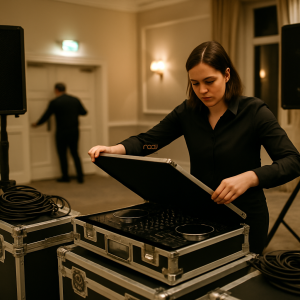
Break the pack-down into small stages. For example: power down, secure cables, pack accessories, move lighter items, then handle the heaviest cases. This avoids the common mistake of trying to do everything at once when concentration is already dropping.
If you are working a high-energy event and know the end will be late, consider how you can reduce physical demand before you arrive. For example, choose transport cases that roll well, minimise unnecessary kit, and keep frequently used items easy to reach. NADJ’s wider guidance on practical DJ set-ups, including choosing reliable gear such as professional DJ headphones, is part of the same principle: equipment should support safe, efficient work, not create extra strain.
Work within your limits, not against them
There is no prize for carrying everything in one trip. A second run is usually safer than a rushed first run. Use wheeled cases, carts or dollies where suitable, and do not lift loads that are awkward, unstable or beyond your comfortable capacity.
Good manual handling is not about being strong; it is about being controlled. Keep your path clear, bend your knees, hold items close and avoid twisting while carrying. If something feels too heavy or too awkward, ask for help. Venues often have staff who are willing to assist if you ask early and politely.
It is also worth checking your own working arrangements periodically. If you are a self-employed DJ, review the practicalities of your business setup as well as your kit. NADJ membership options and support can be explored through our membership tiers explained page, while the NADJ Hub provides access to useful member information.
Insurance, venue rules and professional judgement
Some DJs ask whether there is a specific legal duty around late-night load-outs. In practice, the safest answer is to follow current venue instructions, apply sensible manual handling principles and check any relevant legal or insurance requirements that apply to your own circumstances. If you rely on public liability cover, make sure you understand what is and is not included by reading the live policy details carefully. NADJ’s page on DJ public liability insurance is a useful starting point, but it should not replace a current policy document or professional advice.
Similarly, if you work with regular venues, keep contact details handy and maintain a professional relationship with staff. A clear understanding of access, lighting and exit routes makes the whole process safer for everyone.
A simple end-of-night checklist
Before you leave, ask yourself:
– Is the route to the vehicle lit well enough?
– Do I know who controls access points, gates or doors?
– Have I packed the heaviest items in a sensible order?
– Am I too tired to rush this safely?
– Do I need a second trip, a torch or help from staff?
If the answer to any of these is no, slow down and correct it. That small pause is often the difference between a routine finish and an avoidable incident.
Final thoughts
DJ load-out safety after midnight is not glamorous, but it is part of being a competent professional. Fatigue, lighting and vehicle access are manageable hazards when you plan ahead and refuse to normalise bad conditions. Whether you are working in a village hall, hotel, club or marquee, the goal is the same: finish the job in one piece and get home safely.
If you are building your DJ business, keeping your kit organised and staying connected to the trade matters too. Explore the NADJ directory to find fellow professionals, check gig listings for opportunities, and visit NADJ Commercial for services that support working DJs and entertainment businesses.
AI transparency note
NADJ uses artificial intelligence as an editorial assistant. Articles produced through this publisher begin with a human-selected idea, source, brief or editorial direction, and AI may be used to research, structure, draft or improve the wording. AI does not set NADJ editorial policy or operate free-range: people acting for NADJ set the instructions and publishing framework, monitor the output and retain editorial responsibility.
Images used by NADJ may include stock photography or AI-generated visuals where appropriate. NADJ is volunteer-led and editorial time is limited; much of our available time is currently absorbed by governance and management, a substantial data audit and membership-system transfer, and planning 12 Tea & Test days across the UK. You can help strengthen member-led content by sending article ideas or completed submissions to hello@nadj.org.uk.




 Avtar Thethy
 Fabio Capozzi
 Alastair Craig
 Dave Mills