

Why transit cover matters for DJs
Your equipment is often mobile, expensive and essential to your income. Controllers, mixers, PA speakers, laptops, microphones, lighting, cables and cases may all travel with you. If any part of that chain is damaged or stolen on the move, the cost is not just replacement. It can also mean a cancelled booking, lost goodwill and the disruption of future work.
Transit cover is designed to respond to risks while kit is being transported. However, not every policy defines transit in the same way. Some include travel in your own vehicle, others extend to courier or hired transport, and some may only apply if certain conditions are met. Always check the live wording of your policy and ask the insurer to clarify anything you do not understand.
What to check in your policy wording
When reviewing DJ equipment insurance in transit, look closely at the following areas:
1. Who is covered to carry the kit?
Some policies only cover equipment when transported by the named policyholder or an employee. Others may allow subcontractors or helpers, but only if they meet specific requirements. If you work with a second DJ or roadie, do not assume they are covered without confirmation.
2. Does the policy cover the vehicle type you use?
Your insurer may require the kit to be in a locked vehicle, a locked boot, or a vehicle fitted with a recognised alarm or immobiliser. Coverage may be different for vans, cars, hired vehicles and trailers. If you regularly use multiple vehicles, make sure each one is accepted under the policy.
3. What happens when the kit is left unattended?
This is one of the most common exclusions. A short stop at a service station, venue entrance or loading bay may still count as unattended, depending on the wording. Some policies expect equipment to be out of sight, secured and removed at the earliest reasonable opportunity. Others may exclude theft from vehicles entirely overnight.
4. Is loading and unloading included?
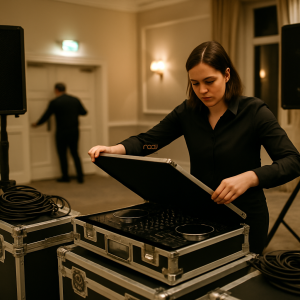
Damage often happens before the event begins or after it ends. A speaker can slip on a ramp, a flight case can be dropped, or a laptop can be knocked during a rushed load-out. Check whether your policy treats loading and unloading as part of transit or as a separate activity.
5. Are there limits for single items or the full set?
Policies may set item limits, total sums insured, and special conditions for high-value kit. If your main controller, camera, or laptop exceeds a single-item limit, you may need to specify it separately. The same applies if your lighting stock or PA system has grown since you last renewed cover.
Common mistakes DJs make
Even experienced DJs can get caught out by simple assumptions. One common mistake is assuming that public liability insurance automatically protects kit in transit. It does not. Public liability insurance is about third-party injury or property damage, not your own equipment. If you are reviewing your overall cover, NADJ has a useful guide on DJ public liability insurance requirements, which is worth reading alongside your equipment policy.
Another mistake is relying on a policy taken out years ago and never updated. Many DJs upgrade their laptops, add lighting, or move into larger events without revisiting the declared value. If your setup has changed, your cover should reflect that. Otherwise, a claim may not deliver the result you expected.
It is also easy to overlook how you travel. If you now do more long-distance work across England, Scotland, Wales or Northern Ireland, or frequently move between venues in busy areas of the Midlands, the level of transit risk may be different from when you started. Insurance should be matched to the way you actually work now.
Practical steps to reduce risk
Insurance is important, but it should sit alongside sensible operational habits. Here are a few practical steps:
- Use strong, lockable cases for your core kit.
- Keep an up-to-date inventory with serial numbers and photos.
- Park in well-lit, secure areas where possible.
- Do not leave gear visible in vehicles.
- Load and unload as efficiently as possible, especially late at night.
- Keep proof of purchase and maintenance records.
These steps will not guarantee a claim outcome, but they can help reduce avoidable losses and may support a stronger risk profile when speaking to an insurer.
Ask the right questions before you buy or renew
Before you commit to a policy, ask the insurer or broker directly: Is transit covered? What counts as transit? Does cover apply in my own vehicle? Are overnight stops excluded? Are theft from vehicles, accidental damage and loss all included? Are there security conditions I must meet?
That conversation is especially important if you operate as a mobile wedding DJ, club DJ, or event supplier working across cities such as London, Birmingham, Leeds, Bristol or Glasgow. A policy that looks suitable at first glance may have restrictions that only become obvious when you read the detail.
Where NADJ members can go for support
NADJ exists to support working DJs with practical information, industry standards and professional development. If you are reviewing your broader business setup, it may also be worth looking at membership tiers, our top DJ training courses guide, and the NADJ directory for suppliers and services. You can also explore the gig listings area, which may be useful for keeping an eye on opportunities in the UK market.
For wider resources and industry tools, visit NADJ Hub and nadj.co.uk. If you are considering your online presence, marketing or admin support, NADJ Media Ltd also offers services that may be relevant to busy DJs and event businesses.
The bottom line – yes, in MOST circumstances the Sharrock’s Equipment insurance does…
The key lesson is that “equipment insurance” does not automatically mean your equipment is fully protected whenever it is inside your vehicle. The policy wording, security conditions and excess can make a significant difference when a claim is made.
Under the Sharrocks equipment policy available through NADJ, DJ equipment, portable dance floors, photobooths and related accessories are insured under the Specified All Risks section, with cover applying throughout the UK. The example policy reviewed provides up to £10,000 of cover.
Importantly, the policy does cover theft or loss from a vehicle, but the standard £100 excess increases substantially to £1,000 for any vehicle-related claim. This means that although equipment may be insured while being transported or stored in your van, smaller losses may offer limited practical benefit once the excess has been deducted.
There is also a clear exclusion for losses from unattended vehicles or trailers where there is no evidence of forcible and violent entry. Leaving a vehicle unlocked, unattended with the doors open, or being unable to demonstrate that it was physically broken into could therefore result in a claim being declined.
The conclusion is simple: never assume. Read your schedule alongside the full policy wording, check the vehicle-security requirements and ensure the insured value reflects the true replacement cost of the equipment you regularly carry.
To access the equipment insurance, you must first be an NADJ member – you can then take out the equipment insurance directly using the equipment insurance tile on your member dashboard,




 Avtar Thethy
 Fabio Capozzi
 Alastair Craig
 Dave Mills