
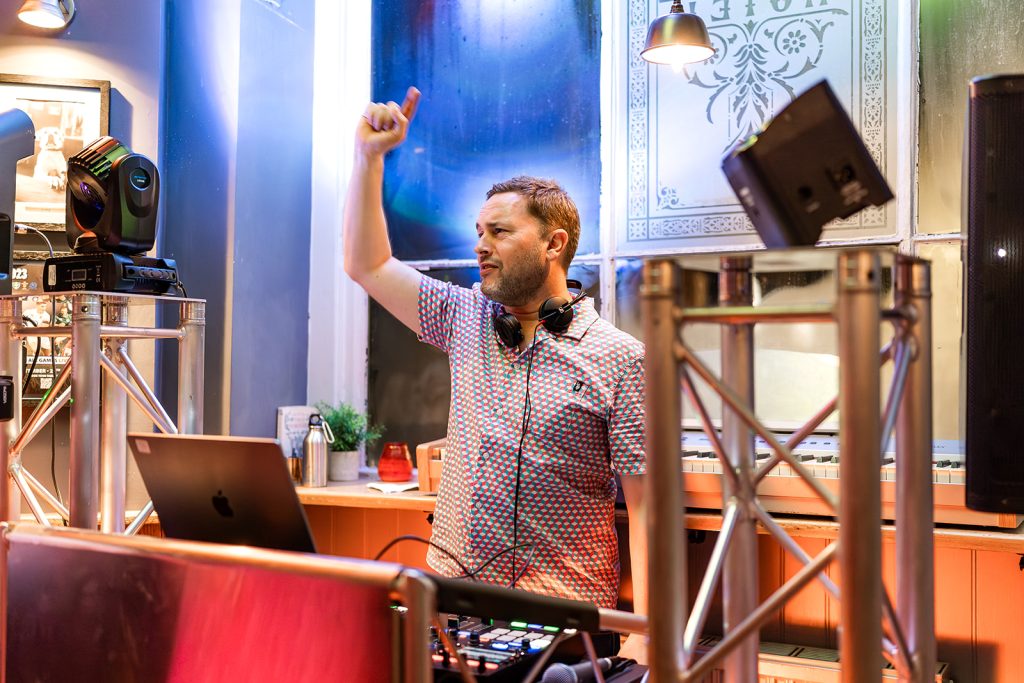
By Craig Gunn
My journey as a DJ didn’t start in wedding venues or elegant country houses. It began where a lot of DJs cut their teeth — in clubs, late nights, loud systems, and dancefloors driven by instant reaction.
Back then, it was simple: read the room, push energy, and keep people moving. If the floor was packed, you were doing it right. If it emptied, you adapted quickly — or you lost it. That environment builds instincts you simply can’t learn anywhere else.
What I didn’t realise at the time was just how transferable that skill would become.
The shift from clubs to weddings and corporate events
Moving into wedding and corporate DJing with Hampshire Event DJ’s completely changed my perspective on what it means to “play a crowd.”
A club dancefloor is anonymous in a way — people come and go, the energy resets every night, and the focus is purely on the music and the moment.
A wedding dancefloor is something else entirely.
It’s personal. It matters.
You’re not just playing music — you’re soundtracking someone’s most important day. The bride and groom aren’t just clients; they’re emotionally invested in every track, every transition, every moment the dancefloor comes alive.
Corporate events bring another dynamic again — balancing professionalism with enjoyment, knowing when to lift the energy and when to keep things refined.
What I’ve learned is that, regardless of the setting, the core skill never changes: reading people.
A more stable and professional way of working
One of the biggest changes in moving away from the club circuit is not just the style of events — it’s the structure behind the work.
I’m no longer in a position where I’m dealing with club promoters or venues that avoid, delay, or even renege on promised fees. That uncertainty is something many DJs quietly accept early in their careers, but over time it takes its toll.
Working with Hampshire Event DJ’s has completely removed that stress. Everything is clear, professional, and structured — from client communication through to payment and event delivery.
It means I can focus entirely on what matters: the performance, the music, and the experience.
Working with Hampshire Event DJ’s and support behind the scenes
One of the biggest changes in my career has been working with Hampshire Event DJ’s and having an agent who genuinely understands both the client experience and the DJ perspective.
Having someone personable and organised dealing with clients allows me to focus fully on what I do best — reading the room, managing the energy, and delivering the music.
Behind the scenes, the business uses a dedicated CRM platform, DJ Teams, to manage bookings and client details. From my side as a working DJ, it’s something I interact with constantly, and I can genuinely see the value it brings from both ends of the customer journey.
It means that when I arrive at an event, everything is clearly laid out — client preferences, timelines, special requests, and important details that allow me to focus purely on delivery.
That level of preparation removes uncertainty, builds confidence, and allows me to concentrate fully on reading the room and creating the right atmosphere on the night.
User & client experience with DJ Teams
Across early feedback and case studies, the general feeling around DJ Teams is that it makes the whole process of planning music feel a lot more engaging and far less stressful for clients.
A lot of couples mention that instead of long email chains or trying to explain vague music preferences, they can actually interact with the music choices. The swiping-style system in particular comes up a lot — people describe it as fun, easy to use, and something they end up doing together while planning their wedding, almost like part of the experience rather than a task.
From a DJ perspective, there’s a noticeable difference in clarity too. Clients tend to be much more specific about what they like and don’t like, which naturally leads to fewer awkward moments on the night and a clearer understanding of the vibe they want.
There’s also a consistent theme around confidence on both sides — clients feel more involved in shaping their night, and DJs arrive with a much clearer picture of how the event should flow. That combination tends to translate into better dancefloors and smoother events overall.
Some of the early comments that stand out are things like:
- “It made choosing music actually enjoyable instead of a chore.”
- “We ended up laughing our way through building the playlist together.”
- “It just felt like the DJ really understood what we wanted.”
It’s still early days for a lot of people using the platform, but the feedback so far suggests the biggest impact is simply how much easier it makes communication — and how much more connected clients feel to the music before the event even happens.
The reality of playing beautiful Hampshire venues
One of the real privileges of this job is travelling to some of the most stunning country houses and venues across Hampshire.
There’s something uniquely rewarding about arriving at a long driveway, seeing historic architecture and manicured grounds, and knowing you’re about to transform a quiet space into a full dancefloor experience.
Whether it’s grand estates, rustic barns, or modern countryside venues, each location has its own personality. Some feel intimate and romantic, others feel expansive and theatrical — but all require the same thing from me: adaptability.
Every room sounds different. Every layout changes how energy flows. Every crowd reacts in its own way.
And that’s where experience really matters.
Club DJ vs wedding DJ: the real difference
People often assume DJing is DJing — just press play and mix tracks. But the difference between club DJing and wedding DJing is actually quite profound.
In a club, you’re building a set for a general vibe. You’re often leading the energy of the night, shaping it as it evolves.
At a wedding, you’re serving a journey that already exists emotionally.
The couple has a vision. The guests bring generational differences. The timeline has structure. The stakes are higher.
But interestingly, the end goal is the same:
A packed dancefloor where people feel something.
That’s the synergy I’ve always found between both worlds. The tools change slightly, but the instinct remains identical — read the room, respond to energy, and build momentum.
Reading the room: the skill that ties everything together
If there’s one thing I rely on more than anything else, it’s reading the room.
That means watching how people react to every transition. Noticing when energy starts to dip before it actually drops. Understanding when to push harder and when to hold back.
It also means being comfortable with requests — but not being ruled by them.
Part of being a confident DJ is knowing when a request will lift the room… and when it might disrupt the flow.
I always stay approachable and positive behind the decks. Taking requests is part of the experience, especially at weddings where guests feel emotionally connected to the music.
But there’s always a responsibility to the bigger picture: the bride and groom’s night, the flow of the set, and the overall energy of the event.
So sometimes it’s a yes. Sometimes it’s a “not right now.” Either way, it’s handled with respect and clarity.
Personal connection is everything
What I’ve come to value most in this career isn’t the technical side of DJing — it’s the human side.
Every event has its own story. Every couple, every company, every group of guests brings something different.
And when it works properly, you feel it.
That moment when the dancefloor is completely connected — strangers, families, friends — all moving together to the same energy… that’s still the same feeling I used to chase in clubs, just in a very different setting.
The context has changed, but the outcome hasn’t.
Final thoughts
Looking back, the journey from club DJ to wedding and corporate DJ with Hampshire Event DJ’s hasn’t been a move away from who I was — it’s been an evolution of it.
The skills I built in clubs are still there. The instincts are sharper than ever. But now they’re applied in environments where connection matters just as much as energy.
With strong support behind the scenes, a structured system to manage clients, and the privilege of performing in some of Hampshire’s most beautiful venues, I feel I’ve found the balance between professionalism and creativity.
At the end of the night, whether it’s a packed club or a candlelit country house, my goal is always the same:
Read the room. Respect the moment. And keep people dancing.









 Avtar Thethy
 Fabio Capozzi
 Alastair Craig
 Dave Mills