
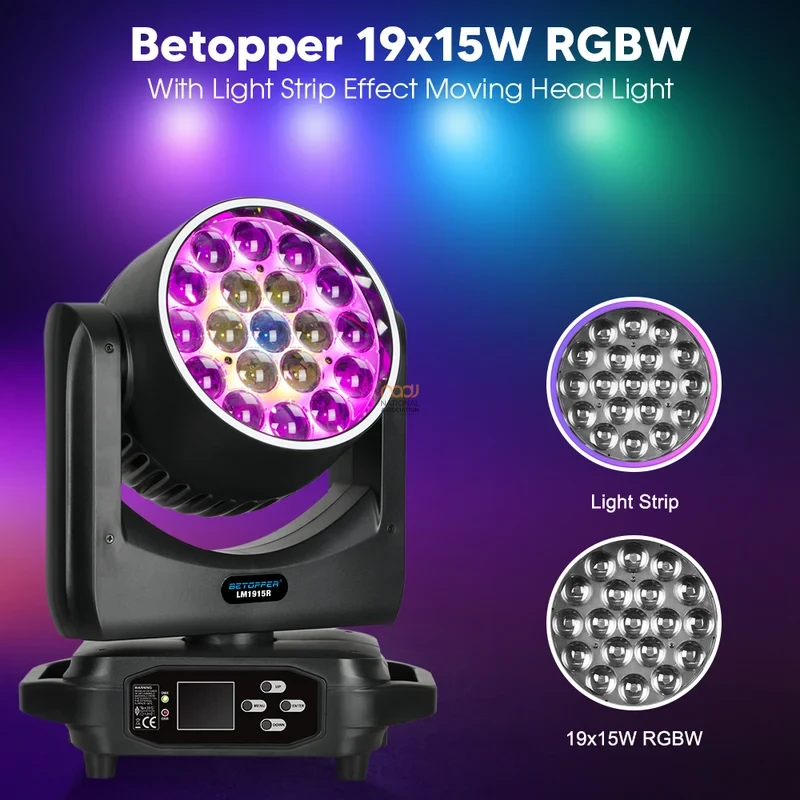
NADJ is updating its recent product safety warning following the publication of two further Betopper stage lighting reports by the Office for Product Safety and Standards (OPSS).
The latest notices, published on 15 September 2026, concern the Betopper LF2405 LED Strobe Stage Light and Betopper LCX200 LED Spotlight Stage Light. Both products were assessed as presenting a high safety risk associated with non-compliant plug fuses.
This brings the number of Betopper lighting models highlighted by UK authorities during September to four.
The four Betopper models currently identified
NADJ members, production companies, venues and equipment hire businesses should check their equipment inventories for the following model numbers:
- Betopper LM1915R – Ring Effect LEDs & LED Strip Stage Light
- Betopper BSW200 – 3-in-1 Beam, Spot & Wash and LED Strip Stage Light
- Betopper LCX200 – LED Spotlight Stage Light
- Betopper LF2405 – LED Strobe Stage Light
The LM1915R and BSW200 reports were published on 10 September 2026, followed by the LCX200 and LF2405 reports on 15 September 2026. All four have been classified by the authorities as high-risk lighting products.
What is wrong with the products?
The common issue identified by the authorities relates to the fuse fitted within the UK plug.
For the LF2405, OPSS reported that the fuse contained insufficient filler material, sometimes referred to as ballast. This means it does not comply with the requirements of BS 1362.
The LCX200 was also found to have a fuse without sufficient protective ballast. Under fault conditions, OPSS states that this can allow the plug to overheat or melt, potentially resulting in fire and, where live parts become exposed, electric shock.
Similar fuse problems were identified in the previously reported LM1915R and BSW200 models.
This is particularly relevant to our industry. Stage lighting may operate for many hours at a time, often in venues containing considerable amounts of combustible material and in environments where equipment is positioned above guests, behind DJ booths or inside temporary installations.
A component costing very little can therefore have consequences far beyond the value of the component itself.
These are border rejections – not consumer recalls
There is an important distinction members should understand.
None of these four notices currently constitutes a general consumer recall.
The corrective action recorded by OPSS is “Import rejected at border”. This means the particular consignments examined by UK authorities were prevented from entering the UK market.
That is good news, but it should not be interpreted as confirmation that every example of these models already in circulation is safe.
Stage lighting can enter the UK through numerous routes, including direct consumer imports, international online marketplaces, third-party sellers and earlier consignments.
It is therefore entirely possible for equipment with the same model designation to already be in use without forming part of the specific shipment rejected by authorities.
Equally, the reports do not establish that every Betopper product, or necessarily every individual unit carrying these four model numbers, is defective.
The sensible response is identification and inspection rather than assumption.
What should NADJ members do?
If you own or operate Betopper lighting equipment, NADJ recommends checking your inventory now rather than waiting until equipment is next booked for an event.
First, identify the manufacturer and exact model number from the rating plate or equipment documentation.
If you have an:
LM1915R, BSW200, LCX200 or LF2405
record it for further investigation and consider removing it from service until you are satisfied that the equipment and its UK mains connection are compliant.
Where equipment has been purchased recently, members may also wish to contact the original supplier and refer them to the relevant OPSS Product Safety Report.
Do not simply assume that changing the external plug or fuse automatically resolves every product conformity issue. The appropriate course will depend upon the individual equipment and its supply history.
“But mine has passed PAT…”
Members should also remember the distinction between in-service electrical inspection and testing and product conformity.
A current PAT/EET inspection record should never be interpreted as proof that every internal component within an appliance, plug or fuse was manufactured correctly.
In this particular case, the problem identified by OPSS concerns the amount of filler material inside the fuse itself. That is not something an ordinary visual inspection can necessarily establish.
Routine inspection and testing remains an important part of electrical safety management, but it does not replace manufacturer conformity requirements, product safety surveillance or checking official safety notices.
This is one of the reasons NADJ encourages members to maintain proper equipment inventories rather than relying solely upon stickers attached to equipment.
Why NADJ monitors these reports
Professional DJs routinely work with significant quantities of mains-powered equipment: lighting fixtures, amplifiers, powered loudspeakers, controllers, effects equipment, distribution equipment and ancillary electrical products.
A product safety notice affecting professional stage lighting is therefore directly relevant to our members









 Avtar Thethy
 Fabio Capozzi
 Alastair Craig
 Dave Mills