

The aim is not to create a complex spreadsheet that you never use. It is to build a practical annual budget for a one-person DJ business that gives you a working view of your finances, supports better decisions and reduces stress when bookings slow down.
Start with your real annual income
Begin by listing everything you expect to earn across the year. For many DJs, that will include weddings, birthdays, corporate events, school parties, club dates, karaoke nights, and any add-ons such as lighting upgrades, photo booths, uplighting or speaker hire. If you also earn through teaching, MC work, livestreams or playlist planning, include that too.
Be realistic. A budget is only helpful if it is based on what you can reasonably deliver. Use your actual recent booking history where possible. If you are newer to the industry, estimate conservatively rather than building a plan on best-case figures.
Think in monthly cash flow, not just yearly totals
The annual total matters, but monthly cash flow matters more for day-to-day survival. A DJ can have a strong summer and a quieter January, February or November. That is normal. So, spread your expected income across the year month by month. This makes it easier to spot lean periods and plan ahead.
For example, if your business is strongest in the Midlands during the wedding season but quieter outside it, you may need to reserve a portion of spring and summer income to cover slower months. The same logic applies whether you work in Leeds, Bristol, Nottingham, Leicester, Coventry or elsewhere in the UK.
List your fixed and variable costs
Next, write down every cost your business has. It helps to split these into fixed costs and variable costs.
Fixed costs are the ones you pay regularly, whether you are booked or not. These may include website hosting, advertising, email software, mobile phone costs, accountancy software, equipment insurance, public liability insurance, vehicle insurance for business use where relevant, and membership fees.
Variable costs change with each job or rise and fall during the year. These may include travel, fuel, parking, tolls, refreshments, replacement cables, batteries, consumables, music purchases, repairs and subcontracted support.
If you want a reminder of why some overheads matter, NADJ has guidance on public liability insurance requirements and professional expectations here: DJ public liability insurance guidance. Insurance products and requirements can vary, so always check current details and make your own assessment before buying cover.
Include equipment replacement and maintenance
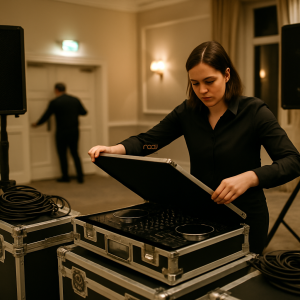
Many solo DJs underestimate equipment costs because the kit was bought years ago and is already paid for. But speakers, lighting, controllers, laptops, cases and leads all wear out eventually. Your annual budget should include a sinking fund for replacements and maintenance, even if you only set aside a modest amount each month.
This is particularly important if you work full-time across England, Scotland, Wales or Northern Ireland and your gear is in regular use. Budgeting for maintenance now is usually easier than replacing a failed item at short notice before a Saturday booking.
Separate business money from personal money
A simple annual budget works best when your business finances are kept separate from your personal spending. If you do not already do so, use a dedicated bank account for business income and costs. That makes it much easier to track bookings, understand margins and prepare for tax-related obligations.
It also helps you avoid the common mistake of treating every payment in as income you can spend immediately. A portion of each booking may need to be held back for future costs, replacement kit, software renewals and any tax you may owe. NADJ cannot provide individual tax advice, so if your situation is changing or you are unsure how to structure things, speak to a qualified accountant or bookkeeper.
Build in tax planning and a safety buffer
For many sole traders, tax does not feel urgent until a bill arrives. That is why a budget should include a sensible provision for tax and National Insurance where relevant to your circumstances. The exact amount depends on your personal situation and trading structure, so use cautious estimates and get professional advice if needed.
In addition, try to build a small cash buffer. A reserve can help with quieter trading periods, late payments, unexpected travel, or emergency repairs. Even a basic buffer makes your business more resilient.
Use NADJ tools and resources to support your planning
If you are refining your business setup, it can help to use the wider support available through the industry. NADJ membership information is here: membership tiers explained. If you are looking to strengthen your presence or find more opportunities, you may also find these useful: the NADJ directory, gig listings and the member hub at hub.nadj.org.uk.
For those reviewing their business image and buying decisions, NADJ also publishes practical product guidance such as top DJ headphones for professional mobile DJs in the UK. If you need support with websites, advertising or other business services, visit NADJ Media Ltd.
Review your budget every quarter
An annual budget should not sit in a folder until next year. Review it every three months. Compare your forecast with actual bookings and actual spending. Ask yourself: which events were more profitable than expected, which costs were higher than planned, and are there any trends in enquiries from cities such as Liverpool, Coventry, Cardiff or Glasgow?
That review process matters because the UK DJ market changes quickly. A simple annual budget should evolve as your bookings, equipment needs and operating costs change.
Keep it simple enough to use
The best budget is the one you will actually maintain. Start with a basic sheet containing income, fixed costs, variable costs, tax provision and reserve savings. Then update it regularly. You do not need complicated software unless your business is large enough to justify it.
If you can see what is coming in, what must go out and what needs to be set aside, you are already ahead of many small businesses. That is the real value of an annual budget for a one-person DJ business: clearer decisions, fewer surprises and a stronger platform for growth.
AI transparency note
NADJ uses artificial intelligence as an editorial assistant. Articles produced through this publisher begin with a human-selected idea, source, brief or editorial direction, and AI may be used to research, structure, draft or improve the wording. AI does not set NADJ editorial policy or operate free-range: people acting for NADJ set the instructions and publishing framework, monitor the output and retain editorial responsibility.
Images used by NADJ may include stock photography or AI-generated visuals where appropriate. NADJ is volunteer-led and editorial time is limited; much of our available time is currently absorbed by governance and management, a substantial data audit and membership-system transfer, and planning 12 Tea & Test days across the UK. You can help strengthen member-led content by sending article ideas or completed submissions to hello@nadj.org.uk.




 Avtar Thethy
 Fabio Capozzi
 Alastair Craig
 Dave Mills