

Vehicle safety for mobile DJs is a working issue, not just a transport topic. If you regularly move sound, lighting, truss, stands, cases and signage between venues, your vehicle is part of your professional setup. Getting loading wrong can affect safety, handling, braking, and even whether you are operating within the law.
For mobile DJs across the UK, from London and Birmingham to Manchester, Leeds, Bristol, Cardiff, Glasgow, Liverpool, Nottingham, Leicester and Coventry, the same principle applies: know what your vehicle can carry, load it properly, and check the rules before you set off. This is especially important if you work long distances across England, Scotland, Wales and Northern Ireland, or do frequent weekend journeys in the Midlands and beyond.
Why vehicle safety matters for mobile DJs
A DJ vehicle is often full of dense and awkwardly shaped equipment. Speakers, amplifiers, lighting rigs, cases and power distribution gear can add up quickly. Even a modest setup can push a small van or car towards its maximum authorised mass if the load is not planned carefully.
Unsafe loading can create several problems. It can reduce control, increase stopping distances, make the vehicle unstable in corners, and cause equipment to move during braking. In an emergency stop, unsecured cases can become dangerous projectiles. From a road law perspective, overloading or driving an unsafe vehicle can attract penalties and could also create complications if you are stopped by police or road enforcement officers. As always, check current rules and your vehicle documentation before making assumptions.
Know your payload before you pack
The most important figure for any mobile DJ is the vehicle’s payload. This is not the same as the towing capacity or the number of seats. Payload is the maximum weight you can add to the vehicle, including passengers, fuel, accessories and all equipment.
Where to find the right numbers
- Check the vehicle handbook and manufacturer plate.
- Look at the gross vehicle weight and axle limits.
- Remember that fuel, water, racking, shelving and roof loads all count.
- If in doubt, ask the manufacturer or a qualified vehicle specialist to confirm the figures.
Do not guess. A van that “feels fine” can still be overweight. Likewise, a car used for smaller mobile events can easily exceed its limits once lighting stands, subwoofers and accessories are added.
Load the vehicle for balance, not just space
Good loading is about distribution as well as total weight. Heavier items should be placed low and as close to the floor as possible, ideally spread evenly between the axle lines. This helps the vehicle stay stable and predictable on the road.
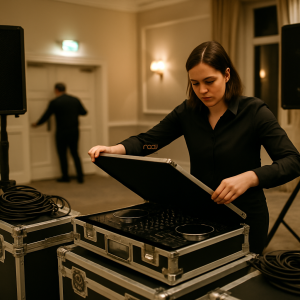
In practice, that means placing items such as amplifiers, subwoofers and flight cases in the lowest part of the load area first, then building upwards with lighter items. Avoid stacking heavy kit high up unless the vehicle is designed for it. If you use shelving or flightcase systems, make sure they are securely fixed and do not shift under braking.
Also think about access. If you often work venues with tight loading bays, steps or long walks from parking to function rooms, organise your equipment so the most frequently used items are easiest to reach. That reduces rushed lifting and the temptation to leave loads unsecured “just for one journey”.
Secure every item before driving
Even if your equipment is within weight limits, it still needs to be restrained. Sudden movement can damage kit and affect the vehicle’s handling. Use proper load restraints, straps, dividers, cages or rated tie-down points where available.
Try to avoid loose bags, stacked boxes that can topple, or single items sliding around the boot or cargo area. Cable bags, microphones, laptop cases and accessory tubs are often overlooked because they seem light, but they can move unexpectedly and cause distractions.
As a working standard, carry out a quick pre-drive check every time: doors shut, load secured, mirrors clear, nothing blocking pedals or driver movement, and the rear view unobstructed if you rely on it. A two-minute check can prevent an avoidable incident.
Road law, licences and vehicle use
Road law changes from time to time, so the safest approach is to verify live guidance with official sources. That said, there are a few general points every mobile DJ should keep in mind.
If your vehicle is overloaded, in poor condition, or being used in a way it was not designed for, you may be committing an offence or driving outside the terms of the vehicle’s construction and use requirements. If you are towing a trailer, you must also check the combined weight, tow limits and licence entitlement. This matters just as much for smaller wedding setups as it does for large club-style rigs.
In addition, make sure your documents are in order. Your driving licence category must match the vehicle you are using, and any trailer use must also be lawful. If you work commercially, it is wise to review whether your business use, vehicle condition and journey types are appropriate for your operation. NADJ always recommends checking current legal guidance rather than relying on old advice or forum posts.
Plan for venue access as well as the road
Vehicle safety for mobile DJs does not stop at the motorway. Venue access can create its own risks, especially when parking is distant, delivery routes are uneven, or time pressure is high. The same applies at hotels, civic venues and private homes across the UK.
Before the event, ask about loading access, stairs, lifts, parking restrictions and unloading windows. If you are travelling to busy city-centre jobs in Manchester, Bristol or Glasgow, factor in congestion, pedestrian zones and time for legal parking. In smaller towns and rural areas, think about narrow roads, poor lighting and weather conditions, particularly in winter.
Good planning reduces lifting strain, rushed carrying and unsafe roadside unloading. It also protects your equipment and your professionalism.
Make safety part of your DJ business routine
The most reliable operators treat vehicle checks as part of their job, just like PAT testing, client communication or insurance review. If you are building your professional standards, you may also find NADJ resources useful, including our member hub, our membership tiers explained page, and guidance on DJ public liability insurance. For those developing their skills more broadly, our DJ training courses guide may also be useful.
If you are looking to connect with the wider profession, the NADJ directory and gig listings can help you stay engaged with the market. And if you are exploring business support, NADJ Media Ltd offers services that many DJs find useful alongside their day-to-day operations.
Final checks before you drive
Before every job, ask yourself three questions: is the vehicle within its weight limits, is the load secured, and is the journey legal and sensible for the vehicle I am using? If the answer to any of those is unclear, stop and verify it.
Safe loading is not about overcomplicating the job. It is about protecting yourself, your equipment, your clients and other road users. For mobile DJs, that is part of professional practice. It is also part of representing the standards that NADJ encourages across the UK DJ industry.
Note: This article is general guidance only. Vehicle law, insurance terms and licensing requirements can change, and they may depend on your exact vehicle, load and journey type. Always check live official guidance and seek qualified advice where needed.







 Avtar Thethy
 Fabio Capozzi
 Alastair Craig
 Dave Mills