
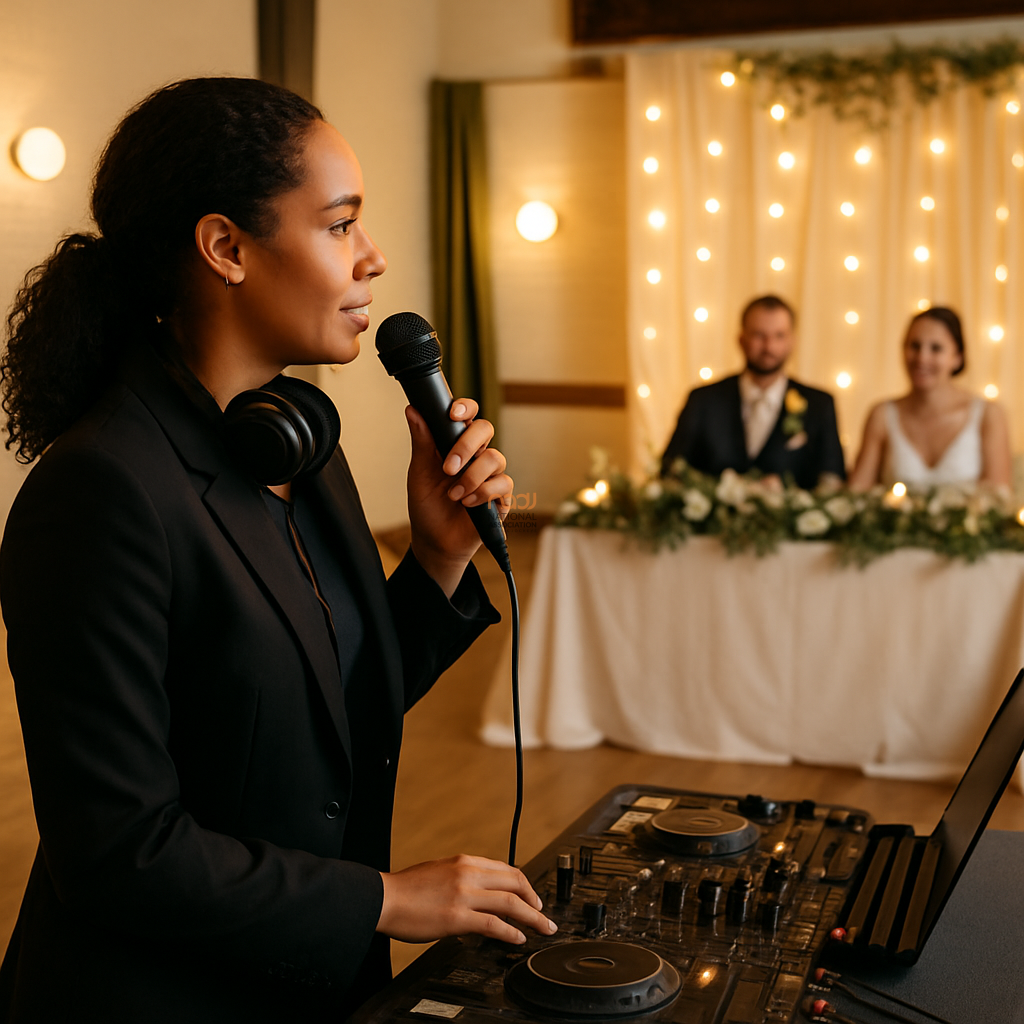
Wedding DJ announcements can be the difference between a reception that feels smooth and one that feels over-managed. For working DJs across the UK, the challenge is not simply making announcements; it is knowing which ones genuinely add value, which ones help the couple, and which ones are best left out altogether.
In practice, couples rarely want a running commentary. They want a well-timed, confident voice that keeps guests informed without interrupting the atmosphere. That means the DJ’s job is usually to support the day, not to become the event planner. As with most parts of mobile DJ work, the answer depends on the venue, the schedule, the couple’s preferences, and the wider team on site.
What wedding DJ announcements usually matter
There are a handful of moments where an announcement is genuinely useful. These are the points where guests need direction, the venue needs coordination, or the event needs a clear reset.
1. Entrance of the couple and wedding party
If the couple is making a formal entrance into the wedding breakfast or evening reception, a short announcement helps focus attention. Keep it brief, accurate, and upbeat. This is one of the clearest examples of a useful announcement because it tells guests exactly what is happening and when to applaud.
2. First dance
The first dance is often the most expected announcement of the evening. Even if the venue staff or photographer is ready, guests still benefit from a simple cue. A concise introduction is enough; there is no need for a long build-up unless the couple has specifically asked for one.
3. Cake cutting
Some weddings still treat the cake cutting as a formal moment. Others prefer it to happen quietly. If the photographer wants a gathering, or if the couple has planned it as a feature, a short announcement can help. If not, it can often be handled discreetly by the DJ, venue coordinator or photographer.
4. Buffet, food service, or call to tables
When there is a clear practical reason for guests to move, announcements are useful. This is especially true in larger venues or when the room is split between day and evening guests. A clear, calm instruction saves confusion and avoids multiple people asking the same question.
5. Last song and carriages
At the end of the night, guests need clarity. A well-timed final announcement helps close the event on a professional note. It also gives the venue and the DJ a clean handover, which matters in many UK hotels, village halls, and function rooms where timings are tight.
What can usually be left alone
Many couples assume that every key moment needs a formal introduction. In reality, over-announcing can reduce energy and make the reception feel scripted. A good rule is simple: if the information is not needed by the guests, it probably does not need to be said.
Quiet background transitions
Guests do not need to be told every time the playlist changes, the room is reset, or a supplier is moving equipment. These are operational details, not guest-facing moments. A professional DJ should manage them without drawing attention.
Photographer-led moments
Some actions, such as group photos, sparkler exits, or confetti throws, are better coordinated by the photographer, wedding coordinator, or venue team. The DJ may support with music and a microphone, but the announcement itself is not always essential. In some cases, too much vocal direction can actually slow the moment down.
Repeated reminders
Once an announcement has been made, repeating it several times can feel unnecessary. If the couple, planner, or venue has already briefed guests, the DJ should avoid duplicating information unless there is a clear benefit.
How to judge whether an announcement is needed
Experienced wedding DJs tend to ask three questions before picking up the microphone: does this help the guests, does this support the schedule, and does the couple want it? If the answer to all three is yes, the announcement is probably worthwhile.
It also helps to look at the setting. A small reception in a local hall in Leeds or Coventry may need more verbal guidance than a tightly run hotel wedding in central London. Likewise, a relaxed marquee wedding in the Midlands may favour a lighter touch than a formal civil ceremony in Glasgow or Manchester. The right approach is always the one that suits the room, not the one that suits the DJ’s habit.
What couples should brief the DJ on in advance
For couples, the most useful preparation is not a long script. It is a clear list of what actually needs announcing and who is responsible for each moment. That usually includes:
- the correct pronunciation of names
- the order of the wedding party entrance, if there is one
- the timing of the first dance
- whether the cake cutting should be announced or kept informal
- any special requests for the end-of-night handover
This is also the point where the DJ should confirm how they fit in with the venue team and any other suppliers. A brief pre-event discussion can prevent confusion later.
Professional delivery matters as much as the wording
Wedding DJ announcements should be calm, clear, and confident. Keep them short. Speak at a sensible pace. Avoid jokes that could fall flat, and avoid filler phrases that make the room feel awkward. The best announcement is often the one guests barely notice because it simply works.
That professionalism also extends to preparation. Good sound, clean microphone handling, and sensible monitoring all matter. If you are reviewing your kit for wedding work, NADJ members often use resources such as the top DJ headphones guide to help with reliable monitoring and event clarity. For broader business standards and peer support, our membership tiers explained page is a useful starting point.
Keep the focus on the couple, not the microphone
The best wedding DJs understand restraint. Couples do not usually book a DJ for constant announcements; they book one to guide the reception smoothly, protect the mood, and keep the event moving. That means some moments deserve a clear voice, while others are better handled quietly in the background.
If you work weddings across England, Scotland, Wales or Northern Ireland, the same principle applies. Whether you are in Birmingham, Bristol, Cardiff, Glasgow, Liverpool, Nottingham, Leicester, Coventry, or serving couples in London, Manchester, Leeds and beyond, the job is to read the room and respond appropriately.
For DJs building their wedding business, visibility and professionalism matter too. NADJ members and users can explore the NADJ directory and gig listings, while the NADJ Hub supports ongoing learning and industry development. NADJ’s wider commercial arm also provides services through nadj.co.uk, and our organisation continues to support the mobile DJ sector with practical resources and professional standards.
One final note: if your announcements involve venue rules, licensing, insurance, or contractual responsibilities, always check the live details with the relevant parties. For example, public liability cover expectations can vary by venue and event, so it is wise to review current guidance such as our DJ public liability insurance guide and verify requirements directly before the event.
In short, wedding DJ announcements should inform, not overwhelm. Know the few moments that matter, confirm them clearly, and leave the rest to the flow of the night. That is what couples actually need.
AI transparency note
NADJ uses artificial intelligence as an editorial assistant. Articles produced through this publisher begin with a human-selected idea, source, brief or editorial direction, and AI may be used to research, structure, draft or improve the wording. AI does not set NADJ editorial policy or operate free-range: people acting for NADJ set the instructions and publishing framework, monitor the output and retain editorial responsibility.
Images used by NADJ may include stock photography or AI-generated visuals where appropriate. NADJ is volunteer-led and editorial time is limited; much of our available time is currently absorbed by governance and management, a substantial data audit and membership-system transfer, and planning 12 Tea & Test days across the UK. You can help strengthen member-led content by sending article ideas or completed submissions to hello@nadj.org.uk.









 Avtar Thethy
 Fabio Capozzi
 Alastair Craig
 Dave Mills