

At NADJ, we believe DJs should be able to work professionally, sustainably and with confidence. That starts with understanding what your service really costs, what value you bring, and where a minimum fee can help you make smarter decisions. This is not about price-fixing or telling every DJ to charge the same amount. It is about setting a floor that keeps your business healthy and your standards intact.
Why a minimum fee helps
A minimum fee gives you a clear line. If a booking falls below that line, you can decide quickly whether it is worth accepting. That reduces emotional selling, avoids repeated haggling and helps you filter out work that is not commercially viable. It also makes your pricing easier to explain to clients, especially when they are comparing you with hobby DJs or operators who are not covering the same costs.
For working DJs across England, Scotland, Wales and Northern Ireland, the same principle applies whether you are in London, Manchester, Birmingham, Leeds, Bristol, Cardiff, Glasgow, Liverpool, Nottingham, Leicester or Coventry: your fee should reflect your actual business reality, not someone else’s social media headline price.
Start with your true costs
The simplest way to set DJ minimum fees is to calculate your baseline costs first. Include the obvious items such as transport, fuel, wear and tear on equipment, music acquisition, marketing, subscriptions and admin time. Then add the less obvious costs: insurance, training, accounting support, website hosting, emergency replacements and the time spent preparing, travelling, setting up and packing down.
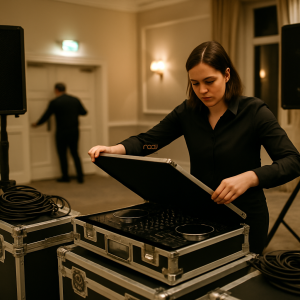
Do not forget your own time. A four-hour event can easily consume most of a day once you add travel, set-up, soundcheck and post-event breakdown. If you only price the performance time, you will undercharge almost by default.
Separate your fee from the client’s budget
One common mistake is to let a client’s budget define the value of your service. Instead, use your minimum fee as your business threshold and decide whether the booking fits your model. If a potential client cannot meet your minimum, you can offer a shorter set, a scaled-back production or a referral to another provider if appropriate. That keeps the conversation professional without immediately discounting your worth.
It may also help to build a service menu with clear options. For example, you might have a base reception package, a premium package with additional lighting, or a bespoke event package. This creates choice without moving your floor price every time someone asks for “your best price”.
Look at the market, but do not copy the cheapest quote
Research is useful, but only when it is done properly. Check what DJs in your area are offering, how experienced they are and what is included. A low quote in a directory or on a social feed may not include the same level of planning, cover or equipment that you provide. Likewise, a higher fee may reflect years of experience, specialist events or a stronger production offer.
Use comparison as context, not as instruction. The goal is not to be the cheapest DJ in the Midlands or the lowest rate in London. It is to be fairly priced for the service you deliver. That is where sustainable work comes from.
Make value visible
Clients often compare prices because they cannot see the difference between providers. Your website, profile and consultation process should show them. Explain your experience, the type of events you handle, the quality of your kit, your planning process and the standards you work to. If relevant, mention professional development, such as one of the top DJ training courses in the UK, to demonstrate ongoing investment in your craft.
It also helps to show that you operate professionally. For many bookings, clients will expect you to have suitable cover in place. If public liability insurance is relevant to your work, you can direct them to the NADJ guidance on DJ public liability insurance and cover requirements. As always, check live details and policy wording with the provider before relying on anything specific.
Do not build your business on discounting
Discounts have a place, but they should be deliberate. A short-term promotion, a quieter date, or a goodwill gesture for a repeat client is different from permanently underpricing yourself. If every quote is negotiable, your published price stops meaning anything.
Instead of random discounting, consider controlled pricing decisions: off-peak rates, weekday rates, or packaged offers with a defined scope. That keeps your pricing coherent and avoids creating expectations that you will always drop your fee when challenged.
Use NADJ resources to strengthen your position
One of the best ways to justify a fair fee is to keep improving your business. NADJ members can use the NADJ Hub for support and industry resources, explore the NADJ directory to increase visibility, and review membership tiers explained to understand the benefits of different levels of involvement.
If you are seeking more work, the gig listings area can be a useful place to monitor opportunities, while NADJ Media Ltd offers services that can help with websites, advertising, and other business support. These tools do not replace good pricing, but they can help you present a more professional offer to the market.
A practical rule for setting your floor
A sensible minimum fee should cover three things: your costs, your time and a realistic profit margin that allows the business to grow. If a booking does not cover those three areas, it is not truly profitable, even if it fills the calendar.
For many DJs, the answer is not to chase more low-value work, but to refine the work they already do. Better positioning, clearer packages and stronger client communication often lead to fewer price objections and better-quality bookings.
Final thought
Setting DJ minimum fees is not about being rigid. It is about being clear. When you know your floor, you can make better decisions, protect your standards and avoid the pressure to compete only on price. In the long run, that is better for your business, your reputation and the wider DJ community across the UK.
If you are building or reviewing your pricing model, start with what the job truly costs, then price for the service you want to deliver. That is how professional DJs move away from the bottom of the market and towards a more sustainable future.




 Avtar Thethy
 Fabio Capozzi
 Alastair Craig
 Dave Mills