

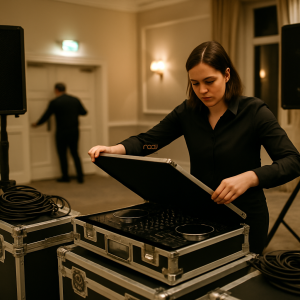
DJ load-in safety is easy to overlook until something goes wrong. For many mobile DJs across the UK, especially those working alone in England, Scotland, Wales and Northern Ireland, the load-in is one of the riskiest parts of the job. Heavy cases, awkward stairs, wet car parks, poor lighting and tight turnarounds can all increase the chance of strains, slips and knocks.
The good news is that most solo load-in injuries are preventable with better planning and safer habits. This is not about turning every job into a military operation. It is about reducing avoidable pressure on your body, protecting your equipment, and making sure you can do the job again tomorrow. As ever, if a venue setup feels unsafe, pause and assess it. If you are unsure about any health and safety duty in a specific venue, check the latest guidance and speak to the relevant site contact.
Why solo load-ins deserve more attention
When you are carrying gear on your own, you do not have a second person to steady a case, hold a door, spot a step, or help you lift if something shifts. That means the margin for error is smaller. In busy city venues in London, Manchester, Birmingham, Leeds, Bristol, Cardiff, Glasgow, Liverpool, Nottingham, Leicester and Coventry, solo access can also involve shared entrances, narrow corridors and limited parking. In the Midlands and beyond, the issue is often distance: a long walk from the car to the function room can be as demanding as the lift itself.
NADJ encourages DJs to think of load-in safety as part of professionalism, just like sound quality, punctuality and client communication. Safer loading is not only about avoiding injury. It also helps protect your kit, preserve your energy for the performance, and reduce the chance of last-minute delays.
Plan the load-in before you leave home
A safe load-in starts long before you arrive at the venue. Check the event details, the venue address and the access arrangements. If you can, ask the organiser or venue contact a few simple questions: Where should you park? Is there a lift? How many stairs are involved? Is there a side entrance? Are there any restricted access times? Does the venue have a designated unloading point?
It is also wise to look at your own kit layout. Can you split the system into smaller, manageable loads? Could you use a wheeled case, trolley or sack barrow for some items? The aim is not to carry less professionalism; it is to carry smarter. If your setup has become too heavy for safe solo handling, it may be time to rethink the case design or transport method.
Use safer lifting habits every time
Keep loads close and stable
Carry equipment close to your body where possible. Avoid twisting while lifting, and do not rush the last few metres because you are eager to get set up. Small, controlled movements are usually safer than one awkward heave.
Test the route first
If you are entering an unfamiliar venue, walk the route before you start moving gear. Look for wet patches, loose mats, low door frames, sudden level changes and blind corners. A quick check can prevent a slip or a dropped case.
Break the journey into stages
If the load-in is long, use a staged approach rather than trying to move everything in one trip. Set down items safely, return for the next load, and keep your hands free when opening doors or navigating stairs. In many cases, a few extra minutes is better than a strained back or a damaged speaker.
Watch for the common hazards
Solo DJs often face the same hazards again and again. Wet paving at the rear of a venue can be a problem in all parts of the UK, especially in winter. Poor lighting makes steps and kerbs harder to judge. Unmarked ramps can be slippery. Doors that close quickly can catch fingers or push a trolley off balance. Even a small snag, such as a cable bag slipping off your shoulder, can cause a sudden twist.
Do not assume that a venue with polished public areas will have the same standard in the service entrance or delivery route. A function room may look straightforward once you are inside, but the safest route may be different from the shortest route. If anything feels unsafe, tell the venue contact and ask whether an alternative entrance is available.
Protect your body as well as your gear
Your kit can often be replaced more easily than your back, shoulder or knee. That is why sensible kit choices matter. Consider lighter cases, better wheels, handle positions that reduce strain, and a layout that avoids unnecessary repetitive lifting. A tidy cabling and packing system can also save you from awkward rummaging while carrying other items.
Warm up before a heavy load-in, especially if you have driven a long distance or have been sat down for hours. Simple shoulder rolls, ankle movement and gentle stretches can help you feel more mobile. That said, warm-ups are not a substitute for good lifting technique or sensible load management.
When working alone, communication matters
Tell someone where you are going and when you expect to be back, particularly if you are travelling to a late-night finish or a venue in a quieter location. Keep your phone charged and accessible, not buried deep in a case. If you arrive to find access blocked, lighting poor or the entrance unsafe, do not be afraid to contact the organiser or venue and ask for support.
Professional boundaries matter here too. If a client has booked a solo setup, that does not mean you must accept unsafe conditions. Being calm, clear and factual is usually the best approach. If the load-in needs assistance, say so early. It is better to delay setup slightly than to risk injury.
Insurance, membership and support
Many DJs review Public Liability Insurance as part of their wider business planning. NADJ’s guidance on DJ Public Liability Insurance in the UK may help you understand what to check, but always confirm live policy terms with your own provider. Likewise, membership can give DJs a useful framework for professionalism, community and development; see membership tiers explained for more detail.
If you are reviewing what you charge for jobs that involve difficult access, long carries or late-night solo loading, it is sensible to look at your overall pricing model too. Our guide on DJ rates and pricing in the UK may help you think through the commercial side of that decision. For more community resources, the NADJ directory, NADJ Hub and gig listings can also be useful starting points. NADJ and NADJ Media Ltd continue to support DJs with services and information designed to strengthen the trade overall, including business support through nadj.co.uk.
Final thought
DJ load-in safety is not a side issue. It is a practical part of being a reliable working DJ. If you make safer choices on every job, you reduce the chance of injury, protect your kit and stay in the game for longer. In a profession that depends on consistency, that is a worthwhile investment.




 Avtar Thethy
 Fabio Capozzi
 Alastair Craig
 Dave Mills