
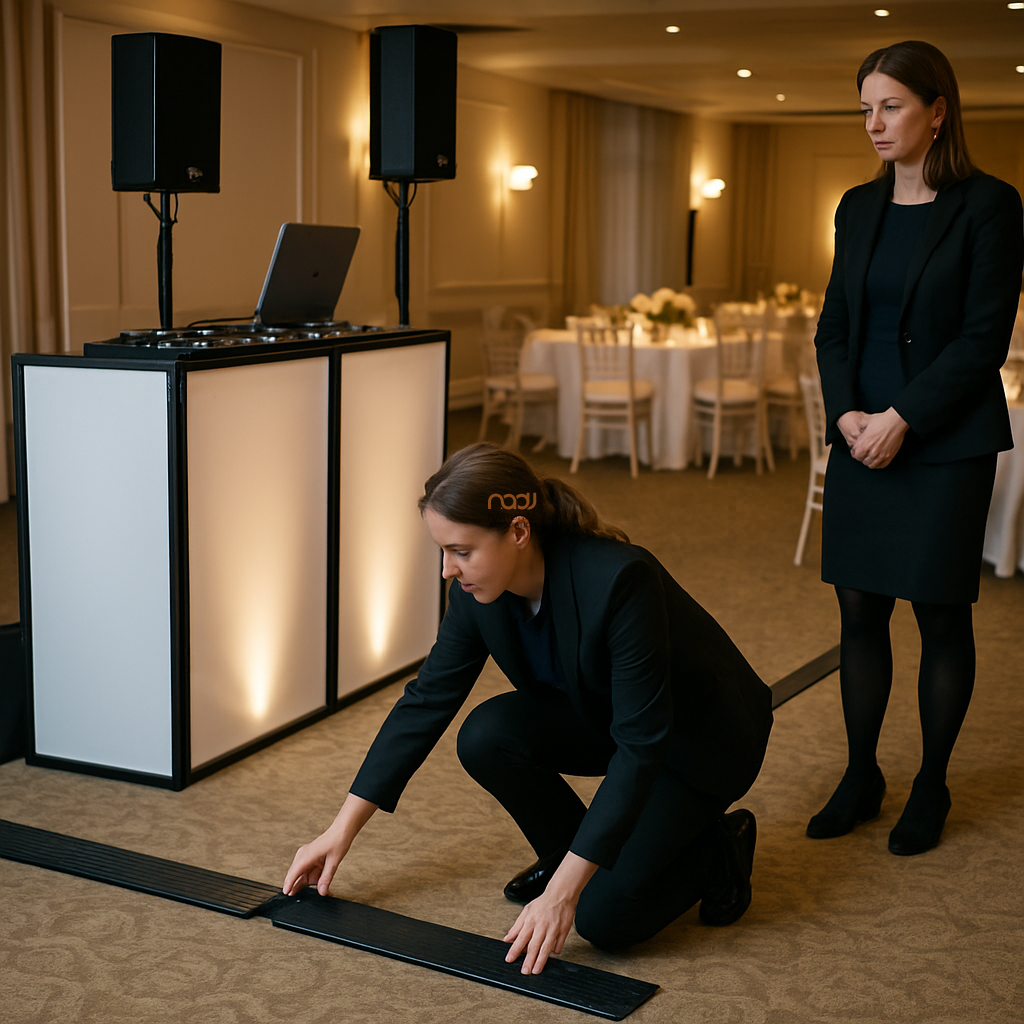
For mobile DJs, the safe use of cable ramps is one of those small habits that can make a big difference. At weddings and corporate events, especially in busy venues across the UK, cable protection helps reduce trip risks, keeps mains and signal leads tidier, and supports a more professional setup. However, a ramp only does its job if it is suitable for the cables being run, placed sensibly, and checked before guests arrive.
NADJ encourages working DJs to think of cable ramps as part of a wider safe working routine, alongside sensible planning, tidy cabling, suitable insurance arrangements, and clear communication with venue staff. If you are also reviewing your wider professionalism, it can be worth looking at NADJ membership tiers explained, our public liability insurance guidance, and the support available through the NADJ Hub.
Why cable ramps matter at weddings and corporate events
Wedding receptions, award nights, Christmas parties and conference socials often involve guests moving unpredictably around a room. Children may be running about, staff may be carrying glasses, and people may be focused on the dancefloor rather than the floor itself. In that environment, an unprotected cable run can become a hazard very quickly.
Cable ramps are not just for large productions. A compact mobile DJ rig can still create a route across a doorway, along a wall edge, or between the DJ position and a lighting bar. Even a single visible lead can present a problem if it sits in a walkway or if floor surfaces change from carpet to wood, or from stage to dancefloor.
Choosing the right ramp for the job
Not every ramp suits every event. Before you buy or deploy one, consider the following:
1. Cable size and quantity
Check the internal channel dimensions. A ramp that suits one IEC lead may not comfortably take multiple mains cables, DMX, audio and network lines. Forcing cables into a channel can damage the jacket, reduce protection, and make the cover sit improperly.
2. Footfall and load
Think about the likely traffic. A small private party in a village hall in the Midlands is different from a busy corporate drinks reception in London. The more people crossing the ramp, the more important the profile, stability and grip become.
3. Surface compatibility
Some ramps perform better on hard floors, while others are more suitable for carpets or temporary event flooring. Always assess whether the ramp sits flat and whether any edge creates a lip that could catch a shoe, case or trolley.
4. Event style
At weddings, appearance matters, so a neat, low-profile ramp may be preferable where it can be used safely. At corporate events, visual tidiness and unobstructed access are often just as important, particularly in hospitality spaces and exhibition-style venues in places like Manchester, Birmingham, Leeds, Bristol, Cardiff, Glasgow, Liverpool, Nottingham, Leicester and Coventry.
How to position cable ramps safely
Placement is just as important as the ramp itself. The best ramp in the world will not help if it is put across a route people must use frequently, or if it creates a pinch point near a doorway.
As a general rule, run cables along walls, behind barriers, or out of the main pedestrian flow wherever possible. Use ramps where a crossing cannot be avoided. Avoid placing them where guests are likely to queue, where service staff need to pass repeatedly, or where they could be covered by décor, draping or furniture.
At weddings, check with the venue team before positioning anything on a dancefloor entrance or near the top table area. At corporate functions, ask whether the room layout is likely to change during the evening. A ramp that is safe at sound-check may become a problem once tables are moved or the room fills up.
Inspection and maintenance before every event
Cable ramps should be treated as working safety equipment. Before each use, inspect them for cracks, worn hinges, damaged lids, missing anti-slip sections and contamination such as spilled drinks or loose debris. A ramp that rocks, lifts at the edge, or no longer closes properly should be removed from service until repaired or replaced.
It is also sensible to check the cables inside. If the lead is twisted, crushed or undersized for the channel, the ramp may not close fully. That can create both a trip hazard and unnecessary strain on the cable itself.
Keep a simple pre-event checklist. Many DJs already do this for audio and lighting kit; cable management should be part of the same process. If you need other gear guidance, you may also find our article on top DJ headphones for professional mobile DJs useful when reviewing your wider setup.
Working with venues and event teams
Good communication avoids problems. Let the venue know where you intend to run cables and ask whether they have preferred routes, access restrictions or floor protection rules. Some venues will have their own cable protection solutions already in place, while others may require you to use specific products or to leave certain walkways clear.
For larger corporate bookings, it is sensible to coordinate with AV teams, caterers and event managers. A DJ setup that looks safe in isolation may become compromised once another contractor adds a power run or a staging element nearby. Clear planning is especially important at multi-use venues common across England, Scotland, Wales and Northern Ireland.
Common mistakes DJs should avoid
There are a few recurring errors that can undermine even careful setups:
- Using a ramp that is too narrow for the cables inside it.
- Leaving a ramp where guests will step on and off it from different angles.
- Failing to test whether the lid closes properly after the cables are laid.
- Assuming carpet hides a hazard; in practice, guests still trip over raised edges.
- Letting power and signal leads cross without a clear, protected plan.
The key principle is simple: if the route can be made safer without creating a new hazard, do so. If a ramp makes the space more cluttered or unstable, rethink the cable route instead.
A professional habit that supports safer events
The safe use of cable ramps is part of the standard expected from a working DJ. It shows attention to detail, respect for the venue, and consideration for guests and staff. It also supports the kind of professional approach NADJ promotes across the UK DJ industry, whether you are working from the directory, seeking bookings through the NADJ directory or browsing gig listings, or building your business presence via NADJ Media Ltd.
As always, check current venue requirements, product instructions and any relevant health and safety guidance before each event. This article is practical guidance only and is not a substitute for site-specific risk assessment or professional advice where needed. Used properly, cable ramps are a straightforward tool that can help you deliver smoother, safer weddings and corporate events in every part of the UK.
AI transparency note
NADJ uses artificial intelligence as an editorial assistant. Articles produced through this publisher begin with a human-selected idea, source, brief or editorial direction, and AI may be used to research, structure, draft or improve the wording. AI does not set NADJ editorial policy or operate free-range: people acting for NADJ set the instructions and publishing framework, monitor the output and retain editorial responsibility.
Images used by NADJ may include stock photography or AI-generated visuals where appropriate. NADJ is volunteer-led and editorial time is limited; much of our available time is currently absorbed by governance and management, a substantial data audit and membership-system transfer, and planning 12 Tea & Test days across the UK. You can help strengthen member-led content by sending article ideas or completed submissions to hello@nadj.org.uk.









 Avtar Thethy
 Fabio Capozzi
 Alastair Craig
 Dave Mills