
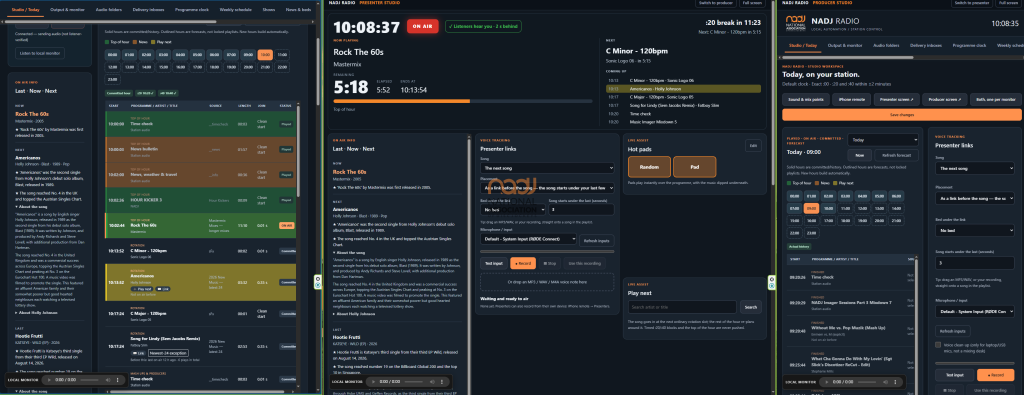
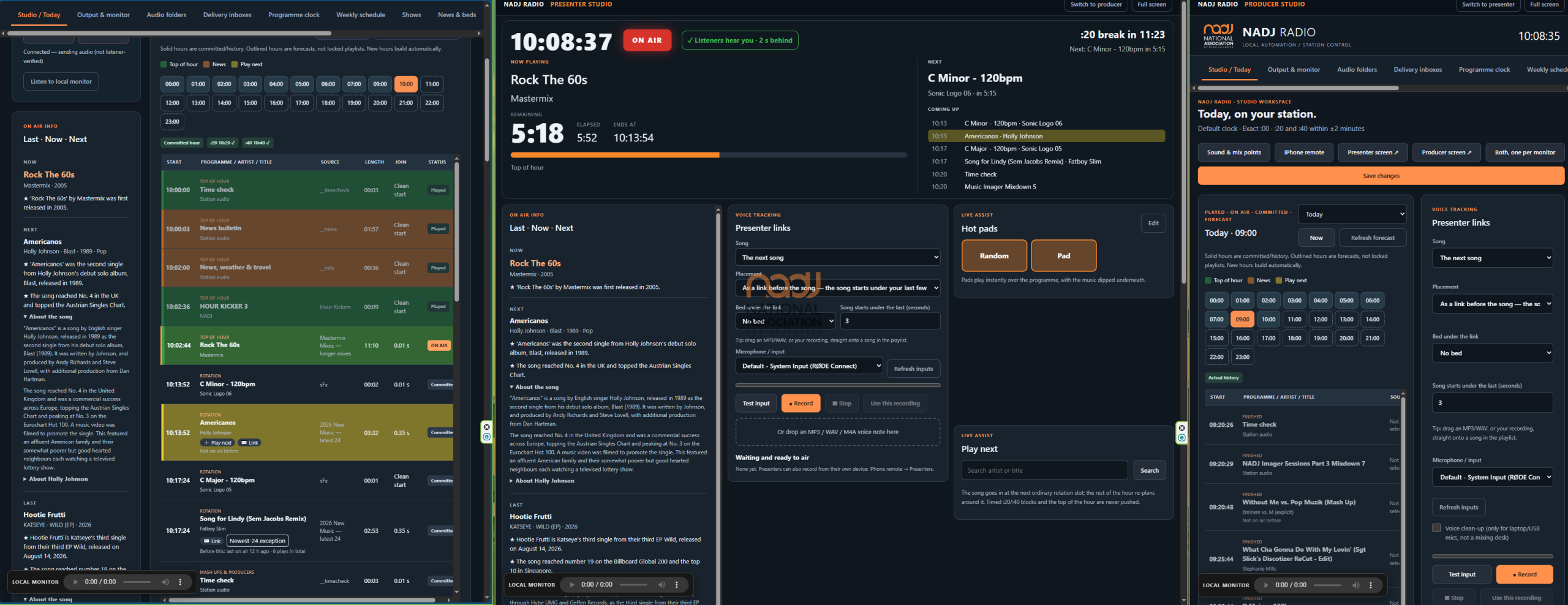
NADJ Radio now runs on playout software we built ourselves, built and tested around how a DJ association’s station actually works. It replaces an estimated £400 a month of subscriptions and paid services, and takes most of the admin off our hands.
Why radio matters to us
Radio is where a lot of DJ careers started, and it is still the one place where a DJ’s craft is heard live, in full, by people who did not book them. For a DJ association, a station is not a side project. It is the shop window.
- It showcases our members. Every hour carries a member mix at :40, and specialist and presenter shows give members real airtime, with their name on it.
- It is our voice. NADJ news is read on air at :20, and station promos tell listeners what NADJ does and why DJs should join.
- It is a training ground. Members can learn to present, voice-track and build a show on a real station, without needing a studio or a licence of their own.
- It can reach people our emails do not. Couples planning a wedding, venue managers and new DJs hear about NADJ and the NADJ directory while they listen.
- It gives back. As a not-for-profit community interest company, what we save on running costs goes back into members and the industry.
The problem we were solving
Running a station properly meant paying for several separate services and doing a lot of the work by hand. Commercial playout suites that do everything we needed cost upwards of £300 a month, and we previously paid around £100 a month just for show logs and automatic Mixcloud publishing.
Even then, the gaps were obvious:
- Our clock is unusual. A mix at the top of the hour, mash-ups and producer edits at :20, a member mix at :40. Long mixes did not fit their segments, and off-the-shelf rotation filled the hour with the wrong thing.
- Too much admin. Cutting supplier examples off imaging packages, building playlists for specialist shows, pulling logs for returns, recording and uploading shows: all by hand, every week.
- Dead air and tired segues. Gaps at the ends of songs, flat transitions, and the same songs turning up at the same time each day.
- No real presenter tools. Presenters could not log in, voice-track their own links from home or prepare their own shows.
- Listeners hear us late. The public stream runs 30 to 60 seconds behind the studio, so the top-of-the-hour time check was never on the hour for listeners.
So we built our own.
An hour on NADJ Radio
Hour kicker and time check, News, weather and travel, Mastermix mix
A long mix fades at the :20 windowMash-ups and producers
NADJ articles read first, Mash-ups and producer edits, Rotation with imagers
Latest 24 plus the library
Member mix
Advert break, A mix from an NADJ member, Rotation to the hour
Between songs, all hour: presenter links, station promos, voice tracks and requests
Music, mixes and the clock
The heart of the platform is a scheduler built around our :00, :20 and :40 clock rather than a generic one. Each segment starts on time, and everything between the junctions is filled intelligently.
- Segments stay 20 minutes. A mix that fits its segment plays in full. A longer mix plays up to the next junction’s window, then fades out, so the clock never slips.
- Newest music, fairly. A “latest 24” category keeps new releases on air without flooding it, and the rest of the rotation comes from the wider library.
- Proper separation. The same song and the same artist are kept apart (seven hours by default). The scheduler also avoids playing the same song at the same time as yesterday, so the station never sounds like a loop.
- Tight segues. Every track is analysed for where it really starts and ends, so songs mix into each other at the right point, with the next track coming in with impact rather than after a gap.
- Plain-English warnings. If a folder is empty or a mix cannot fit, the platform says so in plain words, not error codes.
- Listen before it airs. Any hour can be built and auditioned locally, through the same scheduler and mix points, without touching the live station.
- Delivery inboxes and folder watching. New music, mixes and adverts dropped into their folders are checked, imported and scheduled automatically.
The Audio folders page now has a jump menu with a link to every folder, so finding one section in a large library takes one click.
Voices, news, links and promos
The station speaks for itself between records, using AI voices with a British accent. One OpenAI key covers the voices, the wording and the track facts. This is deployed when s human is not available.
- A voice team. Several AI voices take turns: the news reader changes each hour, the NADJ articles are read by another voice, and presenter links rotate, so the station sounds like a team rather than one robot.
- Live time checks. Every minute of the day is pre-recorded once, so a time check always says the right time, to the second.
- News, weather and travel. A bulletin at the top of the hour, UK weather, and motorway travel from National Highways, read over a music bed. If a feed is down, the text is shown in the studio so a presenter can read it.
- NADJ articles at :20. The latest stories from nadj.org.uk are read as headlines at the start of the :20 break, ending with “to read the full story, head over to nadj.org.uk”.
- Presenter links. Between songs, a short link back-announces the last track and introduces the next, written by AI from real facts only. On the day, it mentions an artist’s birthday or a song’s anniversary.
- Station promos. Short messages about joining NADJ, the NADJ directory, free youth membership and the training hub, read over a bed and spread through the hour. The next song starts under the last words.
- Pronunciation control. NADJ is always said as N-A-D-J, and web addresses are read out properly.
Presenters, specialist shows, recordings and Mixcloud
This is where the platform opens the station up to members.
- Presenter logins. Each presenter has their own name and password, and signs in from a phone or laptop over a private link.
- Voice tracking from anywhere. Presenters choose their microphone, record a link, listen back and send it. It can play over a song’s intro, or before the song with a bed underneath and the song starting under the last few seconds. Links can be recorded up to four weeks ahead.
- Specialist shows. A show owns its hours each week, such as a Motown Hour on Saturdays at 8pm. The station clock stays, but every music slot comes from the show’s music, filtered by genre, artist or years.
- Shows prepare themselves. Each airing’s playlist is built a week ahead. The show’s presenters can swap, reorder, remove or add songs, and the station plays their order. If nobody touches it, the prepared playlist airs.
- Locked to the right people. Only a show’s own presenters can edit it, and it locks two hours before air. The producer can still change anything.
- Recorded automatically. Every show is recorded from exactly what went to air, with a timed tracklist of what actually played.
- Published to Mixcloud. After the show ends, the recording uploads to Mixcloud with its name, description, tags and tracklist, which Mixcloud needs for licensing.
- Two screens. A presenter screen shows the clock, what’s on and what’s next, track facts and the voice-tracking tools. A producer screen holds every setting, the playlist, voice tracking and the station checks.
Listeners, the website, requests and track info
The station and nadj.org.uk now work as one.
- Now playing on the website. Last, now and next are pushed to nadj.org.uk as each song changes, with the year, album and a fact about the track.
- Real track information. For every song, the studio shows the album and year from MusicBrainz, the song’s own Wikipedia article (release, chart positions, the story behind it), the artist’s full biography, AI-written trivia and upcoming UK tour dates found on the web.
- Requests and dedications. Listeners send a request and a message through a form on the website. It arrives in the studio already matched to the library, and a presenter plays it next, with or without the dedication read out. Nothing airs without someone pressing a button, and the form has spam protection built in.
- Show logs. Every song that went out while broadcasting can be downloaded as a spreadsheet for any date range, play by play or as totals per song, ready for PRS and PPL returns.
Imaging, reliability and checking what listeners hear
The last group of features covers the things nobody notices until they go wrong.
- Imaging packages prepared automatically. Point the platform at a supplier package such as ASX Popcore and it finds every version inside each file, sets the supplier’s example aside, splits multi-part files and writes a ready-to-use copy, leaving the originals untouched.
- Dry vox married to imagers. A random dry vox can play over an imager, landing its last word on the imager’s hit. The hit point is set by ear on a waveform in the library, and any pairing can be auditioned before it airs.
- Hot pads. One-touch drops and stabs, including a pad that plays a different dry vox each press.
- Public stream check. Every ten minutes, the platform listens to the public RadioKing stream and compares it with what the studio sent. It confirms listeners are hearing us, how far behind they are, whether they had drop-outs, and what title RadioKing shows.
- Listener delay compensation. The station runs slightly ahead of the clock by the delay listeners actually have. Corrections are made gently before the top of the hour, so the pips and time check land on the hour for listeners.
- Keeps playing on its own. It starts when the PC starts, keeps playing when nobody is signed in, and restarts itself if it ever stops. The producer can also control it from a phone.
- Plain-English diagnostics. A single test button checks every online service the platform uses and says exactly what each one answered.
What it saves
About £400 a month, or roughly £4,800 a year, compared with buying the same capability, before counting the hours of admin it removes.
| What | Before | Now | Saving per month |
|---|---|---|---|
| Playout and automation suite | Commercial software, estimated £300+ a month for these features | Our own platform | £300+ |
| Show logs and Mixcloud publishing | Paid service, about £100 a month | Built in: recordings, tracklists, music logs, automatic upload | £100 |
| Imaging edits | Cutting supplier examples by hand | Prepared automatically | Staff time |
| Show playlists, logs and uploads | Built by hand each week | Prepared, logged and published automatically | Staff time |
The running costs that remain are small: the RadioKing stream we broadcast through, and pay-as-you-go OpenAI usage for the voices, links and track facts, all on one key. Every pound saved goes back into NADJ’s work for its members.
What’s next, and how to get involved
NADJ Radio is built and tested, and it is ours: when members ask for something, we can add it, rather than waiting for a supplier.
- Want your own show? Members can present specialist shows, prepare their own playlists and voice-track from home. Get in touch through nadj.org.uk.
- Send us your mixes. Member mixes air every hour at :40.
- Request a song or send a dedication through the form on nadj.org.uk.
Not a member yet? Join the UK’s not-for-profit association for DJs at nadj.org.uk, from the bedroom to the main room.
Listen to NADJ Radio | Supported by WD82 Ltd









 Avtar Thethy
 Fabio Capozzi
 Alastair Craig
 Dave Mills