
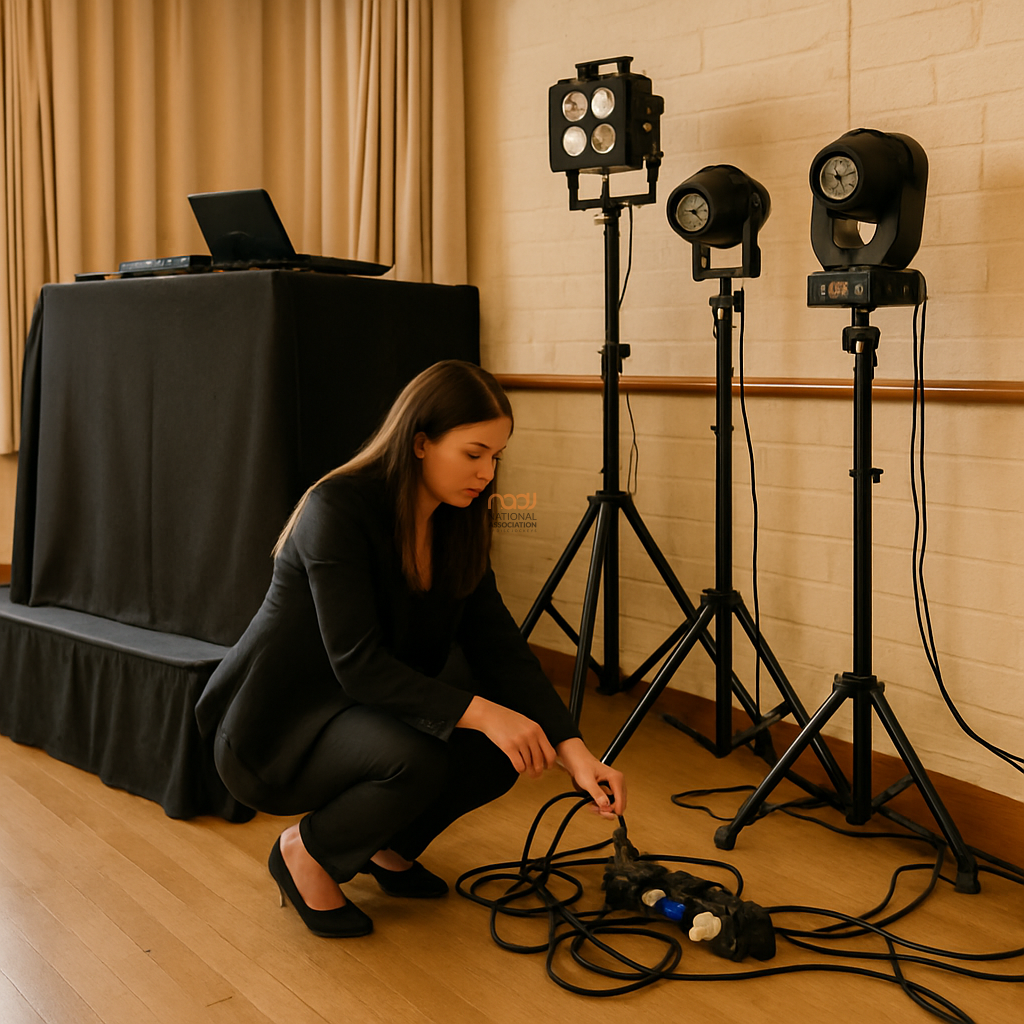
Electrical load planning for DJs matters every time you travel with multiple lighting fixtures. Whether you are working in London, Manchester, Birmingham, Leeds, Bristol, Cardiff, Glasgow, Liverpool, Nottingham, Leicester, Coventry or elsewhere across the UK, the basic challenge is the same: you need enough power for your lights, controllers and ancillary kit without overloading the venue supply. Good planning helps keep your setup reliable, reduces avoidable faults and makes you easier to work with.
For mobile DJs, this is not just a technical detail. It affects arrival times, rig choice, cable management and how confidently you can accept a booking. In practical terms, a thoughtful approach to electrical load planning for DJs can save time on site and reduce the chance of dimmed lights, tripped sockets or last-minute compromises.
Start with the full load, not just the headline wattage
The first mistake DJs make is looking only at the sticker on the back of a fixture. That number may not reflect the real-world draw in use. Some lighting fixtures have a maximum rating, while others vary depending on output mode, movement, colour mix or strobe use. In addition, power supply units, smoke effects, controllers, charging docks and laptop chargers all add to the total.
A sensible approach is to list every item you plan to power and record its rated consumption. If the fixture is designed to link power through to the next unit, note whether that is permitted by the manufacturer and under what limits. Do not assume that because a fixture has a power out socket, it is safe to link several units together indefinitely.
Use a simple power budget
Before a gig, work out a basic power budget. Add together the wattage of each fixture and divide by the supply voltage to estimate current draw. In the UK, mains power is typically 230V, but venue circuits and extension leads still have their own limits, so the headline calculation is only the beginning.
For example, a lighting rig with six moving heads, two uplighters and a small haze machine may look manageable on paper, but in practice the start-up surge and uneven distribution across sockets can still cause issues. That is why it helps to leave headroom rather than planning to use the full theoretical capacity of a circuit.
Allow margin for start-up and variation
Some fixtures draw more at switch-on than they do once running. Others behave differently when motors move, fans speed up or effects intensify. As a rule, build in a sensible margin and avoid treating the advertised rating as a target to reach. The exact margin will depend on the kit and the venue, so there is no one-size-fits-all figure. If in doubt, be conservative.
Split the load across circuits properly
Many venues in England, Scotland, Wales and Northern Ireland will offer more than one socket, but not every socket is on a separate circuit. This is particularly relevant in village halls, hotel function rooms, pubs and community spaces. Two sockets on opposite walls may still share the same breaker.
Ask the venue contact what they know about the supply, and if you are unsure, treat the available sockets as a limited resource. Spread high-demand items across circuits where appropriate, and keep lighting separate from audio where practical. That way, a problem with one circuit is less likely to stop the whole show.
Keep cabling and distribution tidy
Electrical load planning for DJs is also about how you distribute power. A neat setup is not only easier to troubleshoot, it also reduces trip hazards and accidental disconnection. Use properly rated extension leads, avoid daisy-chaining unsuitable adaptors, and check that your cables are in good condition before every event.
If your setup includes multiple stands, truss sections or floor effects, plan where cables will run before you begin building. In busy rooms, especially at weddings and corporate functions, the safest route is not always the shortest one. A slightly longer cable run is usually preferable to a lead crossing a doorway or dancefloor edge.
Match the rig to the venue size
A compact setup may be enough for a small room in Nottingham or Leicester, while a larger event in Birmingham or Glasgow may justify more fixtures and a higher power demand. The key is to match the visual impact to the room without overspecifying the rig. More lights do not always mean better results if they create power complications or clutter the space.
If you regularly work different venue sizes, consider building tiered packages. A smaller package can use fewer fixtures and simpler distribution, while a larger package can be planned around known power availability. This helps with quoting, transport and setup consistency.
Check manufacturer guidance and keep records
Where possible, keep a simple record of each fixture’s power requirements, recommended linking limits and any notes about behaviour in operation. Manufacturer manuals are the best source for this information. If specifications are unclear, contact the supplier or check the latest documentation rather than relying on forum advice or memory.
This is also where good business discipline matters. NADJ members often benefit from having structured systems for equipment management, and if you need wider business support, resources at NADJ Hub and services from NADJ Media Ltd may be useful alongside your own operational procedures.
Why electrical planning supports professionalism
Clients rarely ask how many amps your lighting rig uses, but they do notice reliability. A DJ who arrives prepared, sets up neatly and avoids power-related interruptions builds trust quickly. Good electrical planning also supports other professional standards, including safe working practice and sensible equipment maintenance.
If you are reviewing your wider business setup, it can be worth looking at related NADJ guidance on DJ public liability insurance, membership tiers and the NADJ directory. You can also explore gig listings if you are looking for work, or read the latest updates via the Hub.
Final checks before every event
Before you leave for a booking, confirm three things: first, that your total planned load is realistic; second, that you have enough suitable power distribution for the venue; and third, that your cables and fixtures are in safe working order. If the venue layout changes when you arrive, be ready to adapt.
Electrical load planning for DJs is not about making your rig smaller than necessary. It is about making informed choices, using the available supply responsibly and presenting yourself as a prepared professional. That approach serves DJs well across the UK, from small local functions to busy city-centre events.
Caveat: venue power conditions can vary, and electrical guidance should always be checked against current manufacturer instructions, venue information and any applicable professional advice. If you are uncertain, reduce the load and seek a qualified opinion.
AI transparency note
NADJ uses artificial intelligence as an editorial assistant. Articles produced through this publisher begin with a human-selected idea, source, brief or editorial direction, and AI may be used to research, structure, draft or improve the wording. AI does not set NADJ editorial policy or operate free-range: people acting for NADJ set the instructions and publishing framework, monitor the output and retain editorial responsibility.
Images used by NADJ may include stock photography or AI-generated visuals where appropriate. NADJ is volunteer-led and editorial time is limited; much of our available time is currently absorbed by governance and management, a substantial data audit and membership-system transfer, and planning 12 Tea & Test days across the UK. You can help strengthen member-led content by sending article ideas or completed submissions to hello@nadj.org.uk.









 Avtar Thethy
 Fabio Capozzi
 Alastair Craig
 Dave Mills