
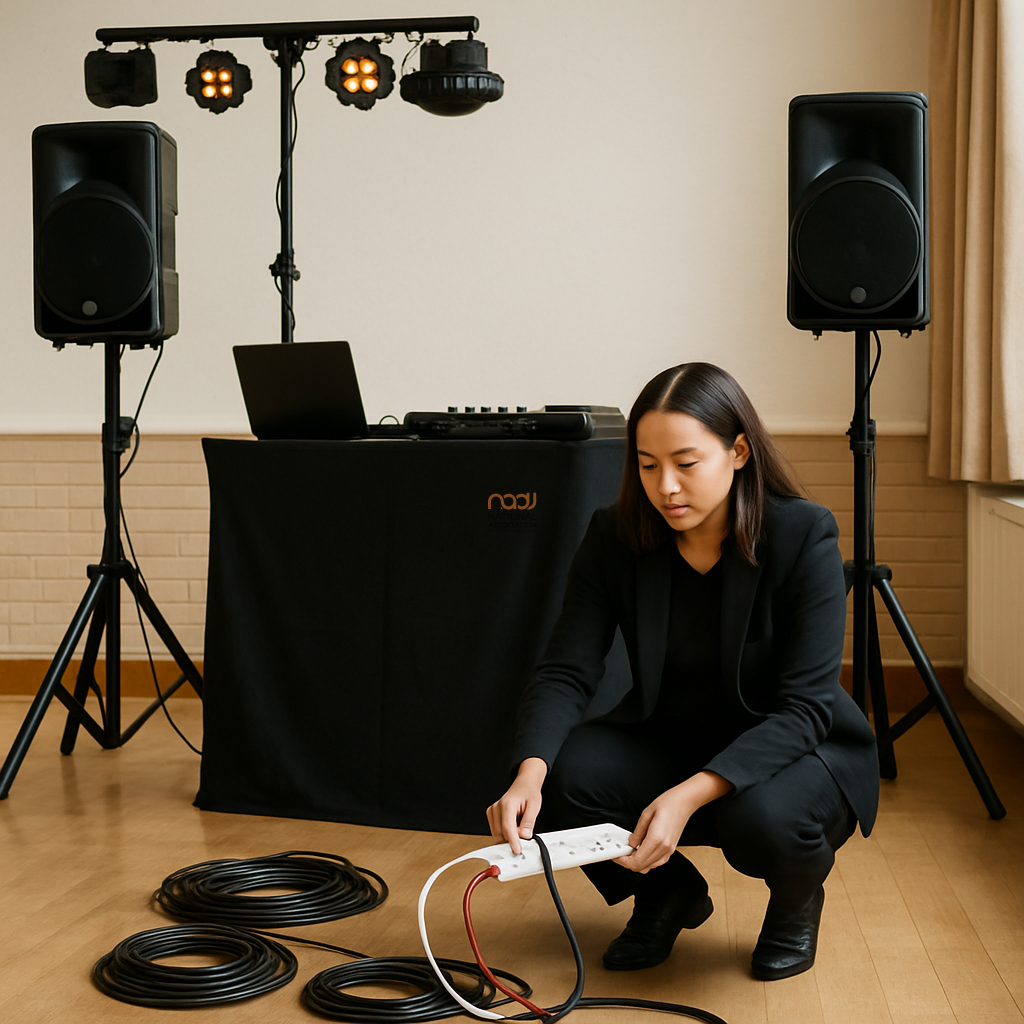
Choosing the right extension leads for professional DJ use is a basic part of building a reliable rig, yet it is easy to get wrong. For mobile DJs working across the UK, from London hotels to village halls in Wales, from club nights in Manchester and Birmingham to weddings in Scotland and Northern Ireland, the wrong lead can mean nuisance trips, voltage drop, overheating or simply an awkward setup on the floor.
At NADJ, we encourage DJs to treat power distribution as part of their core setup, not an afterthought. The goal is simple: choose leads that are suitable for the load, long enough for the venue, and robust enough for repeated professional use.
Start with the actual load, not the guesswork
The first step is understanding what you will plug in. A typical mobile DJ setup may include a controller or mixer, laptop, active speakers, lighting effects, uplighters, screens, chargers and possibly a small accessory hub. Each item draws a different amount of current, and the total matters.
Many DJs assume that because each item seems modest on its own, any extension lead will do. In practice, you should add up the expected demand and allow a sensible margin. A lead that is technically “long enough” may still be unsuitable if it is carrying too much current for its design.
As a general rule, professional DJs should avoid daisy-chaining multiple lightweight household leads together. That may be tempting in a hurry, but it often creates clutter, weak points and unnecessary heat at the connections.
Cable size: why it matters
Cable size, often expressed as the cross-sectional area of the conductor, affects how much current the lead can safely carry and how much voltage drop occurs over distance. For DJ work, this is not just a technical detail. It directly affects how stable your equipment behaves when the bass hits, the lights switch, or multiple devices power up at once.
Common UK guidance in practice
Many professional extension leads for portable audio use are built with thicker cable than domestic reels. As a broad practical guide, 1.25mm² cable may be acceptable for lighter-duty use, but 1.5mm² or 2.5mm² cable is often a better choice for professional DJ applications, particularly where the lead is longer, the load is heavier, or the gear is used regularly.
However, there is no single “one-size-fits-all” answer. You should always check the manufacturer’s specification for the lead, the plug, the socket block and any distribution unit you use. Ratings can differ, and the weakest component in the chain determines the limit.
Lead length: choose enough, but not too much
Length is another key factor. A longer lead is not automatically better. While extra reach is useful in large venues, a very long cable can be harder to manage, more prone to tangles and more likely to create voltage drop, especially if the cable is thin or the load is close to its maximum.
For many DJ jobs in England, Scotland, Wales and Northern Ireland, a sensible mix is often more effective than carrying one oversized reel for every situation. For example, a short lead may be ideal for a compact bar setup in Leeds or Nottingham, while a longer but still suitably rated lead may be necessary in a function room in Cardiff, Glasgow or Coventry where sockets are awkwardly placed.
Always measure the route from the socket to the position of your rig, then add enough slack for safe dressing and movement. Avoid stretching a lead tight across a room. If you need to cross a walkway, use proper cable protection where appropriate and make sure the route does not create a trip hazard.
Reel or fixed lead?
Both can work well if they are selected properly. A reel is useful because it is versatile and easy to store, but there is an important caveat: some reels have a reduced current rating when the cable is not fully uncoiled. Heat can build up if you run a heavy load while the drum is still tightly wound. Check the reel’s instructions and, if in doubt, unwind it fully before use.
Fixed-length extension leads are often neater for DJ booths, especially where you regularly work in similar-sized venues such as hotels, community halls or private hire spaces. They can also be easier to inspect because there is no drum mechanism to manage.
Look at plugs, sockets and build quality
Professional use calls for better-than-basic construction. Inspect the plug top, socket faces, strain relief and cable sheath. The lead should feel solid, not flimsy. Sockets should grip plugs securely, and the cable should be flexible enough to handle transport without cracking or stiffening excessively.
It is also worth looking for features that help in real-world DJ use: illuminated switches where appropriate, decent spacing between sockets for larger plugs and a robust outer jacket that can survive being packed and unpacked every weekend.
If you are buying equipment from a supplier, compare products rather than assuming that the cheapest option is adequate. In the long run, dependable leads are part of your working kit, just like your cases, stands and audio cables.
Practical setup advice for working DJs
Good power management starts before the first guest arrives. Keep mains leads separate from audio signal cables where possible, coil them correctly after each job, and inspect them regularly for nicks, crushed sections or heat damage. If a lead looks suspect, take it out of service until it has been checked by a competent person.
It is also sensible to label leads by length or use case. For example, you may want a short lead for console-to-power-distro use and a longer one for ballroom or marquee jobs. That saves time when loading out in a hurry after weddings, birthdays and corporate events across Birmingham, Bristol, Liverpool or the Midlands.
For DJs building a more structured business, this is part of the broader professionalism that clients notice. Presentation, reliability and good preparation all matter. If you are also reviewing your public-facing setup, our guides on top DJ headphones for professional mobile DJs, DJ public liability insurance and NADJ membership tiers may also be useful.
What to check before every gig
- Is the lead long enough without being unnecessarily excessive?
- Does the cable size suit the expected load?
- Are the plugs, sockets and reel in good condition?
- Is the lead fully unwound if the manufacturer requires it?
- Are there any trip hazards or crushed sections in the cable route?
- Do all connected items fall within the lead’s rated capacity?
Final thoughts
Choosing extension leads for professional DJ use is really about balancing length, load and cable size with the realities of working events. The right lead should be safe, practical and built for repeated use. If you are unsure, check the manufacturer’s data and seek advice from a competent electrician or qualified technician.
At NADJ, we want members and the wider UK DJ community to work safely and confidently, whether they are on the road in London, Manchester, Leeds, Glasgow or Belfast, or serving local clients through our DJ directory, gig listings and member resources at NADJ Hub. If you are considering joining, take a look at NADJ and see how membership can support your business journey.
AI transparency note
NADJ uses artificial intelligence as an editorial assistant. Articles produced through this publisher begin with a human-selected idea, source, brief or editorial direction, and AI may be used to research, structure, draft or improve the wording. AI does not set NADJ editorial policy or operate free-range: people acting for NADJ set the instructions and publishing framework, monitor the output and retain editorial responsibility.
Images used by NADJ may include stock photography or AI-generated visuals where appropriate. NADJ is volunteer-led and editorial time is limited; much of our available time is currently absorbed by governance and management, a substantial data audit and membership-system transfer, and planning 12 Tea & Test days across the UK. You can help strengthen member-led content by sending article ideas or completed submissions to hello@nadj.org.uk.









 Avtar Thethy
 Fabio Capozzi
 Alastair Craig
 Dave Mills