
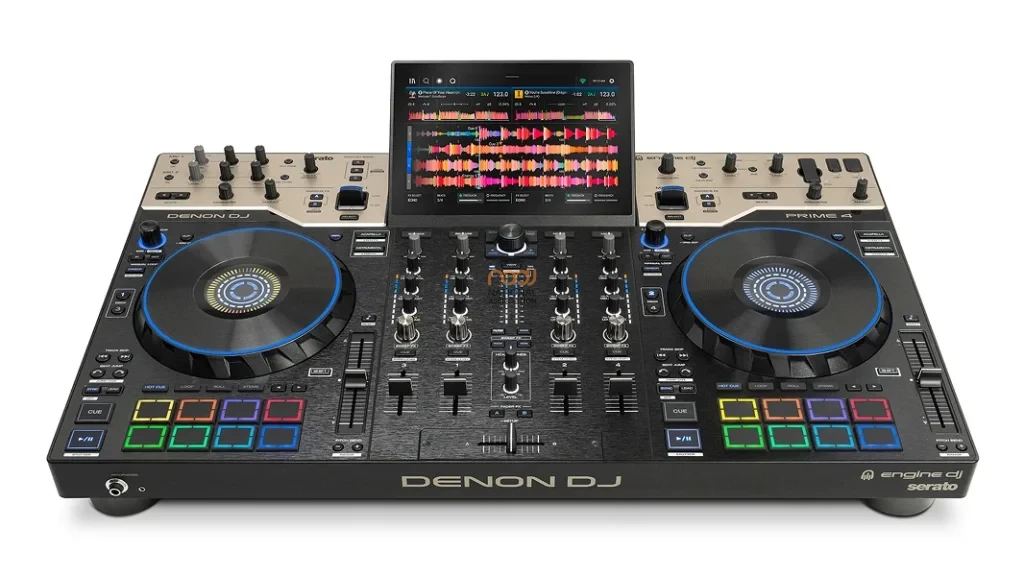
Denon DJ has officially launched the PRIME 4 G2, ending the speculation caused by leaked photographs and a retailer page that briefly appeared before being removed. Priced at £2,299 in the UK, $2,599 in the United States and €2,699 in Europe, this is not another cosmetic PRIME 4 refresh. It introduces substantially more processing power, onboard Stems rendering, larger jog wheels, expressive MPCe pads and built-in DMX control.
The original PRIME 4 established Denon’s four-deck standalone format in 2019. The PRIME 4+ followed in 2023, but was fundamentally an updated version of the same platform. The G2 is the first model that feels like a proper generational replacement.
Does the PRIME 4 G2 have live Stems?
Yes – and this is the most important distinction between the G2 and its predecessors.
The PRIME 4 G2 can render Stems directly on the hardware, either in advance or “on the fly”, without using Engine DJ Desktop. Once rendered, the DJ can isolate and manipulate parts of the track during a performance using dedicated Instrumental and Acapella buttons, Stems pad modes, Stem FX and Stem Level EQ.
That is markedly different from the current PRIME 4 and PRIME 4+ implementation. Those players can perform with Stems, but the tracks must first be rendered in Engine DJ Desktop and exported to the drive. In other words, Stems control happens on the older hardware, but the separation itself does not.
There is an important qualification. “On-the-fly rendering” should not automatically be read as instantaneous separation at the exact moment a track is loaded. Denon says the G2 renders the track onboard and then allows its elements to be manipulated live. Independent testing is still needed to establish rendering speed, audio quality and whether streamed tracks can be rendered. Denon’s launch material does not clearly promise Stems rendering from every streaming service.
Nevertheless, this is the live, computer-free Stems capability many PRIME users wanted. Its inclusion prevents the G2 from being the disappointment it would have been without it.
PRIME 4 G2 processing and performance
Inside the G2 is an eight-core ARM processor with 4GB of RAM. Denon claims four times the processing power of the previous generation, intended to deliver faster library navigation, onboard Stems rendering and smoother overall performance.
The main display remains a 10.1-inch, 1280 × 800 multi-touch screen, although the G2 version is optically bonded. The jog wheels grow from six inches to full-size eight-inch platters, with dynamic displays showing track and Stems information.
The physical performance controls have also been reworked. There are still 16 pads in total, but the new velocity- and pressure-sensitive MPCe pads use multi-zone 3D sensing. Different areas of an individual pad can control Hot Cues, Stems, Rolls, effects and lighting parameters, creating considerably more control without adding rows of buttons.
Other additions include premium dual-rail faders, dual FX toggle switches, Favourite FX buttons, Fade FX controls, dedicated Playlist Bank buttons and a new multi-function navigation encoder.
Built-in DMX is a major mobile-DJ improvement
The PRIME 4 and PRIME 4+ already run Engine Lighting, but controlling conventional DMX fixtures requires a compatible SoundSwitch interface or controller. The G2 adds an isolated three-pin DMX output directly to the rear panel.
That built-in connection provides one DMX universe with 512 channels. DJs needing more can still connect a SoundSwitch DMX Micro or Control One for up to two universes and 1,024 channels. Philips Hue and Nanoleaf control also remain available.
For wedding and event DJs, removing the external DMX interface simplifies cabling and reduces the number of potential failure points. The MPCe lighting mode can control colour, position, intensity, strobe, automatic loops and static looks directly from the pads.
PRIME 4 vs PRIME 4+ vs PRIME 4 G2
| Feature | PRIME 4 | PRIME 4+ | PRIME 4 G2 |
|---|---|---|---|
| Launch generation | 2019 original | 2023 hardware refresh | 2026 new generation |
| Standalone decks/channels | 4 / 4 | 4 / 4 | 4 / 4 |
| Main screen | 10.1-inch touchscreen | 10.1-inch touchscreen | 10.1-inch optically bonded HD touchscreen |
| Jog wheels | 6-inch | 6-inch with 10% larger usable surface | Full-size 8-inch |
| Processing | Original multicore platform | Broadly the same generation | 8-core ARM, 4GB RAM; claimed 4× power |
| Stems rendering | Desktop pre-render required | Desktop pre-render required | Onboard and on-the-fly rendering |
| Stems performance | Available from prepared files | Available from prepared files | Dedicated controls, Stem FX and Stem Level EQ |
| Performance pads | Conventional RGB pads | Updated conventional RGB pads | 16 multi-zone, velocity- and pressure-sensitive MPCe pads |
| DMX connection | External interface required | External interface required | Built-in isolated 3-pin DMX, one universe |
| Main effects workflow | Original selector and controls | Expanded Main, Sweep and Touch FX | Dual toggles, Favourite FX, Touch, Sweep, Fader, Mic, Stem and MPCe FX |
| Channel/crossfaders | Original fader system | Previous-generation fader system | Premium dual-rail faders |
| Streaming | Core specialist services | Adds Amazon Music; now includes Apple Music | Apple Music, Amazon Music, Beatport, SoundCloud Go+ and TIDAL listed |
| Internal storage | 2.5-inch SATA bay | 2.5-inch SATA bay | SATA 3.0 internal bay |
| Audio specification | 24-bit; over 117dB dynamic range | Previous-generation audio platform | ESS ES9017S 32-bit DAC; up to 119dB |
| Dimensions | 728 × 497 × 104mm | 728 × 497 × 104mm | 762 × 497 × 105mm |
| Weight | 9.7kg | Approximately 9.7kg | 9.9kg |
Connectivity: improvements and possible regressions
The G2 retains balanced XLR Main, Booth and Zone outputs, RCA Main output, two microphone/instrument combo inputs, two headphone sockets, SD media and internal SATA storage. It gains USB-C, USB 3.0, Wi-Fi 5, Bluetooth 5.4 and a locking IEC power connection.
However, Denon’s published specifications currently list only two stereo RCA line/phono inputs for channels three and four. The PRIME 4 and PRIME 4+ offered four stereo RCA input pairs, including two line-only pairs. Ethernet is also absent from the G2 connection list, despite being fitted to the earlier models. These may not affect most standalone mobile DJs, but they are genuine considerations for anyone connecting multiple external players or relying on wired networking.
The new chassis is approximately 34mm wider, so owners should not assume that an existing PRIME 4 flight case or Decksaver will fit.
OmniSource comes with a warning
Denon is promoting OmniSource as a way to move between standalone media and Serato DJ Pro, Algoriddim djay and VirtualDJ without interrupting a set. However, the launch information schedules OmniSource support for late 2026.
It should therefore be treated as a future feature rather than a launch-day reason to buy. The same caution applies to any promised post-launch integration until it has been released and tested in working conditions.
Is the PRIME 4 G2 worth upgrading to?
For somebody buying a new premium standalone system, the G2 is plainly the strongest PRIME 4 model. The £300 increase over the PRIME 4+’s recent £1,999 selling price buys a genuinely faster platform, onboard Stems generation, much larger jog wheels, built-in DMX, a more advanced effects workflow and improved audio specifications.
For an existing PRIME 4+ owner, the decision is less straightforward. Four-deck playback, the large touchscreen, streaming, Zone output, internal storage and prepared Stems are already available. Unless onboard rendering, larger jogs or integrated DMX solve a real operational problem, £2,299 is difficult to justify immediately.
Original PRIME 4 owners have a more meaningful upgrade path because they would gain the improved hardware platform as well as the refinements introduced during the PRIME 4+ era. Even then, a dependable original unit remains perfectly capable of handling weddings and mobile events.
The verdict is positive, but measured. Denon has delivered the proper second-generation PRIME 4 that many users expected the PRIME 4+ to be. Crucially, it does include onboard Stems rendering. The remaining questions concern rendering speed, Stems quality, streaming-track compatibility and real-world stability – precisely the points that should be tested before working DJs replace equipment they already trust.
Source: Denon DJ PRIME 4 G2 official product page. UK pricing and availability were checked against current authorised retailer listings at launch.









 Avtar Thethy
 Fabio Capozzi
 Alastair Craig
 Dave Mills