
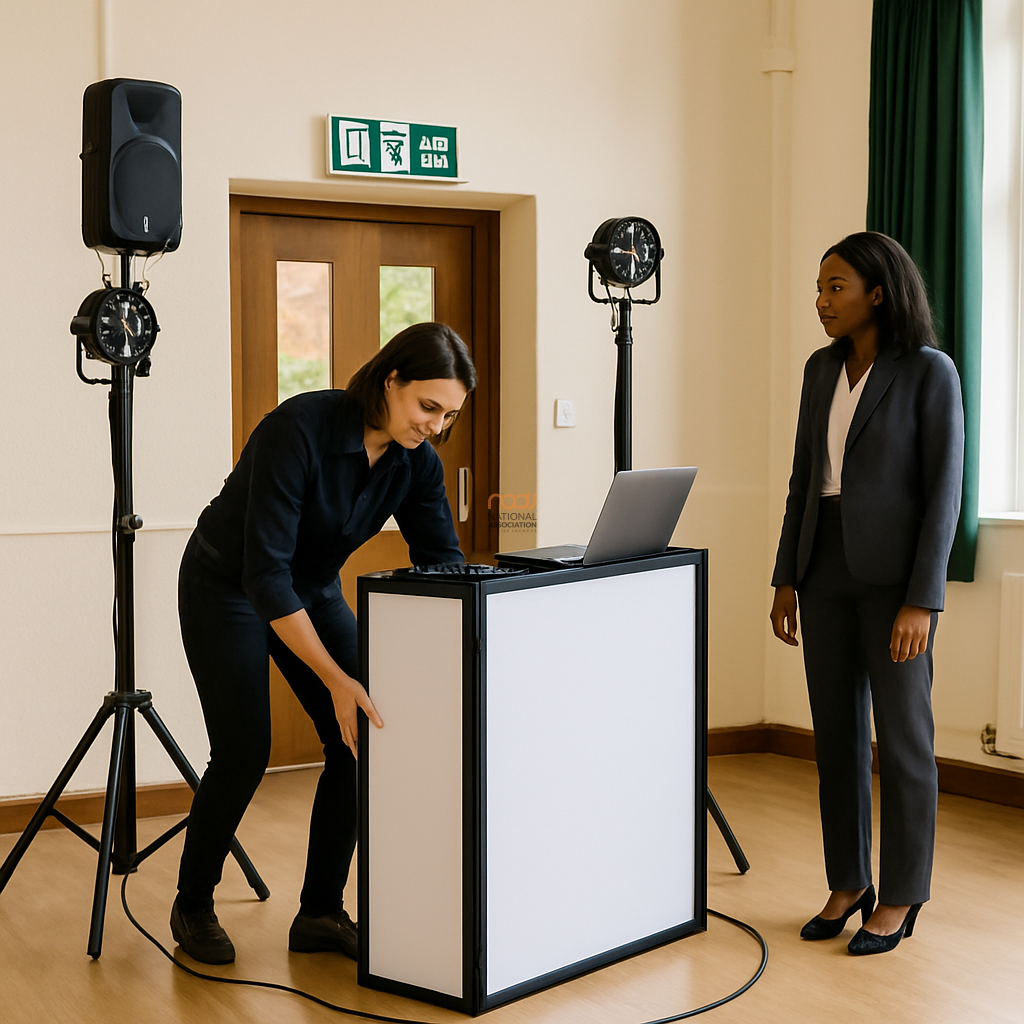
DJ setup areas near fire doors need more thought than many DJs realise. Whether you are working in a village hall, hotel, function suite, nightclub or marquee, the space around a fire door is not just another corner of the room. It is part of the venue’s escape route and must remain usable at all times.
For mobile DJs across the UK, from London and Birmingham to Manchester, Leeds, Bristol, Cardiff, Glasgow, Liverpool, Nottingham, Leicester and Coventry, this is a straightforward but important part of professional setup. The aim is simple: keep people safe, avoid obstructing exits, and reduce the chance of a venue manager having to move your rig at the last minute.
Why fire doors matter in a DJ setup
Fire doors are designed to help people leave a building safely in an emergency. That means the area in front of them, and the route to them, should be kept clear. If your booth, speaker stand, case, lighting tripod or cable run narrows that route, you may be creating a problem even if the door itself is not physically blocked.
In practice, venue staff will usually look for one thing: can the door open fully and can people pass through without delay? If the answer is no, the setup needs changing. This is true in England, Scotland, Wales and Northern Ireland, but venue policies can vary, so always follow the live instructions on site.
What must stay clear
When working close to a fire door, there are several items that should stay out of the area:
- The door swing — nothing should prevent the door from opening fully.
- The immediate doorway space — do not place decks, lighting, speaker bags or flight cases in front of the door.
- Escape routes — keep the path to the door open and easy to follow.
- Cables and adaptors — these should never create a trip hazard across an exit route.
- Speaker stands and lighting stands — these should be positioned well away from any protected route.
- Decorative items or signage — avoid placing banners, uplights or extras where they reduce visibility or access.
A useful rule of thumb is this: if someone had to leave quickly, could they do so without moving your equipment? If not, the setup is too close.
Practical setup choices for mobile DJs
The best approach is to plan your position before unloading. When you arrive at a venue, identify all fire exits, not just the most obvious main door. A function room may have more than one exit, and one of them may be the one closest to your intended setup area.
Where possible, set up on a wall that is well away from exits and out of the line of travel. Leave enough space for guests, staff and emergency access. In venues with tight layouts, such as smaller halls or older buildings, you may need to reduce your footprint, move a speaker, or change the angle of your booth.
It is also good practice to keep your main bag, spare cases and drinks out of the exit zone. Even a “temporary” case left by a fire door can become a serious obstruction when the room fills up. If you use a compact mobile DJ rig, this becomes easier, which is one reason many working DJs pay close attention to the size and weight of their kit. If you are reviewing your headset choice as part of a leaner setup, NADJ’s guide to top DJ headphones for professional mobile DJs in the UK may also be useful when you are thinking about practical kit choices.
What to do if the room layout is difficult
Sometimes the room leaves you with very little choice. If a fire door appears to sit close to the only sensible setup area, speak to the venue contact before you start building. Ask where they want the DJ to position equipment and whether there is a preferred safe zone. This is especially important in busy urban venues, hotels and community spaces where layouts change between events.
If the room cannot accommodate your normal rig without affecting access, it is better to adapt than to force the setup. A smaller frontage, a different speaker position or a revised cable route may solve the issue. If not, raise the problem calmly and professionally with the organiser or venue team.
Do not assume that because another supplier has placed equipment near a door, it is acceptable for you to do the same. Each event is different, and the venue’s current layout, guest numbers and staffing all matter.
Cables, tape and trip hazards
Cables are one of the most common causes of poor practice near exits. A cable that crosses a route to a fire door should be avoided where possible. If a crossing cannot be removed entirely, it should be managed properly, with suitable protection and a route that does not slow people down or create a trip point.
Loose tape ends, tangled extensions and power strips on the floor are all poor choices near an exit. Keep your cabling tidy from the start, and check it again after guests arrive. Rooms often change shape once tables, chairs and people are in place.
Professional standards and venue confidence
Good setup practice is not only about avoiding problems. It also shows venue teams that you understand how their space operates. That can make it easier to work repeat bookings, especially for DJs building a reputation through local venues, directory listings and referrals across the UK.
If you are developing your business, it can help to stay visible in the right places. NADJ members may wish to explore membership tiers explained, the NADJ directory, and gig listings as part of their wider professional presence. You can also find further resources via the NADJ hub and the main site at NADJ.
For DJs who regularly work with public events, public liability cover is often discussed alongside venue safety requirements. NADJ’s page on DJ public liability insurance in the UK may help you understand the subject at a high level, but always check the live wording of any policy and any venue condition before you rely on it.
A simple pre-show checklist
- Identify all fire doors before unloading.
- Keep the door, swing path and escape route clear.
- Place your booth and stands well away from exits.
- Route cables so they do not cross key access points.
- Remove bags, cases and drinkware from doorway areas.
- Re-check the layout after the room fills.
Fire doors are not a minor detail. They are part of the venue’s safety setup, and your DJ area should work with that, not against it. If you plan carefully, keep your kit compact and stay flexible, you can deliver a clean, professional setup without compromising access.
For working DJs across England, Scotland, Wales and Northern Ireland, that is simply part of doing the job properly.
AI transparency note
NADJ uses artificial intelligence as an editorial assistant. Articles produced through this publisher begin with a human-selected idea, source, brief or editorial direction, and AI may be used to research, structure, draft or improve the wording. AI does not set NADJ editorial policy or operate free-range: people acting for NADJ set the instructions and publishing framework, monitor the output and retain editorial responsibility.
Images used by NADJ may include stock photography or AI-generated visuals where appropriate. NADJ is volunteer-led and editorial time is limited; much of our available time is currently absorbed by governance and management, a substantial data audit and membership-system transfer, and planning 12 Tea & Test days across the UK. You can help strengthen member-led content by sending article ideas or completed submissions to hello@nadj.org.uk.









 Avtar Thethy
 Fabio Capozzi
 Alastair Craig
 Dave Mills