
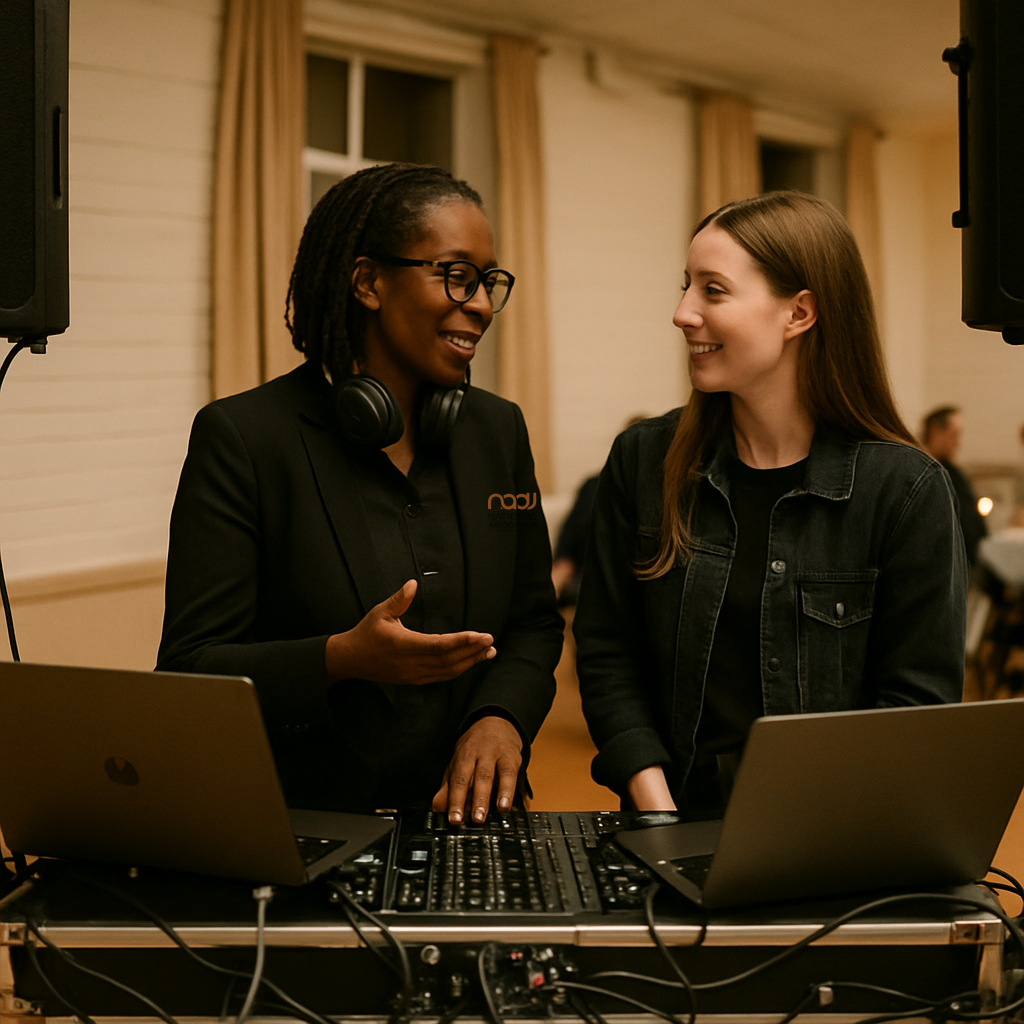
If you want to contribute to NADJ without joining a committee, the good news is that there are many ways to help the association, its members, and the wider UK DJ industry. Not every valuable contribution happens in a formal meeting. In fact, some of the most useful input comes from working DJs who are active on the ground, understand day-to-day realities, and can share practical insight from weddings, clubs, corporate events, private parties, and public functions across England, Scotland, Wales, and Northern Ireland.
NADJ exists to support professional DJs, raise standards, and provide relevant information for the trade. That mission is strengthened when experienced DJs share their knowledge in a way that is useful, accurate, and grounded in real-world practice. If you have been in the industry for years, you may already have something valuable to offer without taking on a committee role.
Share practical experience with newer DJs
One of the most effective ways to contribute is through informal mentoring. Many newer DJs are looking for guidance on setup choices, client communication, music planning, event flow, and how to handle awkward situations professionally. A short conversation can prevent avoidable mistakes and build confidence.
You do not need to run a formal mentoring programme to make a difference. You might help by answering questions in the NADJ Hub, speaking at a local meet-up, or offering honest advice to a younger DJ in your area. Whether you work in Manchester, Birmingham, Leeds, Bristol, Cardiff, Glasgow, Liverpool, Nottingham, Leicester, Coventry, or London, the principle is the same: useful advice is often local, practical, and specific.
Help improve NADJ resources
Experienced DJs are often best placed to spot what is missing from a guide, article, or FAQ. If you read something and think, “This could be clearer,” that feedback matters. NADJ can only improve its resources when members and industry professionals point out gaps, outdated assumptions, or topics that need more detail.
For example, a seasoned mobile DJ may have useful views on equipment selection. If you are looking at performance essentials, you may already know how important reliable monitoring is in a live environment. Our guide to top DJ headphones for professional mobile DJs in the UK is the kind of resource that benefits from ongoing industry insight, because practical gear advice changes as technology and working methods evolve.
Contribute case studies, tips, or article ideas
Not every contribution needs to be a long-form feature. Short case studies, checklists, and “what worked for me” examples can be extremely useful when they are written clearly and kept grounded in professional reality. If you have managed a difficult venue access issue, improved your booking process, or learned a better way to structure a mixed-age playlist, that experience may help other DJs.
Good contributions are usually specific rather than generic. Instead of broad claims, focus on a practical lesson, the context in which it worked, and any caveats. This is especially important where subjects touch on licensing, public safety, contracts, or insurance. In those areas, NADJ should always encourage readers to check the live requirements relevant to their own work and location.
Support local and regional activity
Another valuable way to help is by supporting regional networking. The UK DJ community is not concentrated in one place, and the needs of DJs in the Midlands may differ from those in Scotland, Wales, or Northern Ireland. Local knowledge is useful because event expectations, venue types, travel patterns, and client behaviour can vary significantly.
If you attend events, demonstrations, or meet-ups, your presence helps build momentum. You may also be able to help introduce NADJ to DJs who are not yet members, or encourage peers to engage with the association through the NADJ directory. That directory is a straightforward way for DJs to increase visibility and for the industry to find professional services in one place.
Use your expertise to test ideas
Experienced DJs are well placed to test new ideas before they are rolled out more widely. This might include reviewing website copy, trialling a format for a local event, or giving feedback on how a new member resource reads in practice. Industry-facing materials are only helpful if they are usable for busy working DJs.
This also applies to member journeys and service pathways. For example, if you are exploring the different ways NADJ supports professionals, it can be useful to compare offers and entry points in the membership tiers explained page. Clear, direct feedback from established DJs helps ensure that future messaging remains relevant and easy to understand.
Refer others to useful services and listings
Experienced DJs often become informal signposts for others in the trade. That can be a real asset. If you know a colleague looking for work, regional exposure, or a way to connect with the profession, you can point them towards the gig listings section, where relevant opportunities may be available.
Similarly, if a fellow DJ needs support with their professional setup or wants to benchmark what the market is doing, it helps to direct them towards trusted industry resources rather than speculation. NADJ’s role is to help working DJs make informed decisions, not to add noise.
Help strengthen the professional standard
Above all, experienced DJs can contribute by modelling good practice. That includes accurate representation of services, respectful communication with clients and venues, appropriate preparation, and a willingness to keep learning. It also includes being honest about where specialist advice is needed.
For example, questions about public liability insurance should always be handled carefully. NADJ provides guidance on DJ public liability insurance in the UK, but readers should still check live policy terms, venue requirements, and current conditions before making decisions. The same applies to any legal or regulatory topic.
Small contributions add up
You do not have to join a committee to be useful. In fact, a short review, a practical answer, a regional introduction, or a well-timed suggestion can often have more immediate impact than you might think. NADJ benefits when experienced DJs stay involved in a way that suits their working lives.
If you are active in the UK DJ industry and want to support the association, start with the contribution that feels most natural. Share one useful tip. Offer one piece of feedback. Recommend one resource. Over time, those small actions help NADJ stay relevant, practical, and genuinely useful for DJs across the UK.
And if you are also exploring what NADJ offers more broadly, take a look at NADJ Media Ltd for wider services and support that sit alongside the association’s work.
AI transparency note
NADJ uses artificial intelligence as an editorial assistant. Articles produced through this publisher begin with a human-selected idea, source, brief or editorial direction, and AI may be used to research, structure, draft or improve the wording. AI does not set NADJ editorial policy or operate free-range: people acting for NADJ set the instructions and publishing framework, monitor the output and retain editorial responsibility.
Images used by NADJ may include stock photography or AI-generated visuals where appropriate. NADJ is volunteer-led and editorial time is limited; much of our available time is currently absorbed by governance and management, a substantial data audit and membership-system transfer, and planning 12 Tea & Test days across the UK. You can help strengthen member-led content by sending article ideas or completed submissions to hello@nadj.org.uk.









 Avtar Thethy
 Fabio Capozzi
 Alastair Craig
 Dave Mills