
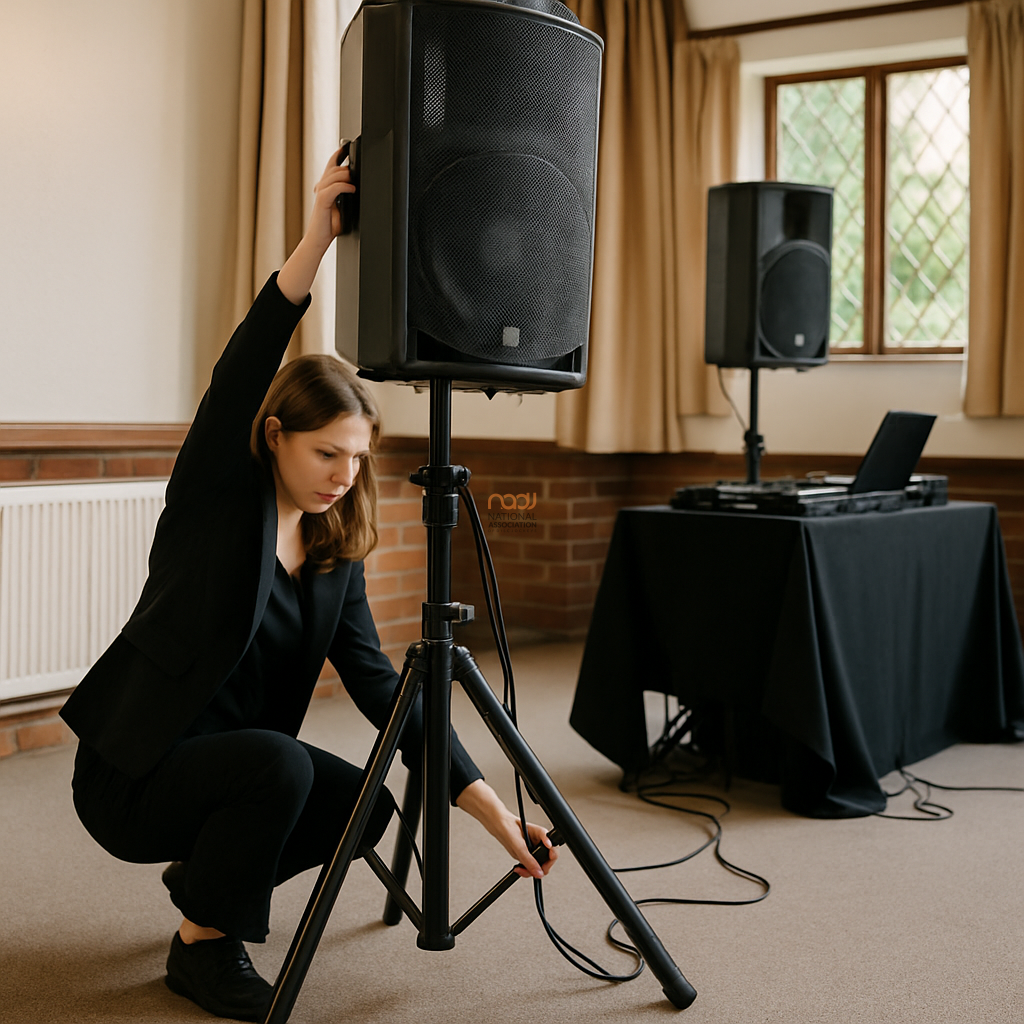
For mobile DJs, preventing speaker tripod collapse on uneven floors is not a niche concern; it is part of everyday setup discipline. From wedding venues in London and Manchester to community halls in Scotland, Wales and Northern Ireland, many performance spaces have sloping timber floors, patched carpet, raised edges or slightly irregular surfaces. That does not mean you cannot use tripod stands safely, but it does mean you need to check, plan and set up carefully every time.
At NADJ, we regularly remind working DJs that good presentation and good safety go hand in hand. A stable rig looks more professional, protects your kit and helps you work with confidence. More importantly, it reduces the likelihood of avoidable accidents around guests, staff and performers.
Why uneven floors create a real risk
Speaker tripods depend on a balanced footprint. When one leg is shorter than the others, or one foot sits on a soft patch of carpet, the stand can lean. That lean may not look dramatic at first, but a small shift in weight, a cable tug or a guest brushing past can move the centre of gravity enough to destabilise the stand.
This matters in a wide range of UK venues: church halls in Leeds, hotel function rooms in Birmingham, sports and social clubs in Liverpool, civic venues in Cardiff and Glasgow, and temporary event spaces in Nottingham, Leicester, Coventry and Bristol. The venue may be suitable for entertainment, but the floor may not be perfectly level.
Start with a proper floor check
Before you lift a speaker onto a tripod, take a minute to inspect the ground. Look for:
- visible slopes or dips
- uneven carpet joins or loose mats
- raised thresholds or cable ramps
- soft or compressed floor areas
- wet patches or slipping hazards
Where possible, place the stand on a firmer, more even section of floor. If the room has obvious variation, do not assume both sides of the stage or dance floor are equally stable. A quick visual check is rarely enough; test the footing with your hand or foot before loading any weight.
Choose the right location, not just the nearest one
It is tempting to place speakers where the layout looks best for the audience. However, the safest position is the one that gives the stand the most stable base. If that means moving slightly left, right or forward, do it. In many cases, a speaker can still cover the room effectively from a safer position.
Also consider the flow of people. Avoid setting tripods where guests, staff or children are likely to pass closely. The risk is not just collapse; it is also impact, bumping and accidental contact with legs or poles. For venues with tight dance floors or narrow performance areas, think carefully about whether a tripod is the best support option at all.
Adjust the stand correctly before loading the speaker
Many incidents happen because the stand is adjusted after the speaker is already on top. Instead, set the tripod on the floor, extend the legs fully and make sure the locking points are engaged before lifting any equipment.
If the floor is uneven, adjust the stand so the load is centred as much as possible. Keep the column vertical. If one leg sits on a noticeably lower section, reposition the stand rather than trying to compensate with the height tube alone. A tripod is designed to stand square; forcing it to correct a slope through the mast can increase instability.
Practical stability checks
- Gently press down on the top collar before mounting the speaker.
- Check that each leg is locked and fully extended.
- Make sure feet are sitting flat, not half on a ridge or cable.
- After mounting, give the stand a careful side-to-side test with one hand.
- Re-check after any change in layout, floor covering or nearby traffic.
Use sensible load and height choices
The heavier and higher the speaker, the more important the base setup becomes. Where your speaker and stand combination allows it, keep the height to the minimum needed for clear sound coverage. A lower centre of gravity is generally more forgiving on uneven floors.
Do not exceed the manufacturer’s stated load limit. That advice sounds obvious, but it is worth repeating because stands are often used with a variety of cabinets, lighting accessories or add-ons. Check the current documentation for the exact model you use. If in doubt, choose a more robust support solution.
Think beyond the stand itself
Tripod stability is affected by the wider setup. Clean cable runs help prevent snags, while tidy positioning reduces the chance of guests catching a lead and putting sideways force on the stand. Use proper cable management and keep power and audio cabling away from the legs where possible.
It is also sensible to avoid overloading the same area with flight cases, bags or other equipment. In cramped setups, the space around the stand can become cluttered quickly, especially during corporate events, school functions and busy weddings. A clear working area is a safer working area.
When to consider an alternative support method
If the floor is significantly sloped, badly worn or too soft for a tripod to sit securely, consider another approach. Depending on the venue and your system, that may mean using a speaker pole on a stable base, a properly weighted stand, a podium, or a ground-stack arrangement. The best choice depends on the room, the kit and the event requirements.
There is no single answer for every job. The key is to avoid forcing a tripod solution where the surface condition makes it a poor fit. A safer layout is usually the more professional one.
Build the check into your routine
The most reliable way to reduce risk is to make floor assessment part of every load-in. That habit matters whether you work in England, Scotland, Wales or Northern Ireland, and whether you are a full-time mobile DJ or building your diary through local events and gig listings. Repetition turns good practice into instinct.
If you are refining your wider professional setup, it may also be useful to review the rest of your kit and working habits. NADJ has guidance that supports day-to-day DJ work, including resources on DJ headphones, public liability insurance considerations, and membership tiers. You can also explore the NADJ directory, the NADJ Hub and the main NADJ site at nadj.co.uk.
Final thought
Preventing speaker tripod collapse on uneven floors comes down to observation, correct setup and a willingness to change plans when the surface demands it. Most jobs will not present major issues, but the occasional awkward floor is common enough that every DJ should know how to handle it. A few extra minutes at setup can make a significant difference to safety, reliability and peace of mind.
Caveat: venue conditions, equipment specifications and safe working methods vary. Always follow the manufacturer’s instructions for your own stands and speakers, and if a setup feels unstable, do not use it until you have found a safer solution.
AI transparency note
NADJ uses artificial intelligence as an editorial assistant. Articles produced through this publisher begin with a human-selected idea, source, brief or editorial direction, and AI may be used to research, structure, draft or improve the wording. AI does not set NADJ editorial policy or operate free-range: people acting for NADJ set the instructions and publishing framework, monitor the output and retain editorial responsibility.
Images used by NADJ may include stock photography or AI-generated visuals where appropriate. NADJ is volunteer-led and editorial time is limited; much of our available time is currently absorbed by governance and management, a substantial data audit and membership-system transfer, and planning 12 Tea & Test days across the UK. You can help strengthen member-led content by sending article ideas or completed submissions to hello@nadj.org.uk.









 Avtar Thethy
 Fabio Capozzi
 Alastair Craig
 Dave Mills