
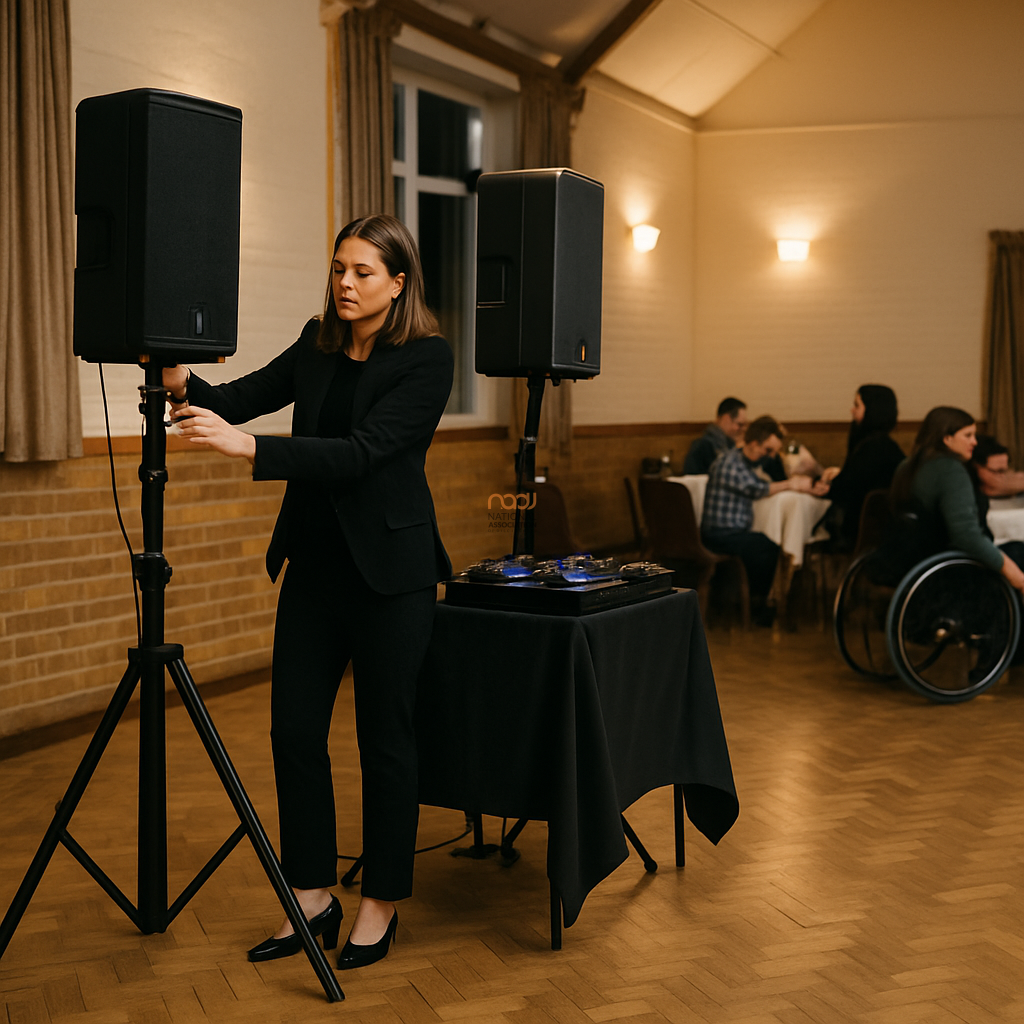
Safe speaker placement is one of the simplest ways mobile DJs can reduce avoidable risk on a job. Whether you are working a wedding in Bristol, a birthday party in Leeds, a school disco in Glasgow or a corporate night in London, your speaker positions affect more than sound coverage. They also affect access, sightlines and the safety of guests, staff and yourself.
At NADJ, we encourage members to think about safety as part of professional presentation. Good rig layout is not about overcomplicating the setup. It is about making sensible choices that help prevent trips, bumps and blocked routes, particularly when children are present, when wheelchair users need clear access, and when people naturally drift through busy walkways.
Why speaker placement matters
Speakers are heavy, tall and often cabling-dependent. They can topple if poorly mounted, create blind corners in crowded rooms, and become obstacles when guests move quickly or unpredictably. Children may run, lean or hide behind equipment. Wheelchair users may need a wider turning circle than you first expect. In busy venues, staff may also need direct access for service or emergency movement.
The aim is not to eliminate every possible hazard. Rather, it is to place your equipment in a way that reduces foreseeable risks and supports the venue layout you have been given. That means planning before unloading, then adjusting once you see the room in person.
Start with the room, not the rig
Before you lift a speaker, walk the space. Identify entrances, exits, fire routes, serving areas, dance floor boundaries, toilets and any ramps or steps. Look for bottlenecks where guests will naturally queue or cross. If the event is in a hotel, village hall, school, leisure centre or community venue, the main walkway may not be obvious until you are standing in the room.
Ask yourself three practical questions:
- Where do guests move most often?
- Where might a child run without warning?
- Where does a wheelchair user need the clearest route?
If the answer to any of these points is “near my speaker stand”, change the layout.
Keep speakers out of main walkways
The most important rule is straightforward: do not place speakers where people are expected to walk. Avoid the middle of a room, pinch points by doors, and the edges of dance floors if they are also transit routes. If you must work close to a thoroughfare, use barriers, a defined floor plan, or venue furniture to discourage people from cutting through your setup.
In practical terms, that often means pushing speakers back slightly and angling them to cover the room properly, rather than placing them where they are easiest for you to reach. Better to spend an extra minute adjusting coverage than spend the evening worrying about a collision.
Think carefully about children
Children are curious and quick. They may touch stands, tug at fabric, or move behind equipment because it looks interesting. If there are young children in the room, keep speakers and stands out of their immediate reach where possible. Avoid low-level placements that invite climbing or leaning.
Where appropriate, position equipment behind the DJ booth, within your working area, or in a zone that is clearly understood to be off-limits. If the venue allows, a modest barrier or controlled setup area can make a real difference. Never rely on “common sense” alone; children do not always see hazards the same way adults do.
Give wheelchair users proper space
Wheelchair access is not only about entrances. It also affects how people move within the room, approach tables, watch the dance floor and leave in an emergency. Leave enough clear width for a wheelchair user to pass comfortably, and do not let speaker stands, subwoofers or trailing cables narrow a route.
If a speaker is on a stand near an access route, check that it does not create an obstruction at head height or force users to take a wider, awkward path. In many cases, the simplest solution is to relocate the speaker and keep the route fully open. If you are unsure about the right clearance for a particular venue, ask the organiser or venue manager and follow the site-specific plan.
Use stable mounting and sensible height
Speaker stands should be fully opened, level and locked before a cabinet goes on them. Use the correct stand for the speaker weight and size. Do not improvise with unsuitable fittings. If you are flying or stacking speakers, only do so if the equipment, venue and your own competence make it appropriate.
Height matters too. A speaker placed too low is easier to reach, strike or trip over. A speaker placed too high can create stability issues if it is not correctly supported. Follow manufacturer guidance and use a layout that is suited to the room, not merely the quickest option.
Control the cables as carefully as the cabinets
Many “speaker placement” problems are actually cable problems. A well-positioned speaker with a loose lead across a walkway is still unsafe. Route cables around the room edges where possible, keep them tidy, and use suitable covers or tape where a crossing is unavoidable. Check that nobody can snag a cable when pulling out a chair, moving a buggy or turning a wheelchair.
Also remember that cable runs can shift during the night. A setup that looked neat before guests arrived may become cluttered once the room fills. Re-check after load-in, before opening, and again if the layout changes.
Build a quick pre-event habit
Use a simple routine before the first track starts:
- Check walkways, exits and access routes.
- Confirm speakers are stable and out of the flow of guests.
- Look at the room from a child’s eye level and from wheelchair height where practical.
- Remove cable slack and tidy any crossings.
- Ask the organiser to flag any expected movement, such as cake service, speeches or a conga line.
This habit takes minutes, but it can prevent avoidable incidents and support a professional standard of working.
Match safety with your wider DJ responsibilities
Safe speaker placement is only one part of overall event management. It sits alongside suitable equipment choice, sensible load-in practice and appropriate cover for the work you do. If you are reviewing your wider setup, our guide to the best PA speakers for mobile DJs in the UK may help you think about portability, size and practical use in real venues.
It is also worth understanding how your public liability insurance relates to your work. Our article on DJ public liability insurance in the UK explains the basics, but you should always check the live wording of any policy and any venue requirements before an event. Coverage can vary, and nothing in this post should be treated as legal or insurance advice.
If you are building your professional profile or looking to connect with other working DJs across England, Scotland, Wales and Northern Ireland, explore the NADJ directory, review membership tiers, or keep up with sector updates via the NADJ Hub. You can also find opportunities through gig listings and learn more about our wider services at NADJ Media Ltd.
Final thought
Good DJs do not just make a room sound right; they help it function safely. In venues across the Midlands, Manchester, Birmingham, Liverpool, Nottingham, Leicester, Coventry, Cardiff and beyond, the safest speaker position is usually the one that protects movement, respects access and keeps children, wheelchair users and staff out of harm’s way. Plan the room carefully, adapt when needed, and make safety part of your standard setup every time.
AI transparency note
NADJ uses artificial intelligence as an editorial assistant. Articles produced through this publisher begin with a human-selected idea, source, brief or editorial direction, and AI may be used to research, structure, draft or improve the wording. AI does not set NADJ editorial policy or operate free-range: people acting for NADJ set the instructions and publishing framework, monitor the output and retain editorial responsibility.
Images used by NADJ may include stock photography or AI-generated visuals where appropriate. NADJ is volunteer-led and editorial time is limited; much of our available time is currently absorbed by governance and management, a substantial data audit and membership-system transfer, and planning 12 Tea & Test days across the UK. You can help strengthen member-led content by sending article ideas or completed submissions to hello@nadj.org.uk.









 Avtar Thethy
 Fabio Capozzi
 Alastair Craig
 Dave Mills