

That does not mean a professional DJ should rush blindly. It means building a system. The more you can prebuild, prewire and preconfigure before you arrive, the smoother your setup will be when access is late and the clock is against you.
Why late access is so common at weddings
Wedding venues work to strict schedules. In England, Scotland, Wales and Northern Ireland, the same room may host the ceremony, drinks reception, wedding breakfast and evening party. That creates pressure on turnaround time, especially at hotels, country houses and city-centre venues in places such as Manchester, Leeds, Bristol, Cardiff, Glasgow, Liverpool, Nottingham, Leicester and Coventry.
From a DJ’s point of view, late access usually means one or more of the following:
- The function room is still occupied when you arrive.
- Load-in routes are narrow, shared or indirect.
- There is limited time to test sound, lighting and announcements.
- The couple want the room transformed quickly once guests leave.
The answer is not to add more kit. It is to reduce assembly time and the number of decisions you need to make on site.
What can be prebuilt before you leave home
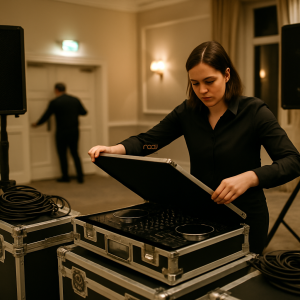
Anything that saves you from opening boxes and building from scratch after arrival is worth serious consideration. The aim is to arrive with self-contained sections that simply need positioning and connection.
1. Lighting bars and truss sections
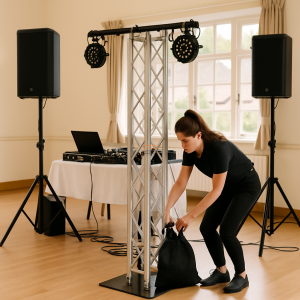
If your rig uses a podium, goalpost or upright stand system, consider prebuilding the top section in your prep space. Many DJs keep lighting fixtures mounted on a bar permanently, with clamps, safeties and power/data routing already in place. That can cut setup time significantly.
Be realistic, though. A prebuilt lighting section must still be safe to transport and suitable for the vehicle you use. Heavy or awkward loads can create handling risks, so do not build in a way that makes lifting unsafe.
2. Speaker stands and brackets
Speaker stands can often be prepped with bags, cable ties, or fitted sleeves so the final job is simply to raise them and secure the speakers. If you use bracket-mounted tops or compact active speakers, some DJs keep their mounting hardware assembled between jobs. That can help when access is tight, provided the equipment remains in good condition and is checked regularly.
3. Backdrops and branding frames
Pipe-and-drape, starcloths and compact DJ booths can be prebuilt as far as practical. Even a partially assembled front panel or frame can save valuable minutes, particularly if the venue offers only a small late-access window.
For wedding work, neat presentation matters. A clean prebuilt system often looks better than a rushed build under pressure.
What can be prewired for a faster load-in
Prewiring is where many DJs gain the biggest advantage. It reduces fault-finding on site and makes your rig easier to understand under pressure.
1. Power distribution
Where appropriate, prewire your power runs so that one or two mains leads feed clearly defined sections of the rig. Label everything. Keep your extension leads grouped by use, not dumped into one bag. That way, when you arrive at a venue in the Midlands or anywhere else in the UK, you are not trying to remember which cable powers which part of the system.
2. Audio signal paths
Where practical, leave your mixer, controllers, processors and wireless receivers connected in a way that reflects how you work. A tidy, semi-permanent signal layout can mean fewer mistakes and faster line checks. Just make sure the arrangement is robust enough for transport and that connectors are not being stressed.
3. Lighting data and linking
If you rely on DMX, consider how much of the data chain can remain assembled. Short prewired links between fixtures on the same bar or stand can save time, provided the cabling is secure and protected from strain. The same applies to any wireless control receivers: position and label them in a consistent way so they are easy to power and test quickly.
What should usually stay flexible
Prebuilding is useful, but not everything should be fixed in advance. Some parts of your setup need to stay adaptable because every venue is different.
- Cable lengths: Keep enough flexibility to cope with unusual power positions.
- Speaker placement: Rooms vary in shape, acoustics and guest layout.
- Lighting angles: Low ceilings, beams and uplighting positions can change from venue to venue.
- Announcements and microphone choice: Keep spare options ready in case of venue interference or interference from other RF users.
The best rig is not the most rigid one. It is the one that can be adapted quickly without becoming messy.
Practical steps for late-access weddings
Good planning starts before the event date. Confirm access times early and ask the venue what the actual load-in route looks like. If possible, request a photo of the room in its blank state. That can help you decide whether a smaller, prebuilt system will be better than a larger modular one.
Also, build in contingency. If your first setup plan assumes the room will be empty at 4.30pm, what happens if you only get in at 5.10pm? Having a pared-down “fast rig” for tight turnarounds can protect both your reputation and your stress levels.
On the day, work methodically:
- Unload only what you need first.
- Place core equipment before decorating the space.
- Test power and audio early.
- Keep your case layout consistent so you can find spares quickly.
- Leave enough time for a final visual check.
Protecting professionalism under pressure
Late access is not an excuse for a compromise in standards. It is a prompt to improve process. Professional DJs in the UK are expected to arrive prepared, communicate clearly with venue staff and deliver a safe, tidy setup. Depending on the venue and event, you may also need to consider current venue policies, electrical requirements and any relevant licensing or insurance expectations. These can vary, so always check live details rather than relying on assumptions.
If you are reviewing your wider business setup, NADJ members may also find value in resources around membership tiers, industry support and the wider community at NADJ Hub. For professional presentation, the NADJ directory can also help couples and venues find reputable DJs. If you are looking for more work, the gig listings area is worth checking regularly.
Final thoughts
When wedding DJs face late venue access, success comes from preparation, not speed alone. Prebuild what makes sense. Prewire wherever it improves reliability. Keep your system modular enough to adapt. Most importantly, design your workflow so that a delayed load-in does not force a rushed, unprofessional finish.
That is the real value of experience: not simply carrying more equipment, but knowing exactly what can be ready before you ever reach the venue door.
For working DJs who want to keep improving their kit choices and professional standards, NADJ also publishes practical buying and industry guidance, such as our article on top DJ headphones for professional mobile DJs and information on DJ public liability insurance. NADJ and NADJ Media Ltd exist to support the trade with useful, practical resources that help DJs work better across the UK.
AI transparency note
NADJ uses artificial intelligence as an editorial assistant. Articles produced through this publisher begin with a human-selected idea, source, brief or editorial direction, and AI may be used to research, structure, draft or improve the wording. AI does not set NADJ editorial policy or operate free-range: people acting for NADJ set the instructions and publishing framework, monitor the output and retain editorial responsibility.
Images used by NADJ may include stock photography or AI-generated visuals where appropriate. NADJ is volunteer-led and editorial time is limited; much of our available time is currently absorbed by governance and management, a substantial data audit and membership-system transfer, and planning 12 Tea & Test days across the UK. You can help strengthen member-led content by sending article ideas or completed submissions to hello@nadj.org.uk.







 Avtar Thethy
 Fabio Capozzi
 Alastair Craig
 Dave Mills