
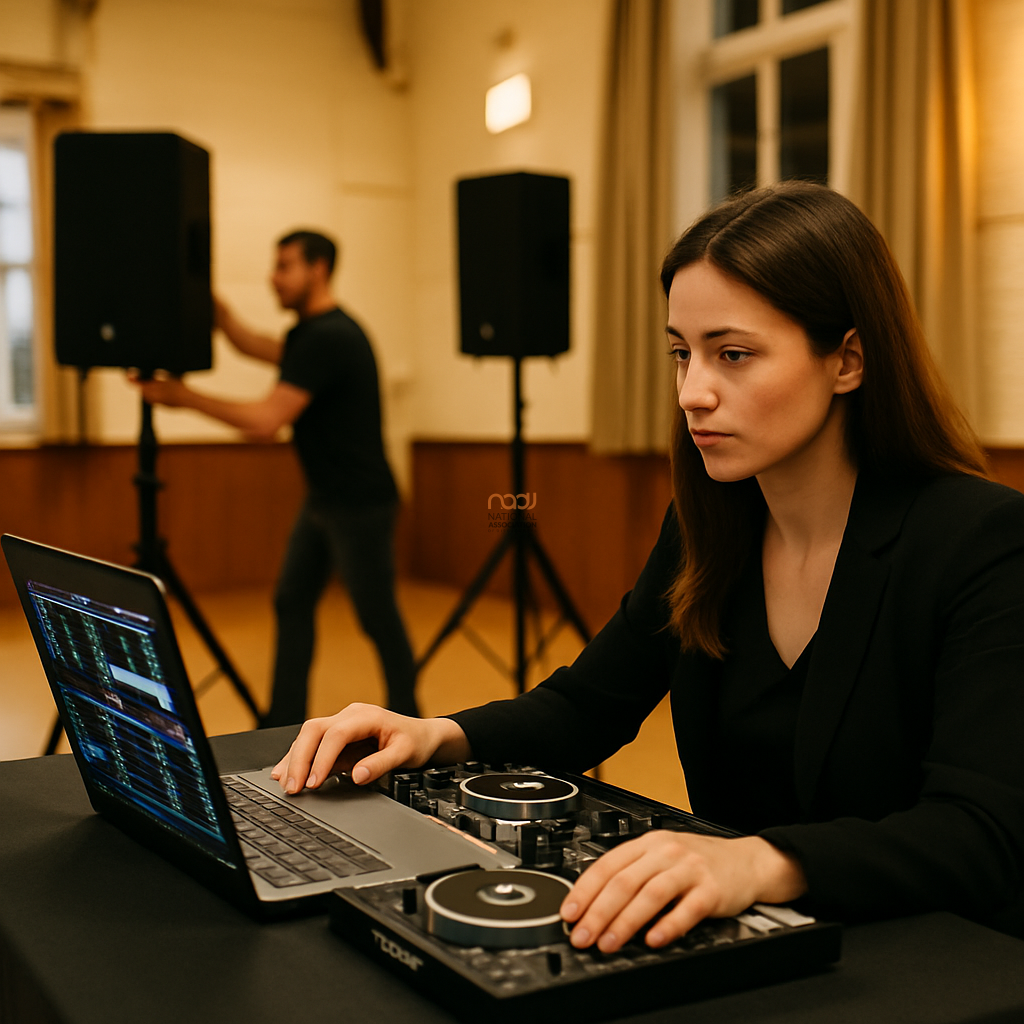
For many DJs, DJUCED beyond the beginner stage is a genuine question, not just a software comparison. Hercules’ DJ software is often associated with first steps, controller bundles and bedroom practice. But once you start taking paid work in the UK, mixing more complex requests, or preparing for larger rooms, the question changes: is DJUCED still enough?
The short answer is that it can be, for some DJs. However, it depends on how you work, what hardware you use, and how much flexibility you need. If you are still weighing up your options more broadly, you may want to start with The Ultimate Guide to DJ Software for UK DJs, which compares the main software routes available to working DJs.
What DJUCED does well
DJUCED’s biggest strength is that it gives newer DJs a manageable path into mixing. The layout is straightforward, the learning curve is relatively gentle, and it suits anyone who wants to build confidence without facing an overcrowded interface. For many DJs in places like Nottingham, Cardiff or Leeds, that simplicity matters when you are trying to learn quickly between gigs, college, work and family commitments.
It is also tightly integrated with Hercules controllers, which can make the setup process easier than wrestling with a more complex platform. For practice, this can be a real advantage. You spend less time configuring software and more time working on beatmatching, phrasing, cue placement and basic library management.
Another plus is that DJUCED can support useful core functions for mobile DJs and hobbyists: waveforms, hot cues, loops, sample playback, and a familiar two-deck workflow. If your sets are mostly bar work, private parties, local community events or small weddings, that feature set may cover what you need.
Where DJs start to feel the limits
The point where DJUCED becomes questionable is usually not about whether it can mix music. It is about workflow, library management and long-term confidence. Once you are playing more frequently, you may want faster access to advanced preparation tools, deeper performance features, and a more widely used platform that other DJs, depots and colleagues understand immediately.
In practical terms, a DJ in Birmingham or Manchester may notice that their needs grow around the same time their gig profile grows. You may be asked for more detailed pre-planning, tighter cue organisation, or easier switching between home practice and live performance. At that point, a software package that felt ideal at first can begin to feel restrictive.
Compatibility and ecosystem are also worth considering. If you borrow club-standard gear, play on different rigs across the Midlands, or want to move between platforms without friction, software choice matters. A beginner-friendly environment is helpful, but professional usefulness is usually measured by how easily the software fits into varied real-world situations.
Who DJUCED still suits beyond the beginner stage?
1. The part-time mobile DJ
If you are doing occasional weddings, birthday parties, school functions or community events, and you already know how to prepare clean playlists, DJUCED may still be enough. That is especially true if your work is fairly predictable and you are using compatible Hercules hardware.
2. The learning-focused DJ
Some DJs are not trying to become festival performers or club regulars. They want a reliable practice environment, perhaps to sharpen technique before taking occasional paid bookings. In that case, staying with DJUCED can make sense while you build confidence.
3. The budget-conscious operator
Many UK DJs are balancing equipment, travel, music purchases, advertising and administration. If you are running a lean setup and DJUCED already meets your needs, there may be no urgent reason to switch. That said, budget decisions should be based on workflow value, not just upfront cost.
When upgrading software is the better move
You should start reviewing alternatives if any of the following apply:
- you are regularly playing new venues and need greater flexibility;
- your library has become large and harder to organise;
- you want to work more like a professional mobile or club DJ;
- you are planning to share files or workflows with other DJs;
- you want software that is more widely recognised across the UK industry.
That does not mean DJUCED is poor software. It means your tools should match the level you are working at. A DJ in Glasgow handling a handful of dates a month will have different needs from a DJ in London, Liverpool or Bristol playing most weekends and preparing for changing client requests.
Practical questions to ask before staying with DJUCED
Before you commit to staying put, ask yourself three simple questions:
Can I prepare a full gig from start to finish without workaround behaviour?
If the answer is yes, DJUCED may still be viable.
Do I feel limited when a booking becomes more demanding?
If you often need to improvise around the software rather than with it, that is a warning sign.
Am I choosing this because it works, or because I have not yet looked at alternatives?
That distinction matters. Many DJs delay upgrading simply because change feels inconvenient.
How NADJ members can approach the decision
The best software choice is rarely the most expensive or the most heavily marketed. It is the one that supports your actual work pattern. If you are moving towards more professional bookings, it may be sensible to compare DJUCED against other packages in the context of your hardware, your venue types and your music library.
Membership can also help DJs make more informed decisions. See Membership Tiers Explained for a quick overview of what NADJ membership levels offer. If you are building your business, you may also find value in the broader resources available via NADJ Hub, while the NADJ Directory is useful for visibility and networking. For gig opportunities, keep an eye on gig listings.
And if you are taking paid work, do not overlook protection and professionalism. For general guidance on cover considerations, read DJ Public Liability Insurance UK and always check the latest terms and suitability for your own circumstances.
The NADJ view: useful, but not always future-proof
DJUCED is not just a toy for first-time users. For the right DJ, it remains a sensible, low-friction tool beyond the beginner stage. However, as your bookings grow across England, Scotland, Wales and Northern Ireland, your software needs usually become more demanding. At that point, the right question is not whether DJUCED is good enough in general, but whether it is still good enough for your work.
If it still supports your prep, performance and confidence, there is no shame in staying with it. If it starts slowing you down, it may be time to move to a platform that better matches your next stage as a DJ.
Further reading: start with The Ultimate Guide to DJ Software for UK DJs for the wider picture.
AI transparency note
NADJ uses artificial intelligence as an editorial assistant. Articles produced through this publisher begin with a human-selected idea, source, brief or editorial direction, and AI may be used to research, structure, draft or improve the wording. AI does not set NADJ editorial policy or operate free-range: people acting for NADJ set the instructions and publishing framework, monitor the output and retain editorial responsibility.
Images used by NADJ may include stock photography or AI-generated visuals where appropriate. NADJ is volunteer-led and editorial time is limited; much of our available time is currently absorbed by governance and management, a substantial data audit and membership-system transfer, and planning 12 Tea & Test days across the UK. You can help strengthen member-led content by sending article ideas or completed submissions to hello@nadj.org.uk.









 Avtar Thethy
 Fabio Capozzi
 Alastair Craig
 Dave Mills