
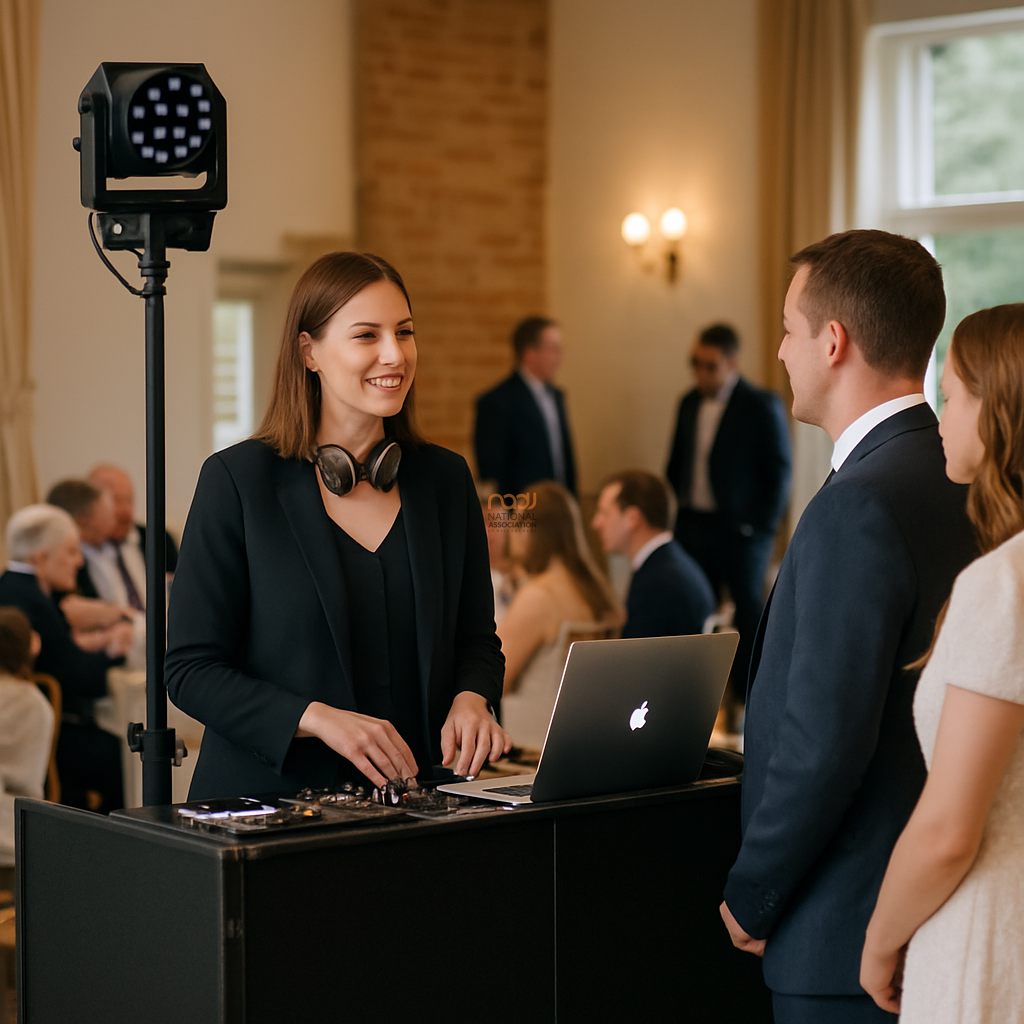
DJing weddings with separate day and evening guest lists is now a familiar job for many mobile DJs across the UK. It is common in England, Scotland, Wales and Northern Ireland, whether the booking is in a London hotel, a Birmingham function room, a Leeds marquee, or a village venue in Cardiff, Glasgow or Liverpool. The challenge is straightforward: you may be entertaining one group for the meal and speeches, then a different and sometimes much larger audience for the evening party.
For working DJs, the key is not to treat this as two unrelated events. Instead, it is one wedding flow with two audience profiles. If you plan it properly, you can protect the atmosphere, avoid repetition, and help the couple feel that both sets of guests have been considered.
Start by understanding who is actually staying
The first step is to get clarity from the couple or planner. Do not assume that the evening crowd will be mostly the same people who attended the day. Ask for a rough split:
- How many guests are expected for the ceremony, meal and speeches?
- How many are likely to remain for the evening reception?
- Are there any key people only coming later, such as friends, colleagues, or younger guests?
- Will there be a significant change in age range, music taste, or dance-floor behaviour?
This matters because a room of 80 seated day guests and a room of 180 evening guests will behave very differently. The couple may have planned a warm, formal daytime celebration with an energetic night party. Your job is to bridge those two moods smoothly.
Build a music plan for two audiences
With separate guest lists, the biggest risk is relying on the wrong music too early. A song that works brilliantly for the day crowd may empty the floor when the evening guests arrive. Likewise, a late-night set designed for younger dancers may alienate older guests who are staying on.
A better approach is to map the evening in stages. Think about the first 30 minutes after your start time, the main party window, and the late-night phase. If the couple has shared music requests, use them to identify the common ground between the two guest lists. You are usually looking for familiar tracks with broad appeal at the beginning, then more targeted choices as the floor fills and the main crowd settles in.
It is also worth checking whether the couple wants a soft reset when the evening guests arrive. Some prefer the DJ to act as a fresh start point, while others want the event to feel continuous. Both can work, but the transition must be intentional.
Use the room plan to your advantage
Separate guest lists often mean a changing room layout. In many venues, daytime tables are cleared, the dance floor is expanded, and the bar area becomes busier once the evening guests arrive. That change can transform the atmosphere.
If you are loading in, ask the venue when the room will be turned around and whether your kit position will remain fixed. A good speaker placement, sensible cabling, and a clear view of the dance floor are especially important if people will be entering mid-party. If you are reviewing your sound setup for different room sizes, NADJ’s guide to best PA speakers for mobile DJs in the UK is a useful place to start.
In larger cities such as Manchester, Bristol, Nottingham, Leicester and Coventry, hotel ballrooms and multi-room venues can create awkward transitions between daytime and evening numbers. In more compact spaces, such as smaller venues in the Midlands or a clubhouse in Scotland, the incoming evening guests can quickly change the energy. Plan for both.
Handle introductions and announcements carefully
When there are different guest lists, your microphone work becomes more important. You may need to welcome people who were not present earlier, explain a first dance that already happened during the meal, or gently guide the crowd through cake cutting, bouquet tosses or late speeches.
Keep announcements clear and concise. Avoid over-explaining the schedule unless it is necessary. Many guests only want to know what is happening now, what is coming next, and where they should be. If the couple has planned a private moment for the day guests, respect that and do not assume the evening crowd needs the full backstory.
Read the evening guests as a new crowd
One of the most important habits for any wedding DJ is to treat the evening arrival as a new crowd test. The day guests may have been polite, seated and family-focused. The evening guests might be more social, more alcohol-fuelled, or simply ready to dance from the first track.
Start by observing who heads to the floor first. Are they younger relatives, school friends, or the wedding party? What age group is hanging at the bar? How quickly are requests coming in? These details tell you whether the room wants singalong classics, current commercial hits, indie favourites, or something more specialist.
Do not be afraid to adjust quickly. A strong DJ set is responsive, not rigid. If the incoming crowd is not reacting, move on. If they are reacting strongly, stay with that lane and build momentum.
Agree the transitions with the couple in advance
Clients often appreciate it when the DJ helps them think through the switch from day to evening. Ask whether they want:
- A clean handover after the meal
- A short background music period before dancing starts
- An immediate party opener when evening guests arrive
- Special recognition for guests who have stayed all day
This conversation helps manage expectations and reduces last-minute surprises. It also gives you a better chance of delivering the mood the couple actually wants, rather than one based on guesswork.
Keep professionalism high throughout the day
Separate guest lists can create long gaps between your first arrival and the main party. That means your setup, presentation and communication need to stay consistent all day. Be on time, stay visible, and keep your equipment tidy. In a wedding environment, details matter.
If you are a NADJ member, this is also a good moment to remind yourself of the wider support available through the association. Membership and sector information can be found via membership tiers explained, while DJs looking for opportunities can also check the gig listings area and the main directory. For members using the wider business services and resources, NADJ Hub and nadj.co.uk are worth bookmarking.
Remember the basics that still apply
Even with changing guest lists, the fundamentals do not change. You still need suitable equipment, safe cabling, appropriate public liability insurance where required by venue or contract, and a solid understanding of the venue’s rules. For a refresher on insurance considerations, see NADJ’s guide to DJ public liability insurance in the UK. As always, check live policy wording, venue terms and local requirements rather than relying on old assumptions.
Ultimately, DJing weddings with separate day and evening guest lists is about preparation and flexibility. If you understand who is in the room, plan for the transition, and keep reading the crowd, you can make the evening feel seamless rather than split. That is what wedding clients remember: not just the songs you played, but how well you managed the people in front of you.
AI transparency note
NADJ uses artificial intelligence as an editorial assistant. Articles produced through this publisher begin with a human-selected idea, source, brief or editorial direction, and AI may be used to research, structure, draft or improve the wording. AI does not set NADJ editorial policy or operate free-range: people acting for NADJ set the instructions and publishing framework, monitor the output and retain editorial responsibility.
Images used by NADJ may include stock photography or AI-generated visuals where appropriate. NADJ is volunteer-led and editorial time is limited; much of our available time is currently absorbed by governance and management, a substantial data audit and membership-system transfer, and planning 12 Tea & Test days across the UK. You can help strengthen member-led content by sending article ideas or completed submissions to hello@nadj.org.uk.









 Avtar Thethy
 Fabio Capozzi
 Alastair Craig
 Dave Mills